In a feeble attempt to combat my constant homesickness, I compile tales of New York City rock & roll landmarks, most of 'em long gone. Moronic musings on various other enthusiasms are also thrown in for good measure.
Selected Voice ads for Steve Paul's the Scene, January through June, 1967. Issue dates and other pertinent info (when hard to read in the ads themselves) are in the captions.
1/5 and 1/12/67 issues. Text is much clearer in the poster above, via.
1/19, 1/25, and 2/2/67 issues
The Blues Project (January 21-February 4)
Tim Hardin with an electric group (February 6-March 4)
Also "the incredible Tiny Tim, Skipper's Scary Karate Show, Me, whatever."
2/9 and 2/16/67 issues
Tim Hardin, Jeremy Steig, February 6-March 4.
2/23/67 issue
The Youngbloods and the Free Spirits, "thru March 4."
3/9/67 issue
The Mandala (March 6 through April 7)
The Young Rascals (March 14 I think)
Eric Andersen (March 20-April 1).
3/16/67 issue (also repeated 3/23 and 3/30)
4/20/67 issue
The Siegel-Schwall Blues Band (thru April 22)
The Chambers Brothers (May 5-May 11)
Keith (May 3)
Tommy James & the Shondells (April 23)
The Mandala (April 25-May 4)
Tiny Tim and jam sessions nightly.
4/27/67 issue: The Mandala, the Chambers Brothers, Keith, as above.
5/4/67 issue: The Chambers Brothers (May 5-11)
5/10/67 issue: Diana Brooks & the Soul Searchers and Three's a Crowd, opening May 15.
5/18/67 issue
Dianne Brooks & Eric Mercury & the Soul Searchers, Three's a Crowd (May 17-21)
The Chambers Brothers ("Back by popular demand, good taste and common sense," May 22-June 3)
Tiny Tim (365 nights a year)
The Doors (opening June 12)
"Coming Soon: Scene East in Delmonico Hotel, Park Ave. & 59th Street."
5/25/67 issue, should be pretty readable.
6/8/67 issue
The Jon Lee Group ("Direct from Canada," thru June 11)
The Mandala (June 7)
Laura Nyro (June 7)
Moby Grape (June 8-10)
The Doors (June 12-July 2)
"Now open in Delmonico Hotel, Park Ave & 59th Street, SCENE EAST. Serenity of Park Avenue. Uninhibited dancing to the livest groups. Tiny Tim here, too. Eclectic Ambiance of Rudi Stern & Jackie Cassen. Photographic exhibit of Dylan by Dan Kramer. No Admission, No cover."
6/15/67 issue:
The Doors (thru July 2, except for June 16-18 when they played the Action House).
"Appearing with the Doors nightly for a completely flipped out evening: The Free Spirits and Dianne Brooks/Eric Mercury with the Soul Searchers."
The Seeds, July 3-16, "Direct from L.A., First time in N.Y."
Moby Grape, "returning after the Seeds."
6/22/67 issue. Doors/Free Spirits/Soul Searchers as above
The Seeds (July 3-July 16)
Moby Grape, returning after the Seeds
The Mandala (July 18)
Keith (July 30--he must have not done the May date advertised above, for this is being called his "N.Y. debut.")
At Scene East, "Coming July 4 thru July 9, Direct from S. Francisco, NY Debut: Peanut Butter Conspiracy."
6/29/67 issue
Doors & Seeds as above, but no mention of Moby Grape.
The Jimi Hendrix Experience (July 3-4, "Direct from England, New York Debut."
Keith (July 30)
At Scene East, "Direct from California, N.Y. debut of an unusually exciting & creatively significant new group, the Clear Light." No dates given.
I promised myself I'd crank out a post before leaving for Cavestomp! so here 'tis.
By the way--check out the Bowery Boys' wonderful blog on NYC history every Friday for a wicked wayback trip through all eras of New York nightlife. They're pros, so Lord knows they'll get to some of the more rockin' joints I've been meaning to cover way before I will! Actually, you'll wanna read it on a daily basis if you're any sort of an NYC history geek.
ONDINE--308 E. 59th Street. Arguably the hippest of the posh mid-'60s East Side discotheques that sprang up in Arthur's wake, this frequent Warhol-crowd hangout is best known for hosting the Doors' first New York gig. According to most sources it opened in 1965 and was co-owned by Jerry Schatzberg and Olivier Coquelin. However, the club's sound engineer and DJ Jim Reeves cites Howard Pratt, Claude Bell and Geist Ely as the owners. Reeves explains some of Ondine's internal workings far better than I can on his site:
"Ondine was an exclusive private discotheque club, pretty much a celebrity-based restaurant and dance club which pioneered a new trend in "happenings" of the era and after a year or so of its existence to the public, the then manager, Brad Pierce, had some connection with industry types, and somehow began to book the current acts. There weren't that may venues then so I guess it was a logical step for all involved in entertainment to take.
Around '64, as a recording engineer at Skitch Henderson's Studio 3 during the daytime, my mentor, Dave Sarser, who had set up private discotheques like Le Club (almost "speak easy"-ish) in the '50's and '60's, assigned me to a new club called Ondine. It was named after an Olympic winning sailboat. I was to install their sound system...I had become the head Discaire (now known as "DJ") as a result and played back to back pop records at night and weekends, stirring up a frenzy of go-go dancers. I also handled the sound for the house band, The Losers, and eventually for transient bands like the Pilgrims, who wore tunics styled after the knickers look of the Young Rascals who started out at the Barge, a sister discotheque in the Hampton's on Long Island. There was Arthur's, another New York disco owned by Sybil Burton, whose house band was the Fuzzy Bunnies. Many clubs followed as the trend caught on like Harlowe's and The Coney Island Pub and Nepenthe and many others.
At Ondine, The Doors, The Druidsof Stonehenge, BuffaloSpringfield, Jimi Hendrix, The Denims were among the list of performers. Live PA sound systems were just in their infancy then. It was new and exciting. Lots of real action. Bikers outside, mingled with the limousines. Jackie Gleason and Jackie Kennedy and Faye Dunaway would be mingling with Monti Rock III and Eric Burdon and Hilton Valentine of the Animals, while Jimi bit his guitar strings on the 8'x12'x18" stage. What can I say? Sonny and Cher would pop in. We'd hang out together with Steve Stills in the kitchen snacking on staff dinners together. Hendrix and I would go out after the club closed to the Brasserie for late night dinners. That's how it was. Nothing to compare it to then. Eventually it all led to The Cheetah and Studio 54, along with the Fillmore East and the Electric Circus and so on. It was all new to all of us."
The Olympian yacht Ondine was surely named after the water-sprite. And accordingly, the club was decked out in a nautical motif--an "undersea discotheque heavily draped in fisherman's nets," according to Michael and Ariane Batterberrys' On the Town in New York (New York: Routledge, 1999; orig. 1973). (Hmmm...wonder if it looked anything like T.O.'s TheBoat?) Some suggestion of this can be seen in these photos of Curtis Knight and the Squires, found on earlyhendrix.com (note porthole beside the head of the guy dancing in front of Jimi).
Reeves offers some details about the club's layout on the Hendrix page: "After the new management (with Brad Pierce) took over, they moved the stage to the south wall. You can see the arched, ship-like rafters above on ceiling and the porthole near the guitar on the stand....Ondine was not at all a large venue. There was a 18' to 22' foot bar at the front and a coat check room across from it. Continuing on to the rear was a 25' x 35'x 9'h room with a stage, dance floor, and beyond that, a fairly large kitchen. There were booths around the perimeter of the room. "The Losers" was the house band. They were a funky blues rock pop band. Joe Nessor (bass and vocal), Tony Sal (Guitar and vocal), Brian Keenan (drums) and Russell ??? (guitar) I think."
Did the superstars in Warhol's firmament dig the place because one of their own was named Ondine? Andy doesn't say, but he does give some of the best available evocations of the club's ambiance in Popism: The Warhol Sixties (New York: Harper & Row, 1980; Pat Hackett, co-author).
"A discotheque called Ondine (just a name coincidence...) opened...at the very beginning of '65, and that was where you started seeing lots of beautiful girls in mini-skirts (they weren't even called that yet, though), short and pleated with stripes and dots and big colors and stretchy knits. Everyone started going to Ondine right away, all the celebs in town. The girls there were beautiful--Gerard picked Marisa Berenson there one night on her very first modeling trip to New York and brought her to the Factory for a screen test. Edie went there all the time, throwing a lot of money around in the beginning when she still had it, picking up the check for as many as twenty people every night..." [p. 99]
"[A]fter working all day at the Factory, we'd usually go out to Il Mio and then to Ondine and wind up at Arthur. A band called the Druids had been playing at Ondine for a couple of months. Jimi Hendrix--this was before he was Jimi Hendrix, he was still Jimmy James--would sit there in the audience with his guitar and ask them if he could play with them and they'd say sure. He had short hair and really beautiful clothes--black pants and white silk shirts...before the bandanna and the twangy guitar and all that. But he was already playing with his feet. [p. 189. Probably misheard in the transcribing; I'm sure he meant teeth. --Ed.]
"In November [1966] the Doors came to New York for the first time and they played at Ondine. When we walked in, Gerard took one look at Jim Morrison in leather pants just like his and he flipped. 'He stole my look!' he screamed, outraged. It was true enough--Jim had, I guess, picked it up from seeing Gerard at the Trip...The Doors were at Ondine because, according to Ronnie Cutrone, who should know--he hung out there enough--the girl who played the records, Billie, knew them from L.A. (She also knew the Buffalo Springfield from the Coast and she got them a gig there, too, right after the Doors...)...After [that], the image of the place went from chic to rocking, and groupies started hanging out there, beautiful girls like Devon and Kathy Starf***er...When you walked into Ondine, on the right was the coat check, on the left was a red leather couch, then there was the bar, and then a narrow strip with tables in it, and then the back room that was the dance floor, with the record booth at the end of it. Jim Morrison got to be a regular there, and the Doors played there again a few times the following spring. Jim would stand at the bar drinking screwdrivers all night long, taking downs with them, and he'd get really far gone--he'd be totally oblivious--and the girls would go over and jerk him off while he was standing there." [p. 189-90]
[UPDATE 5/16/2010: Just found a fantastic "Pop Eye" column by Richard Goldstein in the March 23, 1967 issue of the Village Voice, covering several cool topics: Zal Yanovsky's rep as an informant; the growing use of psychedelics among musicians; the Toronto scene ("the influx of draft dodgers has given that city's hip community the status of an international mecca"); Joe Tex; the Monkees; the Fugs; a review of an attempted series of happenings called "Rock Flows" at the Broadway Central Hotel; and a fabulously evocative account of the atmosphere at Ondine during the Doors' stand that month.]
Following a one-night Night Owl stand on December 30, 1966, the Buffalo Springfield did a residency at Ondine's from New Year's Eve '66 through to January 9, 1967, as a support act for Mitch Ryder & the Detroit Wheels. According to this Springfield chronology, during one set Otis Redding sang "In the Midnight Hour" with them; during another, a fight broke out between Stephen Stills and Bruce Palmer after Palmer refused to turn down his bass amp.
[UPDATE 5/6/2010: I can't believe I missed any references to the Bobby Fuller Four's engagement, which started on May 2, 1966! The Barbarians apparently played there also. What can I say, the Billboard Google Archives didn't exist at the time I first wrote this. Must do a more thorough Ondine search there soon.]
I'm not sure how long Ondine was open, but I haven't come across any references to it dating later than 1967. Under new ownership it briefly operated as a disco called Together. Both incarnations of the club were frequently shook down by mobsters, including a certain Sopranos cast member.
Not sure if the same building still stands at 308, but apparently the address is currently used by Danny Alessandro, Ltd., a fireplace specialist.
The fabulous That60sGirl.com has a scan of a terrific article on the mid-'60s discotheque scene. There's no direct link, so click on "music," then "dances," and you'll come across it. One of the "discaires" pictured in it, Annette of L'Interdit, was on What's My Line once; it was hilarious to hear Bennett Cerf ask her about the "watutsi" and "frug" (which he incorrectly rhymed with rug).
[UPDATE 5/6/2010: A while back I actually uploaded the WML clip--here 'tis.]
We turn now to my alma mater. My brother, who among many other things is the king of the misheard lyric, used to enjoy singing the above botched line from Led Zeppelin's "How Many More Times" to me in reference to my status as a Hunter College student. It may not be thee most prestigious school on Earth, but I'm proud to be a Hunter alumnus--prouder still that I went there on a full scholarship, which included a free dorm at its Brookdale campus at 1st Ave. & 25th Street. Imagine, four years in Manhattan, gloriously rent-free!!! Unfortunately I was often so bogged down with responsibilities (studying, copy-editing the school paper, and a part-time job) that finding time to properly enjoy an extended adolescence in the city could be a challenge. Not that I was chained to my desk at all hours--I managed to get out & have fun regularly. But the majority of my all-nighters involved working on essays, not drinking myself blotto or checking out new bands downtown. Which kinda sucked when I was in such close proximity to the Center of the Universe. Many potential nights of fun were sacrificed to the Demi-gods of Good Grades. I graduated in four years' time, but I might have been a happier soul had I slacked off a bit and gone of the typical CUNY 5- or 6-year plan. Jeez, one pal of mine seemed to be on the 10-years-plus plan! But as is my wont, I digress...
HUNTER COLLEGE AUDITORIUM, North Building, 1st Floor, 69th Street b/w Lexington and Park Avenues. (Hunter's official address is 695 Park Avenue, but most main entrances are near the subway stop at 68th & Lex.) I believe the North Building was erected in the late '30s (at any rate, its elevators actually had operators!), and IIRC the Auditorium had an elegant art-deco feel to it. Granted, my memory may be fuzzy. The hall seemed severely underutilized during my time at Hunter. I can recall stepping foot in there only twice--for a speech/Q&A session by then-Mayor David Dinkins, and for my graduation, during which soprano Jessye Norman was given an honorary doctorate. But there was a period when the place saw a fair share of action. In the late '60s and early '70s, a number of Fillmore East-caliber bands put on shows at the Auditorium, including:
The Youngbloods, with Phil Ochs, Feb. 25, 1967. Ochs played there again on October 23, 1971.
The Doors, with the Nitty Gritty Dirt Band, November 24, 1967 (and possibly another date in 1968, if these photos are correctly dated.) A poster for this gig can be viewed here; evidently the show was sponsored by the Alpha Epsilon Pi frat! [Which surprises me, 'cause I'd always heard Hunter was a women-only institution prior to 1968.] [UPDATE 10/19/2007: Just found a site with some images from this gig!]
[I know I recently read somewhere that the Byrds also performed there, but I didn't copy the link and now I can't locate the blasted reference.]
Somewhere along the line the powers that be must have nixed the idea of further rock concerts at the Auditorium. MarianneFaithfull played the College in 2000, but that was at the campus' smaller Sylvia and Danny Kaye Playhouse. Shows by Hunter-centric bands and/or other local acts probably take place at parties elsewhere on campus (I can remember the Toasters playing at Brookdale's cafeteria ca. 1990), but it seems like the Auditorium is given over exclusively to lectures, classical concerts, and other dignified events of that ilk.
UPDATE 6/10/2010: I posted several Hunter College '67 concert ads here.
I've been chancing upon references to this club lately--in a recent Warhol book, and on a Classic Albums documentary about the making of Electric Ladyland--so clearly the universe was telling me it was time to explore:
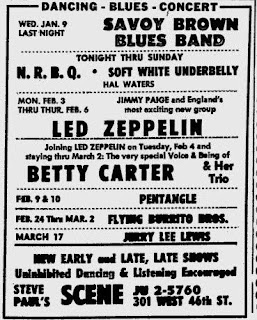
STEVE PAUL'S SCENE, 301 W. 46th Street. Technically it's Steve Paul's The Scene, but that's a tad awkward, no? At any rate, the Scene was among the most "in-crowd" of happening hotspots in late-'60s Manhattan. Major rock stars of the day not only performed there, they relished hanging out there, and these hang-outs frequently evolved into all-night jam sessions. As Lenny Kaye wrote in The History of Rock (1983), "Steve Paul's The Scene provided a watering hole for the late-night superstar, giving over its small, stamp-sized stage to after-hours jams and visiting dignitaries, the coming of age of all that would be known as Sixties rock." In the aforementioned Classic Albums doc, the Scene's maitre d', Jim Marron, describes the space as being "like a Paris disco, in that it was a cave-style. It had three rooms that focused in, like, a cross on the stage, and as a subterranean basement, it had the sort of Paris-cave-disco style to it."
I wish I could find out more about Steve Paul. As for what I do know...seems he first made a name for himself by working as the Peppermint Lounge's publicist during its twisitin' heyday, and later formed a management company, Blue Sky, which had the likes of Johnny Winter, Rick Derringer, and David Johansen on its roster. According to a groovy self-penned article in the May 1967 issue of Hullabaloo magazine, his ambitions for the impresario field were formed via frequent childhood viewings of the Late, Late Show:
The owners of nightclubs in ['30s and '40s] movies had loads of people to keep 'em company. Huge sofas and many phones in massive modern offices. Rising stages. Hidden safes loaded with cash. Beautiful girls in abundance. Bodyguard chums and not a blanket in sight. Doctors and do-gooders and firemen and free-thinkers had to go to bed at night. Nightclub owners didn't. Someday I'd grow up and own me a nightclub...I'd create me a world of reality within the world of reality. Make your dreams come true. It can happen to you. It would be called The Scene. Big S(cene) in name. Little s(cene) in reality (within reality). A place where together people could get together. I'd own it. But so would you. I'd work there. But so would you. I'd play there. But so would you. We'd all give what we could. For the scene's common good.
From what I can gather, the club initially opened in '65 to great fanfare. In the article, Paul writes of the Lovin' Spoonful, the Young Rascals, and Sammy Davis, Jr. gracing the stage. In Popism: The Warhol '60s (New York: Harper & Row, 1983), Warhol writes of a Scene party attended by himself and Edie Sedgwick; other guests included Liza Minnelli and Peter Allen, Baby Jane Holzer, "and Marion Javits and Huntington Hartford and Wendy Vanderbilt and Christina Paolozzi, who was the first model to appear nude in Harper's Bazaar," among other breathlessly dropped names. There's a pic of Edie meeting Mick Jagger at the Scene in Edie: An American Biography (New York: Knopf, 1982), and David McCabe's A Year in the Life of Andy Warhol (London: Phaidon 2003) has some fab shots of Warhol stars cavorting there while watching the Executives, a band made up of 12-year-olds in business suits. After about a year, though, the place got stale:
I know The Scene was great for a while. Because it was real. And because of that it began to stink. Even our scene stinks every now and then. Some of the kids who started coming were only chronological kids. The spontaneous entertainment tonight was yesterday's spontaneity. Being busy became bad. Instead of good. The publicity started stopping. We got what we deserved. We started sinking. And sunk...We owed $90,000. We weren't even doing business on Saturdays. You know where that's at. Real nowhere is the address.
The Scene closed up shop temporarily, but with some help (financial and otherwise--Paul specifically credits Peter Yarrow, Allen Ginsberg and Tiger Morse) it was able to successfully reopen. Legend has it that members of the JuniorMafia regularly came 'round to collect protection money; a certain Sopranos cast member (rest assured it's NOT Li'l Steven) is said to have been among the shakedowners. But such unsavory aspects didn't seem to stop the celebs and heads from packing the place. Chief among the rock gods in residence was Jimi Hendrix. As David Henderson writes in his fabulously florid 'Scuse Me While I Kiss The Sky (New York: Doubleday, 1978):
Jimi soon found the Scene Club irresistible...Fans did not hassle you there. It was dark and intimate, almost labyrinthine, yet you could go there and party, or play and just sit alone and drink, and no-one restrained you either way. And most important of all was that he could play there. He could play any time he wanted to. He could woodshed right in the middle of New York City. The Scene Club was like a miniforum model for every arena he would ever play. The shouting stark frenzy of the close room is what he brought with him to every stage around the world. It was always the small intimate room he was really playing to. The thousand and one nights of playing long into the Scene Club's night. When the chairs would finally be upside down upon the tiny tables. When Steve Paul himself would finally have to pull the plug, while Jimi alone in his universe would be totally unaware of the hour or of the devotees and workers who patiently waited within the exhilaration of his sound. At the Scene, Jimi would completely let himself go--playing all he knew and didn't know, going beyond sharing--playing all. Trying to get it all out.
Henderson describes the layout of the club as follows:
Out front, a big lighted entrance; inside are narrow rectangular panels leading up to a dim box office. You sweep past into a zigzag-shaped mazelike room with tiny tables and tiny-backed chairs. But up on the tiny stage, two feet off the floor, the music happens as it happens in all major cities of the Western world.
He goes on with a delightful account of a night Hendrix spent there with supergroupie Devon by his side--but you'll have to seek out the book to read it. [Speaking of groupies, parts of the 1970 doc Groupies were shot in and around the Scene.] Jimi's wee-hours jam sessions with various mega-musicians not only made their way into legend--some of 'em germinated into tracks on Electric Ladyland, recorded at the nearby Record Plant at 321 W. 44th Street. Hendrix also took part in a benefit concert for Biafran relief at the club--here's a pic of him and Joan Baez hanging out backstage between sets. Hendrix and Paul must have forged a strong friendship over those late Scene nights, for upon Jimi's death his management specially flew Paul in to attend the Seattle funeral.
Before moving to London and snagging a certain Beatle, Linda Eastman honed her photography skills while regularly making the Scene. Her friend Michael Weber provides an atmospheric account of the club and her picture-taking techniques, which I'll excerpt here (but do check out his site for more):
We met at The Scene in the heart of Hell's Kitchen, the most happening music joint in New York City. Linda was rumored to be the heiress to the Eastman Kodak fortune, a myth perpetrated by the fact she often sat with The Scene's resident millionaire, Deering Howe, as in John Deere tractors. Here was this perfectly clad debutante schlepping two Nikons around her neck while everyone else was tripping-out in their caftans. To say Linda stuck out like a sore thumb would be putting it mildly, but she was no heiress. The Scene was the place the top groups got together to jam when performing at New York's bigger venues. Getting past owner Steve Paul at the door was no mean feat, if you got past Teddy first, his sharkskin-suited maitre ‘d, up on the sidewalk. Paul was a brash 21-year-old kid, and if he did ordain your entrance to his club it was not before he unceremoniously put you down. That was his cover charge, a patented one line insult. Rarely, if ever, did he charge his regulars admission. I can't remember Steve ever insulting Linda, though. Her passion was photographing musicians and his was giving them a home. Linda and Steve were simpatico. Tiny Tim always warmed up the house, strumming camp show tunes on his little ukulele while singing along in that nasal falsetto he made famous years later on the Johnny Carson Show. When Tiny decided to finish, it could be one song it could be seven, the Super Groups would get up and jam. That's when Linda sprang to action. She worked seamlessly, blending in with the act. No matter who they were, how famous or infamous, Linda got in their face. That's how she got her portfolio together. For a while Linda was as much a fixture at The Scene as Tiny Tim. That's really saying something.
TheDoors played a number of Scene dates in June, July, and October of 1967. Doors researcher Greg Shaw--again, not the Greg Shaw of Bomp fame--presents another evocative account of the club, which appears to come from another Hullabaloo article (please click the link for Doors-specific details):
Steve Paul's The Scene is a popular midtown nightclub at 46th St. and 8th Ave. It sports a labyrinth floor plan which extends through a bizarre network of brick walled cellar rooms and passageways. While the club caters primarily to the jet-set, it also attracts a growing number of the hippie community. Steve Paul once described the purpose of his club in this way: 'To use music as a common denominator for the fusion between music, musicians, people who like music, and people who are music in their very being.' Steve Paul, who had an uncanny eye for spotting new stars, would often feature new talent at his club long before word of them had gone out. Among the wide variety of performers featured at The Scene are the Velvet Underground, Pink Floyd, Jeff Beck, Traffic, the Rascals, Fleetwood Mac and The Chambers Brothers.
The May, 1967 issue of Crawdaddy! printed this tasty little item:
Steve Paul is producing a series of two-hour color TV specials on pop music and people and the interaction between them; the show will be seen on Channel 5 in New York and certain other Metromedia stations across the country. Steve's club, the Scene, has recently been the late-night home of some very nice New York jam sessions, particularly while the Cream, the Chicago Loop, and Wilson Pickett's band were working nearby in Murray the K's Easter show at the RKO 58th. [From The Crawdaddy! Book (Milwaukee: Hal Leonard, 2002).]
As far as I know, only one of these specials, entitled The Steve Paul Scene, made it to air, featuring the Blues Project, Moby Grape, and the Staples Singers--it's a tripped-out artifact of a bygone era, available for viewing at the Museum of Television and Radio.
And as for the Scene, it closed sometime in 1969. Steve Paul himself had prophesied its demise in the Hullabaloo article. "This time we'll try and make it last. But it won't. Nothing great lasts all the time. Just some of the time and always meaning to the rest. NIGHTCLUB (A definition): A childhood dream come untrue, a reality sinking up instead of down, a Scene, a scene."
[EDIT 11/20/2009: You can see footage of the entrance and interior of the Scene in this excerpt from Groupies.]
[EDIT 3/11/2010: Another one from my "Yes, I DO live under a rock" file...despite being on Facebook for a number of years now, I only just dicovered today there is a Facebook fan page for the Scene! I guess I should start searching for other ancient NYC club pages, stat.]
[UPDATE 5/6/2010: Here are a few Scene ads recently unearthed by a long-time Internet pal of mine, the eagle-eyed Rob B.]
[UPDATE 5/7/2010: Evidently the Motions also played there around June of 1969, with Davy Jones and Micky Dolenz in attendance! Theseclipshave been on youtube since 2006 but I only just discovered them today.]
[UPDATE 5/12/2010: Found an article about Steve Paul and the club in the July 19, 1967 issue of the Village Voice.]
[UPDATE 5/26/2010: NYCDreamin' of This Ain't the Summer of Love posted a cool Scene "win a free record" ad a while back.]
[UPDATE 5/31/2010: Scanned from Clinton Heylin's All Yesterday's Parties: The Velvet Underground in Print, 1966-1971 (NY: Da Capo Press, 2005).]
[UPDATE 6/7/2010: I posted a whole mess of 1967 Scene ads here and here.]
[UPDATE 5/15/2012: Revised and improved posts on 1967 and 1969 Scene ads.]
UPDATE 5/8/2013: Jeremiah's VNY reports that 301 W. 46th Street is slated for demolition. Also, learn a bit about the Scene's predecessor, the Cave of the Fallen Angels, at Gotham Lost & Found.
My husband and I usually stay at a certain Manhattan hotel when visiting NYC, but it's all booked up this week, so we have a reservation at a new Ramada in Corona, my real hometown--overlooking scenic Grand Central Parkway and Shea Stadium. I've got to spend lots of time with what's left of my family (my mother passed away recently), so it's more convenient for my pops anyway. The hotel's proximity to Flushing Meadows Park (more pics/info here, here and here) is prompting me to ponder past rock and roll action in the area. I'll start with a long-lost hotbed of hippiedom:
(Via The Bowery Boys.) SINGER BOWL--At the northern edge of Flushing Meadows, near the Shea Stadium/Willets Point stop on the 7 train. The Singer Bowl was an open-air stadium built for the '64 World's Fair and apparently sponsored by the Singer sewing machine company. Seems it was used primarily for sporting events until the late '60s, when it became a major venue for big summer rock shows. Some notables who played there:
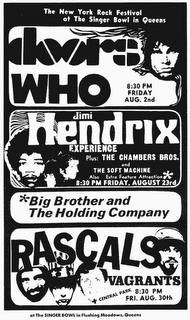
The Doors, with the Who and the Kangaroo as openers, performed on August 2, 1968--an event which caused a riot, though of course volatility was not uncommon at Doors gigs (or Who shows for that matter!). There's a ticket stub for sale here, and the Doors' setlist for the night can be read here.
[UPDATE 5/14/2010: Quite a bit of footage from the Doors show wound up in When You're Strange, as shown on PBS the other night. Not so much of the band performing, but you do get to see Morrison mingling with some people in the crowd before the show (including a guy selling Who programs), and of him backstage comforting a girl who got hit with a chair during the melee. I tried to see if there was more on youtube, but no dice...however, I did find audio of "Light My Fire," and oftheWho'swholeset.]
Janis Joplin with Big Brother and the Holding Company and the Jimi Hendrix Experience were the big draws on August 23, 1968. This show is often called the New York Rock Festival, but I've seen the Doors/Who show referred to as such also--perhaps this was an overall title for concerts at the Singer that summer. I'm not absolutely sure who else was on the bill, but it may have included the Soft Machine and the Chambers Brothers, if this guy's memories are correct. Audio and video of Hendrix's set has been well-circulated among Jimi-philes.
[Oddly, this August 23 date conflicts with a reference I found for a bill featuring Country Joe and the Fish, the Byrds, and the 1910 Fruitgum Company.]
Two of the NYC-area's finest, The (Young) Rascals and the Vagrants, shared a bill there on August 30, 1968--here's a ticket stub.
The Singer Bowl Music Festival happened on July 13, 1969, and appears to have been the heaviest show in the stadium's history. I haven't seen a copy of the full bill, but based on various websites I've perused, it included the Edwin Hawkins Singers, Raven, Jethro Tull, Ten Years After, VanillaFudge, the Jeff Beck Group, and LedZeppelin--plus a jam session (no late-'60s fest was complete without one) comprising various members of those last three bands.
Later that summer, Poco, the Chambers Brothers and Albert King shared a bill on August 23. On August 29-30, Zeppelin played the Bowl again, with support from Buddy Guy and Foreplay, which featured Larry Coryell, Cream's Jack Bruce, and Mitch Mitchell from the Hendrix Experience. The Jimmy Castor Bunch played the Bowl in the early '70s, but I can't confirm the date.
On July 4, 1973, the Bowl was rededicated as the Louis Armstrong Stadium, a fitting tribute to Corona's most famous longtime resident. A concert in honor of what would have been Satchmo's 73rd birthday was held there that summer (presumably on August 4, though I haven't confirmed the date), featuring Ella Fitzgerald, Dizzy Gillespie, Eubie Blake, Gene Krupa and other jazzbos. But the stadium's days as a music venue were numbered. In 1978, Armstrong Stadium was adapted for use as a tennis facility called the USTA National Tennis Center, and it became the new home of the U.S. Open (formerly held at the West Side Tennis Club in Forest Hills--a place with its own musical legacy, to be discussed in a future entry). Armstrong Stadium still stands today, albeit in a much-renovated form; it serves as a supplemental facility to the larger Arthur Ashe Stadium, which was built beside it in 1997. Thousands still flock to the area every summer--but instead of rock and roll, they're more likely to hear grunting tennis players, balls whacked against racquets, and the otherworldy hum of the Fuji blimp circling overhead.
I'll cover more of Flushing Meadows' musical happenings next time.
[UPDATE 5/23/2010: Why I failed to learn about or mention the important role thatGaryKurfirstplayed in all of this until just now is a mystery for the ages.]
[UPDATE 6/17/2020: Here's an ad for the 1969 season from the 6/5/69 issue of the VillageVoice. It's incomplete, so I'll keep looking for revised versions of the ad in the archives.]
[UPDATE 3/15/2012: Revised and updated post on Singer Bowl and NY Pavilion ads here.]