Showing posts with label Second Avenue. Show all posts

Friday, June 04, 2010

1967 Ads: The Village Theater

Selected Village Theater ads, illustrating its eclectic booking policy. Voice issue dates and other pertinent info in the captions.


3/16/67 issue: Ornette Coleman Trio and the Philadelphia Woodwind Quintet, March 17--see a Billboard review here.


3/16/67 issue: Nina Simone, Miriam Makeba, and Flip Wilson, March 25.


3/30/67 issue: The Beers Family, April 22.


4/12/67 issue: Folk-rock concerts on April 14.


4/13/67 issue: Chuck Berry on April 28.


April 13, 20, & 27, 1967 issues: "An Evening with God" on May 13, one of Timothy Leary's regular events at the theater. I can make out the names of Dick Gregory, Rev. Malcolm Boyd, Dr. Harvey Cox, Len Chandler, and Paul Krassner.


4/27/67 issue, & reprinted in several others: Herbie Mann's "Impressions of the Middle East" show, June 3.


5/4/67 issue: Horace Silver Quintet, Morgana King, Ahmad Jamal Trio, May 27.


5/18/67 issue: WOR-FM Anniversary Concert, June 11.


6/29/67 issue: The Blues Project, the Who, and Richie Havens, "Plus After The 3rd World Raspberry," July 8. [Note the accompanying ad for the Young Rascals and Spanky & Our Gang at the Malibu Shore Club in Lido Beach, Long Island on July 3...the Who (on 7/7/67) and the Byrds and the Seeds (on 7/21/67) also did shows there put on by the same promoter, Don Friedman.]


7/20/67 issue: The Byrds, the Vanilla Fudge Conspiracy (interim name between the Pigeons and Vanilla Fudge), and the Seeds, July 22.


7/27/67 issue: Janis Ian and the Grass Roots, July 28.


7/27/67 issue: James Baldwin and Richie Havens, August 24.


8/10/67 issue: James Baldwin lecture/Havens concert on August 24 is fleshed out with Ossie Davis, Dick Davy, and the Frank Mitchell Quintet.


8/17/67: More attractions added to the Baldwin lecture.


8/17/67 issue: "New Stars in '67" Show, August 26.


8/17/67 isue: The Yardbirds, the Youngbloods, and Jake Holmes, August 25.


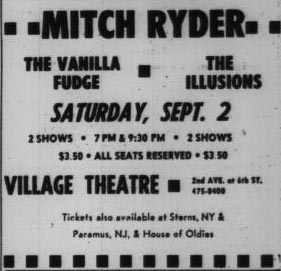
August 24 & 31, 1967 issues: Mitch Ryder, Vanilla Fudge, and the Illusions, September 2.


8/31/67 issue: The Doors, the Vagrants, and the Chambers Brothers, September 9.


9/7/67 issue: Oops! Looks like the Chambers Brothers cancelled and Tim Rose stepped in.


9/21/67 issue: Mixed jazz and folk program, October 15.


10/12/67 issue: Further details on this "October Breakout."


10/12/67 issue: Otis Redding and Carla Thomas, October 20 & 21.


10/26/67 issue: The Yardbirds and Vanilla Fudge, November 3.


11/9/67 issue: Moby Grape, November 11.


11/9/67 issue (and the previous week's): Buck Owens & the Buckaroos, Wynn Stewart, Tommy Collins, and Rose Maddox, November 12. Here's a review of the show from Billboard.


11/16/67 issue: Charles Lloyd Quartet, November 18.


11/16/67 issue: The Who, the Vagrants, and the Rich Kids, November 25 &26.


11/23/67 issue: Moby Grape, the Druids of Stonehenge, Charles O'Hegarty, and Kingdom Come, November 23 & 24.


11/23/67: Slightly different graphics for the Who ad.


12/21/67 issue: The Grateful Dead and Take Five, December 26 and 27.


UPDATE 11/14/2011:  Please see the improved and revised 1967 Village Theater ads post here.

Tuesday, August 30, 2005

Free Be Jeebies

[This title kinda reminds me of the time my moms took a phone message for me about meeting some friends for a show at CBGB's--only she had misheard the name as Heebie Jeebies. Most decidedly not Pandora's Golden ones, though.]

FREEBEING RECORDS, 129 Second Avenue just south of St. Marks Place. Or was it Free Being? I've seen the name of this late, lamented '70s/'80s record shop spelled both ways. According to the aforementioned Mike Fornatale, it "was one of the few places buying/selling used LPs in 1972...(sigh)...those were the days!" I recently rented the DVD of The Nomi Song--a required-viewing elegy for both a man and an era gone by--and among the many excellent extras is a brief "slide show" of some of director Andrew Horn's fave old East Village haunts. To a photo of Freebeing's front sign, he narrates as follows:

I think this was the first record store that I can remember where I started noticing the first sort of independently produced records. There was a point at which the bands at that time started realizing that for a few hundred dollars you could press your own record, and suddenly there was this explosion of records all over the place. And every week or every day [the store] would paste the new single that had just come out in the door, and the door would be full of all these singles. And I think this is the first place where I ever saw the B-52s single and the Elvis Costello.

Some other customer recollections are available here, here, here, and here, but unfortunately they have more to do with records found there than with the vibe and appearance of the store itself. I visited the store a few times as a tentative teenybopper during my earliest solo East Side expeditions (only after fully exploring the Greenwich Village frontier was it finally time to venture beyond Broadway's DMZ). Can't recall any specific items I bought, but I do remember the shop as a loud, crowded, lively hive of frenzied record-flipping activity. I'm not sure when it closed down, but ISTR a San Loco taco stand appearing in its stead by the late '80s. If I'm not mistaken, around that same time there was a record shop on Carmine Street calling itself Freebeing--but I may have the name wrong, and even if I am correct it may not have been a new location for the original. [Despite my iffyness about the Carmine St. shop's name, I can clearly recall how overjoyed I was upon finding a mint vinyl copy of the Jam's All Mod Cons there during my big 1988 Paul Weller phase.]

Since I never got into Friends I haven't seen this, but apparently one of the storefronts near Central Perk was named Free Being Records in honor of executive producer Kevin Bright's fond memores of the shop. As for the real storefront, it is currently home to Cinderella Falafel.


UPDATE 7/20/2006: Just found out that The Big Takeover's Jack Rabid worked there in the mid-'80s.


UPDATE 11/1/2010:  This photo was recently posted to the NY Rocks Facebook group--a portion of the store's sign is visible in the center.


Also, quite a while back I located some ads in the 1971 Voice which revealed that the store was originally  called Silverlight.  Here's one example, from the 7/29/71 issue.


Saturday, August 20, 2005

Walkin' on the sidewalk, hotter than a match head

Remind me to avoid NYC in August if I can help it! We had a compelling reason for an August visit last year--Little Steven's Fest on Randall's Island--but unless a future event of that magnitude should be scheduled during this most sweltering and tourist-ridden of months, we'll be timing our visits for more temperate off-season periods. My usual power walks were largely out of the question due to the energy-sapping extreme heat, but we did manage one big record-and-book-shopping jaunt encompassing the vicinity of Other Music and Rockit Scientist. During this outing I inspected the Anderson Theater's entrance site at 66 Second Avenue--now occupied by a branch of Cartridge World--and was pleased to ascertain that the building's lobby portion and facade are extant from the original, with a couple of floors added to the roof. Also checked out the Emigrant Savings Bank branch housed in the former lobby of the Fillmore East to see if the place is indeed decorated with Fillmore photos. To my surprise and delight, the photo/memorabilia collages on display honor not only the fabled Fillmore, but also the Loew's Commodore, Village Theater, and Saint eras of the building. Yeah, I know, pictures offer small compensation for what was demolished--but I still found this little exhibit to be a lovely gesture on Emigrant's part. Speaking of pictures, though, while on another hike I checked out Bleecker Bob's window, and found no photo of the Blues Magoos at the Night Owl displayed therein (as had been reported on Peter Sando's site)--but no biggie, I was happy with their vintage life-sized Ramones cut-out.

The main reason for our unfortunate hottest-week-of-the-year timing was so I could see DEVO at the Hammerstein Ballroom. Never saw 'em before, and they don't seem to want to put T.O. on their tour itinerary, so we bit the bullet and shelled out $55 a piece (plus Ticketmaster fees) for the privilege despite my moral opposition towards outrageous ticket prices. The band was freakin' phenomenal, but the show was over much too quickly. Drummer Josh Freese (also with the Vandals and other acts), perhaps the most rhythmically precise percussionist I've ever heard, injured his hand about 45 minutes into the set--I didn't witness the actual accident but presumably he sliced it against a cymbal. Emergency first aid was administered and he managed to play a few songs in one-armed Def Leppard guy mode, but clearly couldn't continue to the end. Yeesh--you'd think the spud boys would have all the rhythm parts pre-programmed for just such an emergency. Thus we didn't get our money's worth--upsetting, but not exactly a situation you could feel pissed about given the circumstances. There was an afterparty at the FUSE Gallery/Lit Lounge in conjunction with a Mark Mothersbaugh art exhibit, at which a mostly female DEVO cover band called DEVA was to perform, but somehow we were too disheartened to venture there. Other hi-lites:
  • Beating the heat at a Union Square 14 afternoon matinee of The Aristrocrats.
  • Hanging out with my dear friend Cristina at Life Cafe and the Lakeside Lounge, and later drinking more beer at the Raven during their "Mod Mod World" '60s night.
  • Venturing to Coney Island for one last Nathan's lobster roll and Wonder Wheel ride before the area's slated devolution into some kinda antiseptic mall-like attraction.
  • Watching Peter Sellers clips, a Tom Snyder Tomorrow show tribute, and the A&E Brill Building doc at the Museum of TV (which brought back fond memories of the 2001 premiere of said doc at the Museum--Shadow Morton and Mary Weiss of the Shangri-Las were in attendance!).
  • Chowing down at Pongsri, one of the best Thai places in the city.
  • Cheering on pals Fuzzco and Moparlary at the Subway Surfers' Maxwell's debut.
  • Eating massive meals with my Pops and brother at some of our old regular haunts--the Moonstruck Diner on 23rd, venerable El Quijote in the Chelsea Hotel, and Umberto's of New Hyde Park.
  • And reviving our walk-weary souls with cool tunes and frozen drinks at Otto's Shrunken Head.

Due to massive electrical storms our Sunday night flight home was cancelled, but this later led to another highlight. While stumbling through the baggage claim area at Pearson the next morning, I walked right by Elvis Costello. He and wife Diana Krall, who I later learned had come to town to play at some special tribute to Oscar Peterson, were heading toward the baggage service counter as I was trying to find the LaGuardia carousel. I'm too much of a shy goof to ask for an autograph--and besides, maybe he was livid over a lost suitcase or something--but I had fun furtively staring at him and we did exchange "meaningful" eye contact. They say you better listen to the vice of reason...but they don't give you any chice 'cause they think that it's treason...

Monday, July 11, 2005

A far cry from Jenny Lind

NIGHTINGALE'S BAR, 213 Second Avenue (NW corner of 13th St. & 2nd Ave.) Rejoice--despite my penchant for tracing a locale's evolutions, you'll get no longwinded essay about the historical transitions of this place. I have no idea what establishment preceded Nightingale's, nor do I know when it opened as such. It's often described as a dive, but I never found it to be particularly sleazy or scumbuckety. It was more of a plain, nondescript type of neighborhood joint--ugly brown facade (I could be wrong but ISTR the front sign misspelled as "Nightengale's"--probably a remnant of a beer-soaked false memory, though), long bar on one side, postage stamp-sized "stage" about four inches higher than the floor on the other, pool table at the back. It offered live music just about every night of the week, usually without a cover.

The bar's main claim to fame is that it was one of the main hubs for the city's late '80s-to-early '90s neo-hippie jam band movement, fostering outfits like Blues Traveler (who wrote a song about the place), Joan Osborne, the Spin Doctors, and God Street Wine. NOT MY SCENE, but since the Hunter dorms housed a surprising number of its fans, I couldn't help but be exposed to it--especially that fun-filled semester when I had two of its biggest proponents living on either side of my dorm room. One was a gorgeous Italian-as-in-from-Italy gal who was widely rumored to be John Popper's primo-numero-uno groupie. "Why is this beautiful chick wasting the best years of her life on that fat harmonica-fweeting f**khead?" I'd often ask myself, as she would blast yet another 15-minute harmonica solo off some live bootleg Traveler tape. Meanwhile, the guy on the other side seemed to subsist on a steady musical diet of either the Dead or Bob Marley played at plaster-loosening volume. They were really nice people and I got along with them well, but Bongwater was about as wanked-out as I usually wanted to get back then.

Somehow I did make it to Nightingale's fairly regularly, but not for any of the aforementioned bands, thank you very much. Luckily its booking policies encompassed more styles than jam-band noodling. Got to give a shout-out here to my dear friend Pete, a fine rockabilly-influenced guitarist for whom it was a pleasure to be a cheering section; he performed there often, with his sibling-oriented rockabilly duo Rudy and Ludlow and with the indescribably cool Skepticats. There were sporadic garage-type gigs during the '90s--at one of these I was enraptured by the powerhouse pipes of Jahna Rain, then of the Innuendoes and now of the Demands, the Miscreants and the Coal Gems. Most legendary, at least among the garagenik set, were the Fleshtones' series of residency gigs in '98 and '99--read some reminiscences here, here, here, and here.

Apparently Nightingale's closed down for a while before re-emerging as the Nightingale Lounge, presumably under new management. I haven't been to this new incarnation, but I gather it's more upscale/DJ-fied, and caters a lot less to rock & roll types.

Saturday, July 09, 2005

Still hangin' out on Second Avenue

ANDERSON THEATER--66 Second Avenue b/w 3rd and 4th Streets. It's been difficult to ascertain any historical data about the Anderson--when it was built, its original purpose, etc.--but most accounts state it was primarily a Yiddish theater, which makes complete sense given its location. The best I was able to come up with is this description from world-theatres.com, but the "facts" are probably not 100% accurate: "Anderson Theatre - was located at 66 2nd Ave. in the lower east side of NYC - 5,000 seats [I believe it was more like 2,000] - theater entrance structure is still there with that same address but it is now a pharmacy business. The theater wrapped around a corner building and part of the theater was also on the south side of 4th Street. The 4th St. side of the theater is long gone replaced by some modern housing - began as Yiddish Playhouse circa late 1800s or early 1900s, then used as a music venue in the late 1960s." I've found a scant few references to Yiddish and other productions staged there in the past.

For a few years in the late '60s and early '70s, the Anderson functioned as both an avant-garde theater and a rock venue. A few notable shows:

Soft White Underbelly, precursors to Blue Oyster Cult, on February 2, 1968--a review is available here (scroll down near the bottom). Country Joe and the Fish and possibly the Jim Kwesin Jug Band were also on this bill, which was a benefit for Crawdaddy.

Moby Grape and Procol Harum, February 10 and 11, 1968. Check out the flyer for this show here.


Janis Joplin and Big Brother and the Holding Company had their New York debut there on February 17, 1968; B.B. King was also on the bill. A vintage Village Voice review of the show can be read here. Some Elliott Landy photos of the band (onstage and backstage hanging out with the Fugs' Ed Sanders) can be viewed here. And here's the flyer.

On March 6, 1968, the theater hosted a benefit concert for war resisters featuring Country Joe and the Fish and the Fugs. Elliott Landy took some pics of the Fugs there (scroll down a ways)--I'm not sure if they're from this show, but considering the anti-Vietnam slides projected behind them it seems likely.

UPDATE 1/25/2013:  Ed Sanders discusses this show a bit in his '60s memoir Fug You (New York: Da Capo, 2011):  "On March 6...the Fugs, Country Joe and the Fish, Bob Fass, Paul Krassner, and Light Show creators Joshua and Pablo did a benefit for the War Resisters League at the famous Anderson Theater, home to many a Yiddish production, at 66 Second Avenue.  I wrote a new song for the concert, a country and western satire titled 'I Cried When I Came in Your Best Friend's Mouth.'  I could hear gasps from the front rows of the Anderson Theater as we sailed through the tune.  It was the only ditty in the history of the Fugs that any band member objected to, so I dropped it from the repertoire....Landy's photo of the Fugs on the Anderson Theater stage captured marvelously the grooviness of the stage ambience during those times."

The Yardbirds, with the Rich Kids and the Bagatelle, March 30, 1968--see the flyer here, and click here, here, and here for the saga behind the live recording of this show.     UPDATE 1/25/2013:  According to some Aerosmith fan sites and other sources, the Chain Reaction were also on this bill.


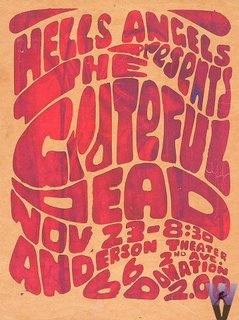
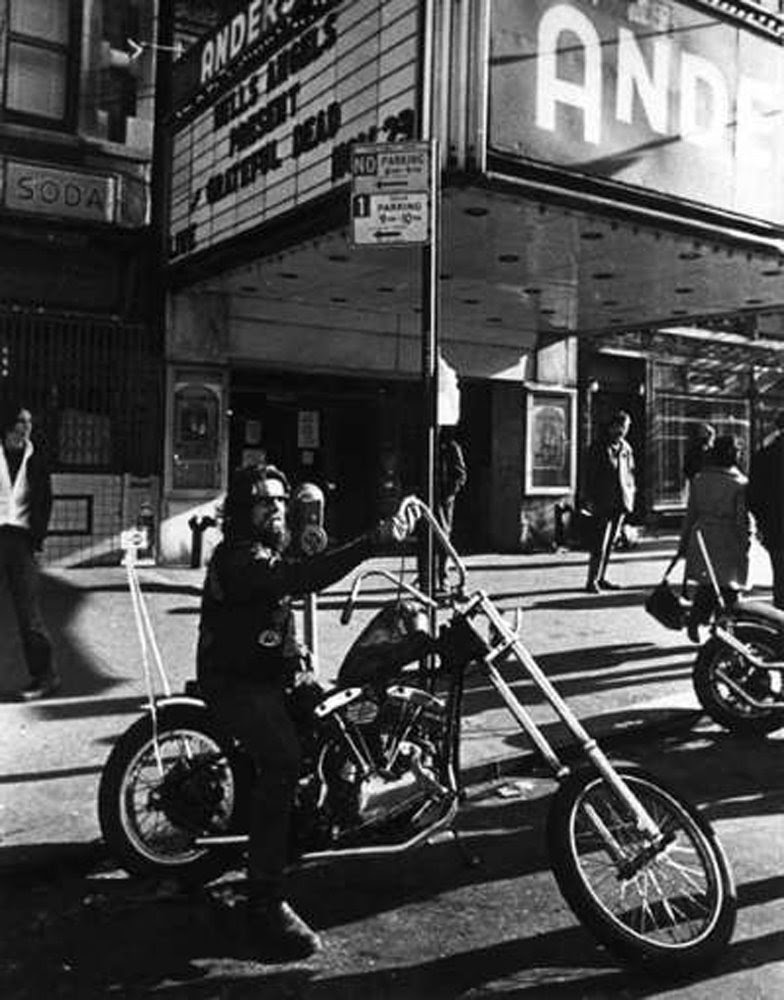
Traffic, New Riders of the Purple Sage, and the Grateful Dead, November 23, 1970.


San Francisco drag-hippie troupe the Cockettes made their New York debut at the Anderson in November, 1971. Their much-hyped revue didn't go over very well with the society types who'd turned out for opening night, but downtown's lower class of glitterati thought they were swell, enabling the show to run for three weeks. Required-viewing documentary The Cockettes includes some footage from the show, and further details can be gleaned from "Sweet" Pam Tent's Midnight at the Palace (New York: Alyson Books, 2004) and Joshua Gamson's The Fabulous Sylvester (New York: Henry Holt and Co., 2005). Click here for a picture of the flyer and a photo of the Anderson's facade and marquee from 1971.


Captain Beefheart, January 15, 1972--here's a vintage Crawdaddy article that mentions the show.

That's all I've been able to find thus far--but there may have been more rock & roll life left in the old gal yet.

When I read Roman Kozak's This Ain't No Disco: The Story of CBGB (Boston: Faber and Faber, 1988) back in 1988, I was intrigued to learn that Hilly Kristal had attempted to run a larger venue in an old Second Avenue theater from late '77 to early '78. This place was called, appropriately enough, CBGB THEATER--but while the book gave a fairly detailed account of the goings-on there, it neglected to mention precisely which old theater it was in, merely hinting that it was "located on Second Avenue only a few blocks from the club." Now by the late '80s, the Anderson had been vacant for years, and its marquee was stripped of all identifying signage. I had noticed the building, but back then I had no clue of its name or of its brief heyday as a sort of Fillmore East, Jr.--indeed, I only learned about the Anderson Theater's existence a couple years ago. Yet since this rotting hulk was the closest in proximity to CB's of all the old Second Avenue theaters, I figured it must have been the home of CBGB Theater. I have tried to confirm this, but to my frustration I've found no concrete evidence. The only reference I've found to suggest that I'm correct comes from an interview with Mayday's Steve Johnstad, in which he talks of rehearsing at the Anderson while renovations were underway for its reopening as the CBGB Theater. There's a detailed history of CBGB penned by Kristal himself on cbgb.com, but so far he's only gotten up to early '77. I wish I had more solid documentation to go by--but heck, I'm 99 and 44/100% sure about this, and that's enough to make me continue with confidence that the CBGB Theater did occupy the Anderson.

The CBGB Theater was just slightly ahead of its time, and circumstantially doomed--a good idea, poorly executed. By late 1977, the crowds at CBGB were getting out of hand. Sensing the growing popularity of the punk scene and hoping to maintain a major role in it, Kristal felt it was time to expand operations, and after a bit of searching he found a location at the nearby Anderson. Unfortunately, the building he bought was in a shabby state of repair. While decrepitude may have been part of the "charm" of the original club on the Bowery, it wouldn't fly in a near-2,000-capacity venue--certain standards of safety, modernization, and class had to be met in a place that large. But it cost a lot of money to bring the theater up to code, and though Kristal had some backing from the likes of Seymour Stein and a theatrical program company, he never quite managed to pull it off. Here are a few colorful anecdotes from This Ain't No Disco:

The CBGB Theater had a legal capacity of 1,734. It opened on a Tuesday night, December 27, 1977, with Talking Heads headlining, supported by the Shirts and the Tuff Darts. The next night it was the Dictators, the Dead Boys, and the Luna Band (formerly Orchestra Luna). Then Patti Smith headlined December 29, 30, and New Year's Eve. There were problems right from the beginning..."It was a great concept, but Hilly never really checked out the place," [says] Bill Shumaker. "It was in December, it was bitter cold, but the heating system never really worked. I never went down into the basement, but you could look down and it honestly looked like one of the rings in Dante's Inferno. And down there was the boiler. Everybody got serious colds. The sound guys were working with their gloves on because the place was never warm. Then, about six hours before opening, some old guy is up on the scaffolding. He started getting dizzy, and what he grabbed was this asbestos curtain release. The curtain weighed a ton, and down it came. Thank God it had a catch on it. It came down really fast, and then it stopped, so they could pull out the electric pianos and stuff, and then it came down again, leaving about three feet free from the lip of the stage. Nobody could do a sound check. And nobody had ever checked the mechanism for bringing it back up again. They had to get some kind of special gear. And the place didn't have enough power. The theater was set up for Yiddish theater. And that was about all the damned thing could take. So they had this noisy generator out on the street."....[Sound engineer] Norman Dunn: "It was an exercise in how many things could go wrong. In twenty-seven degree temperature you don't spray soundproofing under the balcony. It doesn't dry. At the first note it started falling down. The boiler room was under eleven feet of water because the water mains broke. One of the plumbers put in a weak pipe. The generator outside was running the electricity for everything and it was driving the neighbors crazy...There were threats, the police were there; but it would have cost $15,000 and Con Edison would have had to rip up the street to make things right. And this thing was opened on a shoestring. So every time the lights would go full blast, the sound would die to a whisper and then slowly the volume would come back up. There were other things. The chandelier hadn't been cleaned in eighteen years and the mixing board was right underneath it. Every bass note I was being rained on by eighteen years of soot and grime."

Joel Webber is even more graphic, though he does exaggerate for effect: "The place was disgusting. It made the CBGB club look like the Rainbow Room. We were talking about eighty years' worth of dirt. I mean there was popcorn left over from the last performance of the Yiddish theater in 1925...They did manage to clean up the entryway, and made it look like a subway station. They also had a little store where they sold punk paraphernalia. I bought my first skinny tie there."

This cool vintage article from a Cleveland newspaper reports on the earliest shows at the venue--noting with some annoyance that it "boasted $7.50 admissions, spotty central heating, and layers of dust and decrepitude dating back who knows how long (I don't even want to talk about the '"bar")." The Talking Heads, Tuff Darts, Luna, and the Shirts opened the place on December 27, 1977, followed by the Dead Boys and the Dictators the following night. The Patti Smith Group, Richard Hell and the Voidoids, the Erasers, and Mars did three-night stand culminating on New Year's Eve. The second night included a guest appearance by Bruce Springsteen, joining the PSG on "Because the Night." Even more notable was the FDNY's attempt to shut the place down shortly afterwards; Patti reportedly managed to sweet-talk the Marshals into letting the band finish their set, but the incident still made the front page of the NY Post. Here's another terrific vintage review on opening week from the NME.

More from This Ain't No Disco: After the Patti Smith dates the Theater closed. The place was briefly used as a rock and roll flea market and there was a show with the Jam the following March [March 31, 1978], when Mick Jagger showed up...There were obvious physical problems with the Theater, and neighbors on residential Second Avenue were not happy with it or its generator, but there were also other theories and explanations for [its] quick demise. "I think what happened was economic," says Robert Christgau. "I think basically Hilly got outbid when he tried to start that place...Ron Delsener just creamed him. Delsener said this upstart needs a lesson and I'm going to give it to him. And he started hiring all of Hilly's best bands, filled his now defunct hall [the Palladium] with them, and said, 'Fuck you, Hilly. This is my bailiwick."

Kristal nearly lost his shirt, but remained philosophical about the Theater's failure: It cost me about $150,000 or $160,000 loss for everying...But suppose I didn't go into the Theater? Maybe at that time it was a mistake to do it underfinanced, I might have been a little bit too soon, but if I had the money I might have done it. Some say it may have been better to start another CBGB in L.A. or London. People have suggested all those things, but you have to run a new enterprise and at least it was easy for me to run it from here. You have to have a certain perspective on how you want it run.

I'm not sure how active the building was in the '80s. I found a reference to an Anderson Theater Gallery, at which Vincent Gallo had an exhibition in 1983--but for all I know this could be a completely different location. By the time the building entered my '80s consciousness it appeared to be abandoned, and it was torn down sometime in the mid-to-late-'90s. Apartment buildings now occupy the space fronting 4th Street where the theater was. I'm not sure if the lobby portion/facade was preserved, but at any rate the 66 Second Avenue address is still in use. The site is currently home to a branch of Cartridge World, an ink cartridge refilling service.


UPDATE 12/19/2010:  Just found this cool photo of the Anderson, via templeoftheblacksun.  I also recently saw some tidbits of Anderson history on the cinematreasures.org page for the Academy of Music.


UPDATE 5/30/2011:  Oooh, cinematreasures.org has a new look!  Here's their page on the Anderson Theater, which gives more insight into its pre-rock and roll period.  Apparently it was opened in 1926 as the Public Theatre.  It mainly presented Yiddish productions until 1953, when it was renamed the Antillas and operated as a Spanish-language movie house.  Then in 1957 it finally received the Anderson moniker, in honor of theatrical agent Phyllis Anderson.  Also check out this 1977 Billboard article on the CBGB Theatre.

UPDATE 1/25/2013:  For the heck of it I just did a search for some Billboard articles on the Anderson, and found a review for the Eric Burdon show (3/30/68 issue), a couple of mentions about the theater's availability (7/25/70 and 10/2/71 issues), and this ad for Pablo's Lights (3/2/68 issue).


Wednesday, July 06, 2005

Gones!ville

WOWSVILLE RECORD STORE--125 Second Avenue b/w 7th St. & St. Marks Place. For an all-too-brief period at the turn of this century, Wowsville--or "Wows!ville" as it was spelled on its front sign, business cards, and pink (later purple) shopping bags--was thee quintessential East Village rock & roll record shop. Specializing in punk, garage, rockabilly, soul, and all other manner of vintage-to-current coolness, the store was a tiny hot-pink hole-in-the-wall packed to the rafters with vinyl, CDs, rock tchotchkes, posters, T-shirts, 'zines, a giant Rat Fink statue, and a gallery of Dee Dee Ramone paintings and classic Gruen/Bayley/Childers/Rock photos.


The proprietors were a bespectacled Spanish couple, Alberto and Sonia Camarasa--two of the friendliest rock & roll freaks you were ever likely to meet. They were always quick with a smile, a hug, a candid behind-the-scenes anecdote, and recommendations for the best shows/DJ nights in town and the latest (or oldest!) records you couldn't afford not to buy. With their European connections, they had a good line on imports, particularly Spanish labels like Munster. Some complained that they overpriced certain items, but I never found that to be the case--other stores were far more outrageous (Bleecker Bob's, anyone?), and you haven't really overpaid for records until you've shopped for them in Canada. Granted, Wows!ville wasn't the most modern or professional of retail operations. They never got around to accepting credit cards, didn't seem to have a computerized inventory system, and might be inclined to ask a regular customer to mind the shop for a minute if they needed to make a quick run to the nearest deli. But Wows!ville had more heart, soul, personality, and passion than most other downtown hipster emporia put together. Surly, High Fidelity-style attitude? Not here, bud--unless you acted like an asshole first.

About a year after I moved to Toronto, my mother sent me a clipping from Newsday about the Camarasas, dated July 24, 2002. Here's an excerpt from the article, written by Marc Ferris:

Totally Devoted to the Ramones: Spanish Couple from Elmhurst hosts fans of band at East Village Store.
Sonia Camarasa practically lives for the Ramones. She and her husband, Alberto, both from Spain, own a small East Village record store that has become a gathering spot for the band's fans. And her Ramones-infused collection of memorabilia is taking over their apartment in Elmhurst. She recently helped with the campaign to name a stretch of East 2nd Street in Manhattan after Joey Ramone. And sometimes, when she feels depressed, she even heads to Forest Hills High School and other scenes from the band's past. "If I'm not their biggest fan, then I'm really close," Sonia, 27, said. The Camarasas, fans of the band since their teen years, are recent emigres who came to the city to bask in the afterglow of 1970s New York punk rock. "That's why we're here," Alberto, 29, said...Three years ago, the day after getting married in Spain, the Camarasas opened their emporium. The Second Avenue chocolate shop run by the Queens branch of Sonia's family had become a burden when the couple opened Wows!ville, a spartan space named after an obscure 1950s tune and specializing in vinyl by post-World War II garage bands. [Are there any other kind? -Ed.] Alberto takes care of the enterprise's day-to-day operations, freeing Sonia to do her stained glass sculptures and write songs on guitar for her fledgling band. The display window has clay figures of the Ramones carved by an Italian fan, a Joey Ramone bobblehead doll and a handwritten sign commemorating Dee Dee Ramone as "King Fun-King Forever." Ramones t-shirts, videos, albums and general kitsch make up a fourth of the store's revenue. The business breaks even because rent is below market rate and making money is not the couple's primary goal, they said. "It's the music that we love, and it all came from New York," Alberto said.

Wows!ville was a veritable rock & roll rec room. You could hang out for hours both shopping and shooting the shit, and occasionally you could catch a fun in-store show. You could discover a new band, or be discovered, as was the case with the Little Killers. Here's an excerpt from an interview they did with Splendidezine.com.

Andy Maltz: Yeah, in New York there's a record store called Wowsville, which is a place you go and hang out. If you stay there for half an hour, you'll see five people you know. So Tim, who runs Crypt, was there the day before Thanksgiving. A bunch of people were hanging out listening to records. So, Dave, who was in a band called the Tie Reds, he put our recording on, which was, at that point, new. We had just finished it. Tim heard it and really liked it. So he was just like, at the end, he was like...
Sara Nelson: "Play it again."
Andy Maltz: "Play it again." He played it again three times and left with it.
Splendid: So were you there at the time? Or did you hear about it later?
Andy Maltz: No, no, no. I wasn't there. I got a phone message from Alberto, who owns Wowsville. Alberto's from Spain. He's very excitable. And he was like, "Andy, Andy, Andy, someone wants to put out the record." And I didn't know who he was talking about. I didn't want to get my hopes up about it. But I knew that Tim had come by there, so in the best case scenario, it would be him, and it was. It was very much a case of being in the right place at the right time
.

Starting in 2002, the party was extended after hours at Wowsville-a-Go-Go, a weekly Friday-night dance bash held at the faux-tiki Lei Lounge in the basement of Niagara at Avenue A & E. 7th Street. DJs El Rey del Wowsville (Alberto's nom de spin), Dos Platos, and other rotating guests spun the platters that splattered, while local garageniks and go-go gals shook their moneymakers with abandon, archaic cabaret laws be damned. It was a cool scene for a while, reminiscent of the old Green Door parties--until the frat boy types started coming around. But it had staying power, and can still be enjoyed today, albeit at a different bar. Here's a description taken from "mah fren'" Blair's concert calendar:

Le Disquaire Bazooka Joe spins the most savage and greasy mid 50's- late 60's dancefloor records ever made! Expect a super stupid set of soul stomp monsters, garage pounders, greazy r'n'b, honkin' instros, crazy calypsos, kookie limbos, manicmambos, fucked up freakbeat, wild watusis, dink music, fink music, Monk music, junk music, soaking wet reverb, screaming organs, stupid drums, wailing saxes, blaring horns, shakin' maracas, and anything Diddley-fied! Wows!ville A Go Go takes place every last Friday at the Motor City bar (Ludlow between Rivington and Delancey in Manhattan's Lower East Side)! NO COVER and plenty of room to twist, grind, rock and burn...table tops count!!!

Unfortunately, Alberto can no longer spin at the night he established--and neither can he ever unlock the hot-pink portals of Wowsville again. For reasons I won't go into here, Alberto and Sonia had to move back to Spain--and thus the shop that had so quickly become a beloved New York institution closed in December, 2004. There was a final farewell party at Siberia--its announcement was as follows:

A bittersweet Rock n Roll Bash! DOT DASH PRESENTS Wowsville Records going away party. Thurs December 2: THE LITTLE KILLERS, BLACK LIPS, SHOP FRONTS, DC SNIPERS. At Siberia – 356 W. 40th Street at 9th Avenue, Doors 8:30PM. Cover TBA.
This show is a send off for NYCs ONLY punk rock record store, Wowsville Records on 125 2nd Avenue. Alberto Camarasa and his wife Sonia opened the store 5 years ago this December. The couple moved from Spain and knew no one; in 5 years time, the store became THE punk/garage record store, hangout, meeting spot, make shift happy hour in NYC.
Wowsville was also a shrine to some of NYCs most important bands, especially THE RAMONES – rare vinyl, memorabilia, posters, videos and, of course the photos. The store had an amazing collection of punk photos for sale by Roberta Bayley, Godlis and others. NYC artist and scene-hopper Mark Khostabi painted a recent series honoring his old haunts in the East Village– he decided to include Wowsville in a painting because he felt it too has become a landmark. And Lux Interior and Poison Ivy from the Cramps dropped by their last time in town to say hi and spend some money!
Alberto is also a tireless promoter of bands that he loves – go into his store around the time of a release by a band in his favor and you'd hear it ALL WEEK LONG –he would make people buy new releases by such bands as BLACK LIPS, LITTLE KILLERS, TYRADES, THE SPITS and THE LIDS among many many others. Also, when many of these bands were on tour, they would always make sure to pay a visit. This was the meeting place for the underground punk and garage scene both locally and nationally and it will be sorely missed!

[Just as an aside--another celebrity customer of note was Benicio Del Toro; Alberto proudly showed me his autographed photo the day after he'd dropped a couple hundred there.]

Some memorial linkage:

The never-fully-constructed Wowsville homepage is still up.

Descriptions/reviews of the store are available here, here, here, and here (yes, I wrote the brief one signed "D.C.").

Scroll about two-thirds down on this page to see a pic of Alberto quaffing a beer with a member of the Vapids.

And here's a "polaprint" of Wowsville's shopfront by Sophie Kim.


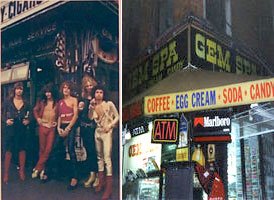
I'm told a nail salon now occupies the storefront. Glamourous, maybe. But I'd prefer a more "Dolls at Gem Spa" type of glam in this part of town.

Friday, July 01, 2005

Fill no mo'.

I think I'll hang around the East Village for a spell. And though I said I'd focus mainly on the not-too-obvious landmarks of NYC rock lore, something compels me to cover this one--with emphasis on its less familiar incarnation.

THE VILLAGE THEATER/FILLMORE EAST/THE SAINT--105 Second Avenue between 6th and 7th Streets. I haven't been able to nail down a precise history of the site's original embodiment as the Commodore Theater, but its page at cinematreasures.org comes mighty close. Apparently dating from 1926 and decorated in the Adamesque style, the Commodore was likely purpose-built as a combination legitimate theater and movie house. As befitting its Jewish Rialto address, it frequently hosted Yiddish productions. It was also occasionally used as a meeting hall for leftist groups in the '30s and '40s. At some undetermined point it was taken over by Loew's and live theater took a back seat to MGM films. At yet another undetermined point--presumably the early '60s--the Commodore became the Village Theater. [I've submitted a query to cinematreasures.org about the approximate dates for these transitions.]

Managed by Ben Barenholtz (who later operated the Elgin, a revival/art/midnight movie house at 175 Eighth Avenue--which is now the Joyce, a dance performance space), the Village Theater functioned as "a sort of bargain-basement counterculture Carnegie Hall," according to this article attributed to J. Hoberman. It must have still featured some Yiddish productions during this period; a 1966 photo of Timothy Leary standing outside the theater shows a "Yiddish-American Vaudeville and Films" sign hanging under the marquee. But many of its events were designed to appeal to the area's growing population of hepcats, hipsters, and hippies. A random sampling of notable performers follows:


Lenny Bruce--November 29-30, 1963, and March 27-28, 1964, days before his bust at the Cafe au Go Go. Another gig was planned for November 25-27 that year but it got cancelled.

John Coltrane and Ornette Coleman shared a bill during December, 1966.

Timothy Leary staged a series of lectures/"psychedelic celebrations" beginning in September, 1966. Jackie Cassen and Rudi Stern provided the light shows; Stern gives an account of his experiences here. Click here for a review of one of these events, "An Evening With God," held on May 13, 1967. And here's a photo of Leary, Allen Ginsberg and Ralph Metzer praying before a 10-foot plaster Buddha in preparation for another psych fest.

On page 221 of The Crawdaddy! Book (Milwaukee: Hal Leonard, 2002) there's a reprint of an ad for a concert by Chuck Berry "and his original band" on April 26, 1967.


Supposedly there was a "Cosmic Love-In" on May 3, 1967 or thereabouts, but I have no idea who played at it.

UPDATE 1/24/2013:  Here's a poster for the event, which was recently shared on the Fillmore East Facebook group by the ever-lusty Harold Black.  The New Yorker's website has an abstract for an article about it, as published in the May 13, 1967 issue.


Sally Eaton, a Hair cast member, remembers a fashion show she modeled in at the theater during May, 1967, in this 1970 Astrology Today article.

WOR-FM held its first anniversary concert there on June 11, 1967, with Janis Ian, the Blues Project, Richie Havens, the Chambers Brothers, Jeremy and the Satyrs, and the Doors, all emceed by WOR jocks like Rosko, Murray the K, and Scott Muni. The Doors played the theater again on September 9, 1967.

[UPDATE 6/1/2010: Richard Goldstein's "Pop Eye" column in the June 22, 1967 issue of the Village Voice features a review of this event. And a couple years ago, Tim at Stupefaction put up an image of the poster.]

The "Bread For Heads" Festival, a legal defense benefit for busted marijuana smokers, took place on June 28, 1967. Included on the bill were Allen Ginsberg, The Mothers of Invention, Tim Buckley, the Fugs, and in perhaps their only Manhattan appearance ever, the Left Banke. On the Leftbankism yahoogroup, Banke bassist Tom Finn recalled that this gig was probably set up by their stage pianist Emmett Lake, who by day worked as music editor for the East Village Other. Singer Steve Martin took issue with the retinal-searing projections of the Joshua Light Show, exhorting them to "turn those f---in' lights off, we're not a psychedelic band!" The Banke borrowed the Mothers' gear and left theirs in the van outside, only to find it all stolen afterwards.


UPDATE 7/20/2006: A while back a reader named Terry K. generously sent me a picture of an ad for another "Bread For Heads" gig. To the best of my psychedelic-blobby-lettering reading ability, this one took place on June 25, and included Timothy Leary, Allen Ginsburg, the Group Image, and the Northern Lights, among others.


The Who, July 8, 1967 with the Blues Project and Richie Havens, and November 25-26, 1967, again with Havens; the poster is available here. This guy offers some memories and a photo from one of those gigs (scroll down almost to the bottom of the page).

Vanilla Fudge played the Village Theater three times in '67. On July 22 they shared the bill with the Byrds and the Seeds--it could have been an extremely avian event had the Fudge not recently changed their name from the Pigeons. On September 2 they and the Illusion opened for Mitch Ryder, and on November 3 the Yardbirds were the openers (part of an apparent weeklong engagement for the 'birds, according to the Chromeoxide.com site--November 3-8).


Speaking of the Yardbirds, they had previously played the Village Theater on August 25, 1967, on a bill with the Youngbloods and Jake Holmes. Page and co. heard Holmes perform "Dazed and Confused" that night, which eventually "Led" to an act of "Page-iarism." (Holmes had also played the theater earlier that month on August 5, with Janis Ian, the Association, and Chrysalis.)

Cream, September 23 and 30, 1967. The 9/23 gig was shared with Moby Grape, who in turn headlined the place on November 11, 23 and; 24 later that year.

Blood, Sweat and Tears debuted at the Village Theater as openers for James Cotton--not sure of the date but I think it was in October, 1967.

Procol Harum, October 28, 1967.

The Grateful Dead, December 26-27, 1967.

Shortly afterwards came Bill Graham and the Fillmore East, about which so much has already been said that I'll mainly point you to other sources for more info:


  • Glatt, John. Rage and Roll: Bill Graham and the Selling of Rock (New York: Carol, 1993).
  • Graham, Bill and Robert Greenfield. Bill Graham Presents: My Life Inside Rock and Out (New York: Doubleday, 1992). There's also a 2004 edition by Da Capo Press.
  • Kostelanetz, Richard (text) and Raeanne Rubenstein (photos). The Fillmore East: Recollections of Rock Theater (New York: Schirmer, 1996).
  • Rothschild, Amalie R. and Ruth Ellen Gruber. Live at the Fillmore East: A Photographic Memoir (New York: Thunder's Mouth Press, 2000).
  • The Fillmore East Preservation Society (lots of info, including a comprehensive list of shows).
  • Wolfgang's Vault (all manner of memorabilia from the Fillmores West and East).
  • Fillmore East Concert Journals.
  • Fillmore East Show List

Still, I can't resist inserting some anecdotes from my library. Here's one from Joel Lobenthal's Radical Rags: Fashions of the Sixties (New York: Abbeville, 1990):

In the late '60s, the rock hall replaced the discotheque as as the prime area for innovative fashion display. "In fashion terms a Fillmore East opening night deserves as much coverage as the Philharmonic Galanosed Galas," claimed the Village Voice shortly after the rock auditorium opened in March 1968. "It's a scene-making pageant whether they're seeing Lenny at Lincoln Center or Jimi at the Fillmore." In 1968, Bill Graham...tied together the pageantry in the audience with the fireworks on stage when he organized a mini fashion happening during an interval in the evening's mixed bill. Unheralded, Barbara Mott, wife of designer Michael Mott, zoomed up the center aisle of the rock palace on an enormous Harley Davidson. Dressed in Mott's black leather bra top and miniskirt pegged with hobnail studs, she tore up a ramp to the stage and parked her vehicle to the accompaniment of a cannonade of cheers from the Fillmore's audience.

And from Perry and Glinert's Fodor's Rock and Roll Traveler USA (New York: Fodor's, 1996): Graham had to contend with the dynamics of a neighborhood even seamier than it is now. The Hells Angels, to whom an entrance fee was an alien concept, had their New York headquarters around the corner, while anarchic underground political groups like the Motherfuckers tried to use the place as a launching pad for changing the world. The MC5, who rolled into the Fillmore advertised as the "people's revolutionary band," had all their gear ripped off. Graham recalled the incident with an ironic chuckle in his autobiography: "The people's band had all their equipment stolen. By the other people, I guess." Other mishaps included Led Zeppelin bassist John Paul Jones being turned away from his own gig in May 1969 by a security-conscious steward--Jones threatened to bring gargantuan manager Peter Grant's wrath down on the guy's head--and the firebombing of a grocery store next door during a packed Who concert. As the blaze threatened to spread, an undercover cop in full hippie gear rushed onto the stage to try to clear the building; not aware that there was a fire or that the stage crasher was a cop, Pete Townshend knocked him off the stage with a well-aimed kick to the nads. Graham eventually got to the mike and organized a peaceful exit as the Who slunk out the side door. The next day Townshend and Roger Daltrey, who had also shown some tasty brawling skills, gave themselves up to the police. [Eventually] Graham--frustrated by bands who found they could make as much money by playing one night at Madison Square Garden as from several shows [at the Fillmore]--surprised the rock world by closing the Fillmore East on June 2, 1971, a few days before he also closed the Fillmore West. For the final show, the Allmans were back, accompanied by the J.Geils Band, the Beach Boys, and Albert King.

[An interesting factoid that I didn't know until I was researching the Electric Circus post--for a while the East Village Other had its offices in a loft at the Fillmore, provided gratis by Graham. This sweet deal didn't last forever, though. After the Circus was bombed, an EVO article implied that this act was in protest of the club's high admission fees, and further suggested that someone should do the same at the Fillmore East since its ticket prices were just as expensive. Graham promptly told the paper's editors to get the hell out of his building.]


[UPDATE 9/28/2007: A while back, Ben Barenholtz himself left a comment setting a few things straight--including the fact that it was he who had donated the office space to the EVO. Read it!]


Apparently there were sporadic attempts to keep the theater going as a live music venue called the Village East in the early '70s, but none were successful. The building was vacant for most of the decade, but on September 20, 1980, it was reopened as the Saint, owned by Bruce Mailman--perhaps thee most highly esteemed gay dance club of all time. Gone were the old theater's seats, stage, LSD, and freak-out rock; in their place were high-tech astronomical fantasy decor (check out these pics), poppers/coke/ecstasy, and throbbing '80s disco. From Brewster and Broughton's Last Night A D.J. Saved My Life (New York: Grove, 1999):

$4.2 million was spent in transforming what had been the revered rock venue the Fillmore East into a huge club, purpose-built for its newly liberated gay constituency. Within three weeks of its opening, 3,000 men had paid $250 to become members...The Saint was the most spectacular club anyone in New York had seen. You walked through a pair of gleaming stainless steel doors through to a massive area with bars, banquettes and cushioned chairs. Upstairs was the vast 5,000 square foot dancefloor, and above this the club's famous dome. Imagine a hemisphere seventy-six feet across made of aluminum and theatrical scrim. Lit from inside it appeared solid, but when illuminated from above it became formless clouds of psychedelic light. In the center of the dancefloor was a planetarium projector, and when the moment was right this would cast the image of the night sky onto the darkened dome.

It was the hottest dance club in town for a few years, and an important focal point for the gay community. From Terry Miller's Greenwich Village and How It Got That Way (New York: Crown, 1990):

As the AIDS epidemic began its relentless decimation...the Saint made its facilities available for benefits for organizations intent on providing help that the government would not offer. "The Saint reflected what was happening to the gay community," Mailman recalled. "Here's a group that had no established social consciousness, and it organized itself instantly to deal with a nightmare. Like that community, the Saint began with one purpose, but shifted to another. I thought it had to be done." Though large amounts of money were raised, attendance began to decline. In October 1985 the club opened to nonmembers, and about a year later to its first non-gay crowd. "In the end, we stopped because I was just burned out," Mailman commented," and there was no one else to do it." News of the Saint's impending closing [spread] like word of a death in the family...[At the final fifty-hour party] songwriter Paul Jabara came to say good-bye and to sing his hit tune, "Last Dance." Disco diva Thelma Houston came by as well to belt out her torchy hit, "Don't Leave Me This Way." But they did leave, and in the early morning of May 2, 1988, the Saint closed its doors. Within days, those doors were spray-painted with words of memory, words of hope for a dark night: "Hold on to my love--J. Ruffin."

Attempts were made to turn the Saint into a live venue but they never quite panned out (ISTR announcements for a Public Enemy show ca. late '89 or early '90 that was either cancelled or moved to another club, possibly the World). After it finally closed for good, the building stood dormant for several years. There was talk of turning it into a multiplex, and supposedly one local businessman-on-a-mission attempted to get funding to restore it as Fillmore-like auditorium--but neither scenario came to pass. The theater portion of the building was demolished in the mid-'90s; in its place now stands the Hudson East, a luxury rental apartment building with a plaque near its 225 E. 6th St. entrance explaining what had previously been there. The lobby section and its facade still exist, however, and currently house a branch of the Emigrant Savings Bank. There's supposed to be a display of Fillmore East memorabilia inside the bank, including photos by "unofficial house photographer" Amalie Rothschild--I'll have to scope it out on my next visit this coming August.


UPDATE 5/6/2010: A couple months ago EV Grieve did a nice post on the Loew's Commodore, including pics of the tribute collages that now hang in the Emigrant Bank branch. There is a Fillmore East Archives group on facebook. And here are some Village Theater ads recently unearthed by a long-time Internet pal of mine, the eagle-eyed Rob B.


UPDATE 5/23/2010: Why I failed to learn about or mention the important role that Gary Kurfirst played in all of this until just now is a mystery for the ages. And oh my, were there actually Wilson Pickett and Carla Thomas/Otis Redding shows here, and when did they happen?

UPDATE 5/31/2010: I've found a few items pertaining to the Village Theater in the Billboard Google archives.
  • From the November 5, 1965 issue: "Donovan will make his first concert appearance in the U.S. on November 19 at the Village Theater. Harold Leventhal is presenting."
  • The March 17, 1967 issue has a review for a concert with the Ornette Coleman Trio and the Philadelphia Woodwind Quintet.
  • From the May 20, 1967 issue: "The Herbie Mann Orchestra will do excerpts from its Atlantic album, 'Impressions of the Middle East,' at the Village Theater on June 3."
  • From the June 10, 1967 issue: "[The Doors] will perform at a June 11 concert at the Village Theater with Janis Ian and will work the Scene for three weeks following the concert."
  • From the September 16, 1967 issue: "The Glories played the Village Theater on Wednesday (6), with the Vibrations and Sam the Sham and the Pharoahs."
  • From the October 7, 1967 issue: "Lastest showcase for pop talent will be the Village Theater. Starting October 11, and continuing each Wednesday evening, the theater will hold a 'Weekly Freakly,' featuring local Lower East Side talent and some top recording acts. Admission charge will be $1. The acts will not be announced in advance.
  • From the November 13, 1967 issue: "Chuck Berry will make his New York concert debut Nov. 24 at the Village Theater." The following week's issue clarified that this wasn't his debut in the area, but rather his first full-length concert in town. This makes me wonder if I've got the correct date for the Berry concert mentioned above, even with the existence of that ad.
  • From the November 25, 1967 issue: "Buck Owens is not a hippie, though obviously some hippies are country music fans, but he is a trouper and he performed a quality show November 12 at the Village Theater, a site that has been featuring rock acts on a weekly basis. It was undoubtedly an experience for both entertainer and the entertained, as well as an experiment by the promoters to see how well country would go in the Village. It didn't go all that well; only 800 showed up...also on the show included Bobby Austin, Wynn Stewart and Tommy Collins."
  • The January 27, 1968 issue has an ad for the lightshow services of Pablo, who listed "rock shows at the Village Theater" among his credits.
  • From the February 10, 1968 issue: "Pearls Before Swine, ESP-DISK recording artists, play the Village Theater Feb. 23 and 24."
  • The April 6, 1968 issue has an ad for Herbie Mann's "The Wailing Dervishes" album, recorded live at the Village Theater, presumably at the June 3, 1967 show.]
[UPDATE 5/31/2010: More on that June 3, 1967 Herbie Mann show...according to an ad and a mention in the "Scenes" column of the April 27, 1967 issue of the Village Voice, "A schmaltzy Arabian bazaar will be set up in the big lobby to lend desert sights and sounds. Halvah, Turkish coffee, incense, dates, and a belly dancer will further atomize the sand-dune scene."]

[UPDATE 6/4/2010: I posted a whole bunch of '67 Village Theater ads here.]

[UPDATE 6/25/2010: Here are some 1969 Fillmore East ads.]

[UPDATE 12/19/2010: I revisited cinematreasures.org's page on Loew's Commodore today, and found that much more information has been added since I was last there.  Of particular note: lots of gaps are filled in about the dates when the building's various transitions occurred; some light is shed on the "New Fillmore East" and "Village East" phases in the early '70s; and several brave urban explorers discuss the times they ventured into the building during its pre- and post-Saint periods of abandonment.  Also, here are some late '60s and early '70s Fillmore East ads from the Village Voice.


UPDATE 11/14/2011: Please see the improved and revised 1967 Village Theater ads post here.

UPDATE 3/16/2012:  Please see the improved and revised 1969 Fillmore East ads post here.


UPDATE 1/24/2013:  It sat on my "to read" pile for over a year but I finally got around to Ed Sander's fantastic Fug You (New York: Da Capo, 2011).  He mentions playing at the Bread for Heads benefit on June 28, 1967, and included a small reproduction of the poster.  I found a photo of the ad not too long ago on eBay, taken from the July 1-15, 1967 issue of the East Village Other.


A few pages later, Sanders wrote about another event which I hadn't heard about before: "The Community Breast concert at the Village Theater on Second Avenue on August 16 raised $1,000 for a Lower East Side version of the Digger's San Francisco Free Store.  The Fugs performed, as did Tiny Tim, Judy Collins, Ritchie Havens, Paul Krassner, Hugh Romney (soon to become Wavy Gravy), and Timothy Leary's sitarist, Peter Walker."  Again, a small repro of the poster is included in the book, but here's a photo of it from the Oakland Museum's website.


UPDATE 11/27/2014:  Always required reading around these parts no matter what the topic, Binky Philips' most recent Huffington Post piece (published 11/14/2014) was on the Who's first appearance at the Village Theater. And on October 29, 2014, the Greenwich Village Society for Historic Preservation dedicated a plaque on the former Fillmore East facade. Coverage of this event is available at the Villager, Bedford + Bowery, and EV Grieve, and here is the full video of the ceremony.


UPDATE 12/8/2014:  Marky Ramone has a book coming out next month. As part of the advance publicity, Bedford + Bowery did a cool post on his favorite East Village clubs and venues of yore, including the Fillmore East. There's also a new book called Live at the Fillmore East and West by John Glatt; check out this NY Post article on it. And enjoy this Bowery Boogie post on the F.E. from 2012 which I somehow missed until now.

UPDATE 3/29/2015: Here's another piece from a couple of years ago that I'm only seeing now (courtesy of a post at the Fillmore East Archives FB group). In it, Daytonian in Manhattan delves into the early history of 105 Second Avenue.