In a feeble attempt to combat my constant homesickness, I compile tales of New York City rock & roll landmarks, most of 'em long gone. Moronic musings on various other enthusiasms are also thrown in for good measure.
Selected Voice ads for Steve Paul's the Scene, July through December, 1967. (Some issues were missing from the archive, and sometimes ads weren't printed every single week--that and possible eye failure on my part account for any ads missing here!)
7/13/67 issue
Monti Rock III and The Triangle (thru July 16)
Beacon Street Union (thru July 23)
The Mandala (July 18)
Keith (July 20)
Scene East: Clear Light (thru July 23)
7/20/67 issue
Monti Rock III with the Triangle and Clear Light (thru July 30)
Keith (July 20)
The Rich Kids (July 25-30)
Scene East: Beacon St. Union (thru July 30)
8/17/67 issue
Monti Rock III (thru 8/27) with the Triangle and Splendor's Castle
The Candy Men (9/6/to 10/8)
Digger's Benefit, August 27 and every Sunday thereafter. "One dollar donation. No admission. No uptightness. From 8 p.m. on--many famous and unfamous groups--all having creative significance--will appear for you."
Scene East: The Triangle. "Coming in September, Scene East goes strictly 'soul' and will feature the finest R&B and soul groups that can be found."
8/24/67 issue
Monti Rock III (thru 9/3) with the Triangle and the British Modbeats
The Candy Men (9/6-10/8)
Digger's Benefit
Scene East: The Triangle
8/31/67 issue
Monti Rock III (thru 9/3) with the Triangle, Scott Fagan & His Incredible Group, and the James Gang
The Candy Men (9/6 to 10/8)
Bobby Comstock & the Counts (10/4)
Scene East: The Triangle
I imagine Steve Paul himself wrote the ad copy, which started getting very wordy and effusive for a few weeks here. I hope you can read it, 'cause while I haven't got it in me to type it all out, it's pretty darn amusing.
8/31/67 issue
Ad for The Steve Paul Scene TV show on WNEW Metromedia Channel 5. This was very hard to read even on the site, but I could make out the Blues Project, the Chambers Brothers, Aretha Franklin, Janis Ian, Moby Grape, the Staples Singers, and the Young Rascals. Looked like the broadcast date was Monday, September 4. from 8 to 10 p.m. I watched it once at the Museum of Television, but it has probably been bootlegged on DVD as well since then. (Incidentally, I also spotted an ad for a WOR-TV Channel 9 show called "From the Bitter End" in the 12/28/67 issue.)
9/7/67 issue
Bobby Comstock and the Candy Men, as above.
Van Morrison (9/11-18)
9/14/67 issue
Van Morrison dates changed slightly (9/13-18)
9/21/67 issue
The Candy Men
Ray Whitley (starting 9/25 for one week only)
No more mentions of Scene East from now on, so I gather it was a short-lived venture.
9/28/67 issue
More Candy Men media blitz
The Free Spirits (thru Oct. 1)
The Mandala (9/27)
10/19/67
Carnival Connection and David Clayton-Thomas & the Phoenix (thru 10/22)
"Double Louble Bill": Nico and Kaleidoscope, 10/23-29
Announcements for upcoming Blood, Sweat & Tears debut (the pre-Clayton-Thomas lineup), and "The Greasy Spoon," which sounds like the Scene's version of the V.I.P. room.
10/26/67 issue (slightly larger version appeared the previous week.)
10/26/67 issue
Nico and Kaleidoscope (now thru 10/28, instead of 10/29)
The McCoys and the Tropics (10/30 to 11/5)
11/9/67 issue--this one should be easy to read.
11/16/67 issue
Thanksgiving Jam (11/19-26), same names listed in previous ad.
11/23/67 issue
Thanksgiving Jam, but John-John McDuffy and the Soul Purpose replace Sam Laye & the Mojo Men as listed in the previous ad.
12/21/67 issue--again, should be quite legible.
12/21/67 issue
The Critters and the Dickens, Dec. 18-24
12/28/67 issue
Holiday Blues Festival, 12/28 thru New Year's Eve: Influence, Bruce Scott with the Head Set, BST (12/29-31)
Further reading: Richard Goldstein's "Pop Eye" column in the 1/19/67 issue is a great profile on Steve Paul.
UPDATE 3/15/2012: Please see the revised and improved post on 1967 Scene ads here.
Selected Voice ads for Steve Paul's the Scene, January through June, 1967. Issue dates and other pertinent info (when hard to read in the ads themselves) are in the captions.
1/5 and 1/12/67 issues. Text is much clearer in the poster above, via.
1/19, 1/25, and 2/2/67 issues
The Blues Project (January 21-February 4)
Tim Hardin with an electric group (February 6-March 4)
Also "the incredible Tiny Tim, Skipper's Scary Karate Show, Me, whatever."
2/9 and 2/16/67 issues
Tim Hardin, Jeremy Steig, February 6-March 4.
2/23/67 issue
The Youngbloods and the Free Spirits, "thru March 4."
3/9/67 issue
The Mandala (March 6 through April 7)
The Young Rascals (March 14 I think)
Eric Andersen (March 20-April 1).
3/16/67 issue (also repeated 3/23 and 3/30)
4/20/67 issue
The Siegel-Schwall Blues Band (thru April 22)
The Chambers Brothers (May 5-May 11)
Keith (May 3)
Tommy James & the Shondells (April 23)
The Mandala (April 25-May 4)
Tiny Tim and jam sessions nightly.
4/27/67 issue: The Mandala, the Chambers Brothers, Keith, as above.
5/4/67 issue: The Chambers Brothers (May 5-11)
5/10/67 issue: Diana Brooks & the Soul Searchers and Three's a Crowd, opening May 15.
5/18/67 issue
Dianne Brooks & Eric Mercury & the Soul Searchers, Three's a Crowd (May 17-21)
The Chambers Brothers ("Back by popular demand, good taste and common sense," May 22-June 3)
Tiny Tim (365 nights a year)
The Doors (opening June 12)
"Coming Soon: Scene East in Delmonico Hotel, Park Ave. & 59th Street."
5/25/67 issue, should be pretty readable.
6/8/67 issue
The Jon Lee Group ("Direct from Canada," thru June 11)
The Mandala (June 7)
Laura Nyro (June 7)
Moby Grape (June 8-10)
The Doors (June 12-July 2)
"Now open in Delmonico Hotel, Park Ave & 59th Street, SCENE EAST. Serenity of Park Avenue. Uninhibited dancing to the livest groups. Tiny Tim here, too. Eclectic Ambiance of Rudi Stern & Jackie Cassen. Photographic exhibit of Dylan by Dan Kramer. No Admission, No cover."
6/15/67 issue:
The Doors (thru July 2, except for June 16-18 when they played the Action House).
"Appearing with the Doors nightly for a completely flipped out evening: The Free Spirits and Dianne Brooks/Eric Mercury with the Soul Searchers."
The Seeds, July 3-16, "Direct from L.A., First time in N.Y."
Moby Grape, "returning after the Seeds."
6/22/67 issue. Doors/Free Spirits/Soul Searchers as above
The Seeds (July 3-July 16)
Moby Grape, returning after the Seeds
The Mandala (July 18)
Keith (July 30--he must have not done the May date advertised above, for this is being called his "N.Y. debut.")
At Scene East, "Coming July 4 thru July 9, Direct from S. Francisco, NY Debut: Peanut Butter Conspiracy."
6/29/67 issue
Doors & Seeds as above, but no mention of Moby Grape.
The Jimi Hendrix Experience (July 3-4, "Direct from England, New York Debut."
Keith (July 30)
At Scene East, "Direct from California, N.Y. debut of an unusually exciting & creatively significant new group, the Clear Light." No dates given.
Yes, here's yet another update to an old post! I was recently contacted by one LHM, who got a kick out of my Murray the K show essay, and generously offered some memories of his own along with a couple of choice pics from the "Music in the Fifth Dimension" Easter '67 show.
I count myself VERY LUCKY to say that I witnesed the American debut of THE WHO at the Murray the K Easter Show at the RKO 58th Street Theatre. On Monday, March 27, 1967 I was 14 years old and in the 9th grade. My friend Dan S. and I were on line by 6:30 AM to get the best seats, but we wound up in the 5th or 6th row. Still, it was a great place to be to see history in the making.
Quite frankly, most of the acts I saw that day are a blur to me now, except for the short but riveting performance(s) by the Who. There was something so raw, cool and aggressive about them and their sound that they stood out miles ahead of the other performers. The Who had "IT" and for a 14 year old, the Who was the epitome of Rock and Roll. Pete's windmills and guitar smashed-ups were astounding and I remember to this day the pungent smell of smoke when they finished their sets that day -- yes, I could smell the smoke bombs from the 5th row!
Attached is a photo I took of the Who at this show, I regret that I only took one picture. The other attachment is a full page ad that appearead in the New York Daily News on Sunday, March 26. 1967.
The live shot reminds me of a set of '60s Who pics I saw a while back, taken at the Indiana Beach club in Monticello, Indiana. Which in turn remind me of all the shots I try to take at shows but inevitably wind up with better views of backs-of-heads than band action...except instead of some garage punk unknowns, it's the bleedin' 'Oo up there in between all the heads! (Make sure to check out the incredible and back-of-head-free '66 Yardbirds pics on the next page of the same site.)
As it happens, late last year while looking for more info on Murray I found this wonderful blog post on the '67 Easter show. It's part of a growing and graphically-rich site called Talkin' About My Generation, which features the first-person rock & roll reminiscences of one David Gross. Required reading!
And since we're on the subject of Brit Invaders, I should share a tidbit I was ignorant of until a few days ago. Seems that as part of the promotion for their flick Catch Us If You Can (a.k.a. Havin' a Wild Weekend), the Dave Clark 5 made appearances at the Richmond HillRKOKeith's, and possibly the Flushing RKO Keith's as well!!! I can't quite tell from the comments I've seen whether these were actual concerts or just personal appearances, but I'm pleased as punch the DC5 touched base in my home borough either way.
Speaking of Brits in Queens, I might as well throw this query out there and see if anyone bites as I've been darn curious for a while. According to the Hollies' '60s tour schedule, they played a location in Flushing on December 8, 1967. I'm thinking it was Queens College as they toured through quite a few U.S. colleges around that time, but does anyone know for sure?
Other updates: Steve Paul's the Scene has its very own Facebook page, and it's been active for about a year now--how come I only found out about it today? Also, it looks as though that "Tent of Tomorrow" the New York Pavilion may see some tomorrows after all.
I've been chancing upon references to this club lately--in a recent Warhol book, and on a Classic Albums documentary about the making of Electric Ladyland--so clearly the universe was telling me it was time to explore:
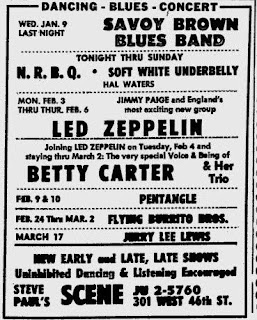
STEVE PAUL'S SCENE, 301 W. 46th Street. Technically it's Steve Paul's The Scene, but that's a tad awkward, no? At any rate, the Scene was among the most "in-crowd" of happening hotspots in late-'60s Manhattan. Major rock stars of the day not only performed there, they relished hanging out there, and these hang-outs frequently evolved into all-night jam sessions. As Lenny Kaye wrote in The History of Rock (1983), "Steve Paul's The Scene provided a watering hole for the late-night superstar, giving over its small, stamp-sized stage to after-hours jams and visiting dignitaries, the coming of age of all that would be known as Sixties rock." In the aforementioned Classic Albums doc, the Scene's maitre d', Jim Marron, describes the space as being "like a Paris disco, in that it was a cave-style. It had three rooms that focused in, like, a cross on the stage, and as a subterranean basement, it had the sort of Paris-cave-disco style to it."
I wish I could find out more about Steve Paul. As for what I do know...seems he first made a name for himself by working as the Peppermint Lounge's publicist during its twisitin' heyday, and later formed a management company, Blue Sky, which had the likes of Johnny Winter, Rick Derringer, and David Johansen on its roster. According to a groovy self-penned article in the May 1967 issue of Hullabaloo magazine, his ambitions for the impresario field were formed via frequent childhood viewings of the Late, Late Show:
The owners of nightclubs in ['30s and '40s] movies had loads of people to keep 'em company. Huge sofas and many phones in massive modern offices. Rising stages. Hidden safes loaded with cash. Beautiful girls in abundance. Bodyguard chums and not a blanket in sight. Doctors and do-gooders and firemen and free-thinkers had to go to bed at night. Nightclub owners didn't. Someday I'd grow up and own me a nightclub...I'd create me a world of reality within the world of reality. Make your dreams come true. It can happen to you. It would be called The Scene. Big S(cene) in name. Little s(cene) in reality (within reality). A place where together people could get together. I'd own it. But so would you. I'd work there. But so would you. I'd play there. But so would you. We'd all give what we could. For the scene's common good.
From what I can gather, the club initially opened in '65 to great fanfare. In the article, Paul writes of the Lovin' Spoonful, the Young Rascals, and Sammy Davis, Jr. gracing the stage. In Popism: The Warhol '60s (New York: Harper & Row, 1983), Warhol writes of a Scene party attended by himself and Edie Sedgwick; other guests included Liza Minnelli and Peter Allen, Baby Jane Holzer, "and Marion Javits and Huntington Hartford and Wendy Vanderbilt and Christina Paolozzi, who was the first model to appear nude in Harper's Bazaar," among other breathlessly dropped names. There's a pic of Edie meeting Mick Jagger at the Scene in Edie: An American Biography (New York: Knopf, 1982), and David McCabe's A Year in the Life of Andy Warhol (London: Phaidon 2003) has some fab shots of Warhol stars cavorting there while watching the Executives, a band made up of 12-year-olds in business suits. After about a year, though, the place got stale:
I know The Scene was great for a while. Because it was real. And because of that it began to stink. Even our scene stinks every now and then. Some of the kids who started coming were only chronological kids. The spontaneous entertainment tonight was yesterday's spontaneity. Being busy became bad. Instead of good. The publicity started stopping. We got what we deserved. We started sinking. And sunk...We owed $90,000. We weren't even doing business on Saturdays. You know where that's at. Real nowhere is the address.
The Scene closed up shop temporarily, but with some help (financial and otherwise--Paul specifically credits Peter Yarrow, Allen Ginsberg and Tiger Morse) it was able to successfully reopen. Legend has it that members of the JuniorMafia regularly came 'round to collect protection money; a certain Sopranos cast member (rest assured it's NOT Li'l Steven) is said to have been among the shakedowners. But such unsavory aspects didn't seem to stop the celebs and heads from packing the place. Chief among the rock gods in residence was Jimi Hendrix. As David Henderson writes in his fabulously florid 'Scuse Me While I Kiss The Sky (New York: Doubleday, 1978):
Jimi soon found the Scene Club irresistible...Fans did not hassle you there. It was dark and intimate, almost labyrinthine, yet you could go there and party, or play and just sit alone and drink, and no-one restrained you either way. And most important of all was that he could play there. He could play any time he wanted to. He could woodshed right in the middle of New York City. The Scene Club was like a miniforum model for every arena he would ever play. The shouting stark frenzy of the close room is what he brought with him to every stage around the world. It was always the small intimate room he was really playing to. The thousand and one nights of playing long into the Scene Club's night. When the chairs would finally be upside down upon the tiny tables. When Steve Paul himself would finally have to pull the plug, while Jimi alone in his universe would be totally unaware of the hour or of the devotees and workers who patiently waited within the exhilaration of his sound. At the Scene, Jimi would completely let himself go--playing all he knew and didn't know, going beyond sharing--playing all. Trying to get it all out.
Henderson describes the layout of the club as follows:
Out front, a big lighted entrance; inside are narrow rectangular panels leading up to a dim box office. You sweep past into a zigzag-shaped mazelike room with tiny tables and tiny-backed chairs. But up on the tiny stage, two feet off the floor, the music happens as it happens in all major cities of the Western world.
He goes on with a delightful account of a night Hendrix spent there with supergroupie Devon by his side--but you'll have to seek out the book to read it. [Speaking of groupies, parts of the 1970 doc Groupies were shot in and around the Scene.] Jimi's wee-hours jam sessions with various mega-musicians not only made their way into legend--some of 'em germinated into tracks on Electric Ladyland, recorded at the nearby Record Plant at 321 W. 44th Street. Hendrix also took part in a benefit concert for Biafran relief at the club--here's a pic of him and Joan Baez hanging out backstage between sets. Hendrix and Paul must have forged a strong friendship over those late Scene nights, for upon Jimi's death his management specially flew Paul in to attend the Seattle funeral.
Before moving to London and snagging a certain Beatle, Linda Eastman honed her photography skills while regularly making the Scene. Her friend Michael Weber provides an atmospheric account of the club and her picture-taking techniques, which I'll excerpt here (but do check out his site for more):
We met at The Scene in the heart of Hell's Kitchen, the most happening music joint in New York City. Linda was rumored to be the heiress to the Eastman Kodak fortune, a myth perpetrated by the fact she often sat with The Scene's resident millionaire, Deering Howe, as in John Deere tractors. Here was this perfectly clad debutante schlepping two Nikons around her neck while everyone else was tripping-out in their caftans. To say Linda stuck out like a sore thumb would be putting it mildly, but she was no heiress. The Scene was the place the top groups got together to jam when performing at New York's bigger venues. Getting past owner Steve Paul at the door was no mean feat, if you got past Teddy first, his sharkskin-suited maitre ‘d, up on the sidewalk. Paul was a brash 21-year-old kid, and if he did ordain your entrance to his club it was not before he unceremoniously put you down. That was his cover charge, a patented one line insult. Rarely, if ever, did he charge his regulars admission. I can't remember Steve ever insulting Linda, though. Her passion was photographing musicians and his was giving them a home. Linda and Steve were simpatico. Tiny Tim always warmed up the house, strumming camp show tunes on his little ukulele while singing along in that nasal falsetto he made famous years later on the Johnny Carson Show. When Tiny decided to finish, it could be one song it could be seven, the Super Groups would get up and jam. That's when Linda sprang to action. She worked seamlessly, blending in with the act. No matter who they were, how famous or infamous, Linda got in their face. That's how she got her portfolio together. For a while Linda was as much a fixture at The Scene as Tiny Tim. That's really saying something.
TheDoors played a number of Scene dates in June, July, and October of 1967. Doors researcher Greg Shaw--again, not the Greg Shaw of Bomp fame--presents another evocative account of the club, which appears to come from another Hullabaloo article (please click the link for Doors-specific details):
Steve Paul's The Scene is a popular midtown nightclub at 46th St. and 8th Ave. It sports a labyrinth floor plan which extends through a bizarre network of brick walled cellar rooms and passageways. While the club caters primarily to the jet-set, it also attracts a growing number of the hippie community. Steve Paul once described the purpose of his club in this way: 'To use music as a common denominator for the fusion between music, musicians, people who like music, and people who are music in their very being.' Steve Paul, who had an uncanny eye for spotting new stars, would often feature new talent at his club long before word of them had gone out. Among the wide variety of performers featured at The Scene are the Velvet Underground, Pink Floyd, Jeff Beck, Traffic, the Rascals, Fleetwood Mac and The Chambers Brothers.
The May, 1967 issue of Crawdaddy! printed this tasty little item:
Steve Paul is producing a series of two-hour color TV specials on pop music and people and the interaction between them; the show will be seen on Channel 5 in New York and certain other Metromedia stations across the country. Steve's club, the Scene, has recently been the late-night home of some very nice New York jam sessions, particularly while the Cream, the Chicago Loop, and Wilson Pickett's band were working nearby in Murray the K's Easter show at the RKO 58th. [From The Crawdaddy! Book (Milwaukee: Hal Leonard, 2002).]
As far as I know, only one of these specials, entitled The Steve Paul Scene, made it to air, featuring the Blues Project, Moby Grape, and the Staples Singers--it's a tripped-out artifact of a bygone era, available for viewing at the Museum of Television and Radio.
And as for the Scene, it closed sometime in 1969. Steve Paul himself had prophesied its demise in the Hullabaloo article. "This time we'll try and make it last. But it won't. Nothing great lasts all the time. Just some of the time and always meaning to the rest. NIGHTCLUB (A definition): A childhood dream come untrue, a reality sinking up instead of down, a Scene, a scene."
[EDIT 11/20/2009: You can see footage of the entrance and interior of the Scene in this excerpt from Groupies.]
[EDIT 3/11/2010: Another one from my "Yes, I DO live under a rock" file...despite being on Facebook for a number of years now, I only just dicovered today there is a Facebook fan page for the Scene! I guess I should start searching for other ancient NYC club pages, stat.]
[UPDATE 5/6/2010: Here are a few Scene ads recently unearthed by a long-time Internet pal of mine, the eagle-eyed Rob B.]
[UPDATE 5/7/2010: Evidently the Motions also played there around June of 1969, with Davy Jones and Micky Dolenz in attendance! Theseclipshave been on youtube since 2006 but I only just discovered them today.]
[UPDATE 5/12/2010: Found an article about Steve Paul and the club in the July 19, 1967 issue of the Village Voice.]
[UPDATE 5/26/2010: NYCDreamin' of This Ain't the Summer of Love posted a cool Scene "win a free record" ad a while back.]
[UPDATE 5/31/2010: Scanned from Clinton Heylin's All Yesterday's Parties: The Velvet Underground in Print, 1966-1971 (NY: Da Capo Press, 2005).]
[UPDATE 6/7/2010: I posted a whole mess of 1967 Scene ads here and here.]
[UPDATE 5/15/2012: Revised and improved posts on 1967 and 1969 Scene ads.]
UPDATE 5/8/2013: Jeremiah's VNY reports that 301 W. 46th Street is slated for demolition. Also, learn a bit about the Scene's predecessor, the Cave of the Fallen Angels, at Gotham Lost & Found.