Further pieces of the Hotel Diplomat puzzle were found in a cheapo book I picked up recently at the Strand--Times Square and 42nd Street in Vintage Postcards, by Randall Gabrielan (Charleston, S.C.: Arcadia, 2000). Beside a ca. 1911 postcard of the building is the following caption:
New York Lodge No. 1 of the Benevolent and Protective Order of Elks opened its 43rd Street clubhouse in 1911, a time when fraternal organizations were enjoying rising membership and growing financial capabilities. The architect of this 14-story, Neo-Classical structure was James Riley Gordon, who had earlier designed the Elks' Bronx lodge. The facility, with 240 rooms and a main ballroom with a 32-foot-high ceiling, was, in effect, a city hotel for visiting Elks. The Depression hit fraternal organizations hard. Their business diminished while they retained major operating expenses, the likely cause for its 1932 opening to public guests and a 1934 foreclosure. The place was later a modest-priced hotel, first the Delano, then the Diplomat, and in time, a single-room occupancy hotel for long-term residents. The hotel was acquired by real estate interests and demolished c. 1990 for inclusion in a prime development assemblage.
The Diplomat also gets a brief mention in another recent read--James Traub's The Devil's Playground: A Century of Pleasure and Profit in Times Square (New York: Random House, 2004). Anita Durst, a theater artist and member of the Durst real estate family, once put on a play there:
Like many shy people, Anita fell in love with acting. Unlike most of the others, she had a father who owned Broadway theaters...He [Douglas Durst] allowed her to use the semi-defunct Diplomat Hotel, on West 43rd Street, for a play called The Law of Remains, in which, Anita says, "Andy Warhol and Jeffrey Dahmer meet in Heaven." They play was apparently based on The Egyptian Book of the Dead. The hotel had a series of splendid, haunted-looking ballrooms. "The big ballroom was Heaven," Anita says, "and God was a Puerto Rican drag queen with an erection."
Her grandfather Seymour was a passionately voracious collector of books about New York City. Upon his death his collection was bequeathed to the CUNY Graduate Center to form their Seymour B. Durst Old York Library. Would that I were a CUNY student again and could peruse those riches.
The Devil's Playground also offers some further info on the International Casino, precursor to Bond's:
The International Casino was the last word in refinement, luxe, and swank. Here is how a reporter described the opening, in September 1937: "Hollywood on Broadway...a glittering gallimaufry of chromium and glass, crystal fountains, sliding doors, revolving stages, staircases which descend from heaven (when they work), a stainless steel escalator and a three story spiral bar, where you can drink your way up and fall your way down, or vice versa, as befits your mood." Life magazine did one of its "Life Goes to a Party" series about the International soon after it opened, and the author noted, with what seems admirable candor for a family magazine, that "most people go to the International Casino to see a hundred odd youngish girls in various states of undress." The article's opening photo spread shows a glistening chrome escalator with a tuxedoed headwaiter standing at the top, and then half a dozen beauties in two-piece bathing suits balancing spinning plates on long rods. Inside, Life offered pictures of bathing beauties descending from the ceiling in an elaborate trapezelike contraption and another riding bareback on a revolving stuffed horse.
The book also contains an extremely poignant chapter on the last Howard Johnson's, entitled "A la Recherche des Fried Clams Perdus," which I'd urge all clam-diggers to read.
Lastly for today...is this the work of thee Steve Paul?
Showing posts with label Times Square. Show all posts
Showing posts with label Times Square. Show all posts
Thursday, March 09, 2006


Thursday, November 17, 2005
Rockin' the Para--uh, mount, toniiiiiite!
I can trace my fondness for old theaters back to two habits of my misspent youth--special-treat Saturday matinees at the RKO Keith's in Flushing (whose building may be finally redeveloped as condos after two decades of vacancy and decay), and frequent pre-teen contemplation of the poignant gatefold cover of Styx's Paradise Theater (sorry, couldn't find a photo showing both the "1928 Gala Premiere" front and the "1958 slated-for-demolition" back). I oughta be ashamed of the sheer cheesiness of the latter, but I'm not--and though I haven't listened to the record in eons, I still find the cover entrancing. Evidently I'm not alone, either. Let's stick together and futurize our attitudes!
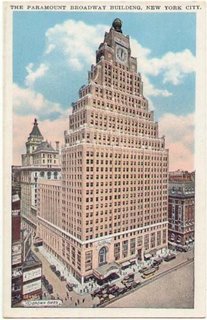
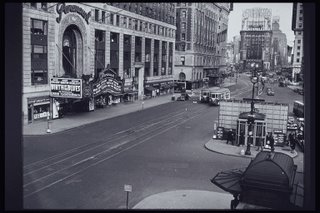

(NEW YORK) PARAMOUNT THEATRE--in the Paramount Building, 1501 Broadway between 43rd and 44th Streets. There's no need for one of my usual redundant recaps on the Paramount Theatre's history--cinematreasures.org's Paramount Theatre page contains a surfeit of lore galore, plus further links to photos and movie screening ads. Can't resist poaching a few pertinent quotes, though:
The Paramount was the first great movie palace in New York City that was built in the "Chicago-style" pioneered by the architectural firm of Rapp & Rapp. When first opened in 1926, its extravagant French Renaissance interiors were a radical change from the restrained Adam and Empire styles that New Yorkers had become accustomed to at the Paramount's main rivals, the Strand, Capitol, and Loew's State (all designed by Thomas Lamb). The Paramount became one of the city's top tourist attractions, but not for long due to the 1927 opening of the Roxy, which was almost twice as large and even more spectacular...For a theatre of its size (3,664 seats), the Paramount was one of the narrowest ever built because the auditorium had to be squeezed between two adjacent buildings--the Paramount office tower, which faced Broadway, and the headquarters of The New York Times (229 West 43rd Street). Consequently, the Paramount Theatre's entrance and a short lobby were carved out of the Paramount Building. After you passed through that short lobby, the actual theatre building began with the Grand Lobby, where you found yourself at the rear of the auditorium, which ran parallel to Broadway with the stage wall backing on West 44th Street. The main floor had only four sections of seats. Above that was a separate and recessed mezzanine with boxed seats. And one level above the mezzanine was the steeped balcony, divided into five sections of seats across and four from front to back. Due to the narrowness of the auditorium, the Paramount also had a narrow stage opening that proved a problem throughout the theatre's lifetime. Stage productions had to use the orchestra lift as part of the show or erect small platforms next to the pit. When the wide screen era arrived, some of the procscenium had to be removed to accommodate it...
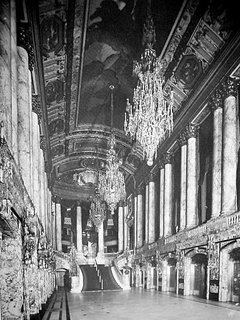
The lobby was modeled after the Paris Opera House with white marble columns, balustrades and an opening arms grand staircase. Inside, drapes were red velvet, the rugs were a similar red. The theater also had a grand organ, and an orchestra pit that rose up to the stage level. The ceilings were fresco and gilt. The railings were brass, and the seats plush. There were Greek statues and busts in wall niches. The rest rooms and waiting rooms were as grand as any cathedral. In the main lobby there was an enormous crystal chandelier.


[Side note: these pages on early Times Square signage mention the previous structure on this site, the Putnam Building--named in honor of General Israel "whites of their eyes" Putnam. Supposedly he and George Washington met at this spot during the Revolutionary War.]
Famed as much for its stage shows as for its films and sumptuous decor, the Paramount boasted a long list of legendary performers, including Mary Pickford, Bing Crosby, Benny Goodman (with Gene Krupa on skins), Cab Calloway, Woody Herman, Duke Ellington, Artie Shaw, Tommy Dorsey, Jimmy Dorsey, Count Basie, Ella Fitzgerald, Nat King Cole, Perry Como, Eddie Fisher, Erskine Hawkins, the Treniers, Martin and Lewis (and apparently Jerry had worked as a Paramount usher in the early '40s), Peggy Lee, Tony Bennett, Vic Damone, Joey Bishop, Les Paul and Mary Ford, the Mills Brothers, Louis Prima and Keely Smith, Imogene Coca, and Jackie Gleason with his "Honeymooners" cohorts, among many others. Fine as these folks were, none of them caused quite as much of a stir as Frank Sinatra, who played several multi-date engagements to hordes of screaming, swooning, street-blocking bobby-soxers in the early '40s.
Alas, the theater's rock & roll connections concern us most here. Such events were few and far between, but fun.
Elvis never made an appearance, but his 40-foot-tall, guitar-slung likeness was mounted above the marquee for the November 15, 1956 premiere of Love Me Tender.

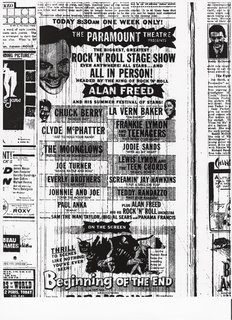
Although Alan Freed's association with the Brooklyn Paramount is more well-known, he did put on a few of his extravaganzas at the Manhattan location. Some researchers confuse the two venues, which has made ascertaining the correct dates a bit difficult.
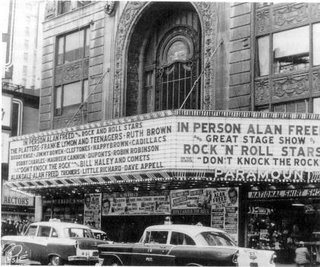
Here's a pic of the statuary management put in storage before these bookings in an effort to prevent rowdy teens from toppling them. And here's a pic of said delinquents dancing in the aisles and on seats. Be sure to consult the archives section of alanfreed.com--especially the "newspaper articles" link, loaded with vintage scans about these events.
[Side note # 2: While Freed booked most frequently at the two Paramounts, he also utilized the Brooklyn Fox (10 Flatbush Avenue), the Academy of Music, Loew's State (1540 Broadway), Loew's Paradise (2413 Grand Concourse in the Bronx--which hopefully won't meet a Stygian fate), the St. Nicholas Arena in Harlem, the Sussex Avenue Armory in Newark, and the New York Coliseum (10 Columbus Circle, demolished; now the site of the Time Warner Center).]
[UPDATE 2/7/2007: The Game Show Network recently aired a '50s episode of To Tell the Truth with Alan Freed as one of the contestants. It must have been originally aired around the time of the 57/58 Holiday Show of Stars, because some references were made to broken house records--not to mention broken house seats and other damage sustained by the Paramount in the wake of those raucous record-breaking delinquents. The panelists, including Polly Bergen, Ralph Bellamy, Kitty Carlisle, and Hy Gardner, clearly had an anti-rock & roll bias--I mean, jeez, the man had been in three movies by then and they didn't recognize him? Still, Bellamy and Carlisle correctly identified him as the real Freed. Polly Bergen chose one of the impostors because he knew the Paramount's manager was named Bob Shapiro.]
A cinematreasures.org regular posted the following: "For the Easter holiday period in 1964, the Paramount presented what the press reported as the theatre's first stage show in seven years. It was a Rock-N-Roll revue emceed by the radio deejays known as the 'WMCA Good Guys.' The performers included Sam Cooke, Dean & Jean, Rufus Thomas, the Devotions, the Sapphires, the Four Seasons, Terry Stafford, Chris Crosby, Diane Renay, and King Curtis & Band. There were five stage shows per day, punctuated by screenings of Zenith International's "No, My Darling Daughter," a British comedy with Juliet Mills and Michael Craig. The engagement ran from March 27 through April 5." Another cinematreasures guy remembers seeing Lesley Gore and James Brown at one of these shows. "Dandy" Dan Daniel offers some memories of those shows in this obit for his former fellow Good Guy, Dean Anthony.
Just when I thought I couldn't possibly learn anything new about the Beatles, along came another factoid. As if to commemorate the 20th anniversary of Frankie's fervent '44 fanbase, the Fab ones caused further screaming to echo off the Paramount's proscenium on September 20, 1964. Steve Lawrence and Eydie Gorme, of all people, were the opening act. All proceeds went to the United Cerebral Palsy and Retarded Infants Services charities--and this was the sole benefit concert the lads did in the U.S.


[UPDATE 7/20/2006: According to Norton Records' required-reading Mary Weiss interview, the Shangri-Las were also on this bill!!!]
[UPDATE 9/29/2007: Mary offers some further memories of this gig in a NY Sun interview.]
[UPDATE 6/9/2010: Oh my, am I late to the party on this one. Over a year ago, an NYC photo-blogger ("what about the plastic animals?") located the remnants of an old poster on the side of a Harlem building that was undergoing renovations at the time. It advertised a Dave Clark Five show at the Paramount, emceed by Murray the K. The blogger couldn't ascertain a concert date, but according to this DC5 chronology, it must have been on October 31, 1964.]

In May, 1965, coinciding with the engagement for Harlow (one of two Jean Harlow biopics released that year, this one starring Carol Lynley), local dance-party TV show host Clay Cole put on a revue featuring several soulful acts--Mary Wells, the Marvelettes, Ronnie Dove, Tony Clark, Charlie & Inez Foxx, and the Gypsies.

[UPDATE 2/14/2007: While researching an entry on the Brooklyn Fox, I came upon this auction site page featuring a number of '60s concert programs for sale, including three for shows held at the Paramount:


[UPDATE 5/27/2010: In a BBC Radio 2 documentary originally broadcast on 5/26/2010, Allan Clarke and Bobby Elliott recalled that Jimi Hendrix was playing for Little Richard's band at the time...but that Penniman was let go and forcibly removed from the premises at a certain point, for refusing to cut his set down to two songs.]
The Paramount closed later that year; Thunderball was the final flick shown. The auditorium and lobby sections were gutted and remodeled as office space, most of it serving as an annex to the adjacent New York Times headquarters. (The theater's renowned Wurlitzer organ survived and eventually found its way to Wichita, Kansas.) In the early aughts, the World Wrestling Federation operated a theme restaurant on the lower level of the building, where the theater's lounges and restrooms had previously been located. To spruce up the entrance, the WWF funded the construction of a replica of the Paramount's original marquee design. Though fans were presumably pleased that they now could actually smell-ell-ell-ell-ell what the Rock was cookin', the wrasslin' restaurant didn't last very long. As of August, 2005, the space became the new home of the Hard Rock Cafe. In a related-in-name-only twist, plans are afoot to convert the nearby Paramount Hotel (235 W. 46th Street) into the city's first Hard Rock Hotel by Spring 2006.

(NEW YORK) PARAMOUNT THEATRE--in the Paramount Building, 1501 Broadway between 43rd and 44th Streets. There's no need for one of my usual redundant recaps on the Paramount Theatre's history--cinematreasures.org's Paramount Theatre page contains a surfeit of lore galore, plus further links to photos and movie screening ads. Can't resist poaching a few pertinent quotes, though:
The Paramount was the first great movie palace in New York City that was built in the "Chicago-style" pioneered by the architectural firm of Rapp & Rapp. When first opened in 1926, its extravagant French Renaissance interiors were a radical change from the restrained Adam and Empire styles that New Yorkers had become accustomed to at the Paramount's main rivals, the Strand, Capitol, and Loew's State (all designed by Thomas Lamb). The Paramount became one of the city's top tourist attractions, but not for long due to the 1927 opening of the Roxy, which was almost twice as large and even more spectacular...For a theatre of its size (3,664 seats), the Paramount was one of the narrowest ever built because the auditorium had to be squeezed between two adjacent buildings--the Paramount office tower, which faced Broadway, and the headquarters of The New York Times (229 West 43rd Street). Consequently, the Paramount Theatre's entrance and a short lobby were carved out of the Paramount Building. After you passed through that short lobby, the actual theatre building began with the Grand Lobby, where you found yourself at the rear of the auditorium, which ran parallel to Broadway with the stage wall backing on West 44th Street. The main floor had only four sections of seats. Above that was a separate and recessed mezzanine with boxed seats. And one level above the mezzanine was the steeped balcony, divided into five sections of seats across and four from front to back. Due to the narrowness of the auditorium, the Paramount also had a narrow stage opening that proved a problem throughout the theatre's lifetime. Stage productions had to use the orchestra lift as part of the show or erect small platforms next to the pit. When the wide screen era arrived, some of the procscenium had to be removed to accommodate it...
The lobby was modeled after the Paris Opera House with white marble columns, balustrades and an opening arms grand staircase. Inside, drapes were red velvet, the rugs were a similar red. The theater also had a grand organ, and an orchestra pit that rose up to the stage level. The ceilings were fresco and gilt. The railings were brass, and the seats plush. There were Greek statues and busts in wall niches. The rest rooms and waiting rooms were as grand as any cathedral. In the main lobby there was an enormous crystal chandelier.


[Side note: these pages on early Times Square signage mention the previous structure on this site, the Putnam Building--named in honor of General Israel "whites of their eyes" Putnam. Supposedly he and George Washington met at this spot during the Revolutionary War.]
Famed as much for its stage shows as for its films and sumptuous decor, the Paramount boasted a long list of legendary performers, including Mary Pickford, Bing Crosby, Benny Goodman (with Gene Krupa on skins), Cab Calloway, Woody Herman, Duke Ellington, Artie Shaw, Tommy Dorsey, Jimmy Dorsey, Count Basie, Ella Fitzgerald, Nat King Cole, Perry Como, Eddie Fisher, Erskine Hawkins, the Treniers, Martin and Lewis (and apparently Jerry had worked as a Paramount usher in the early '40s), Peggy Lee, Tony Bennett, Vic Damone, Joey Bishop, Les Paul and Mary Ford, the Mills Brothers, Louis Prima and Keely Smith, Imogene Coca, and Jackie Gleason with his "Honeymooners" cohorts, among many others. Fine as these folks were, none of them caused quite as much of a stir as Frank Sinatra, who played several multi-date engagements to hordes of screaming, swooning, street-blocking bobby-soxers in the early '40s.


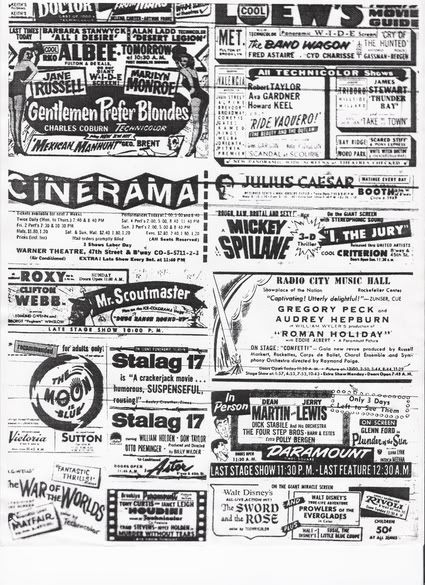
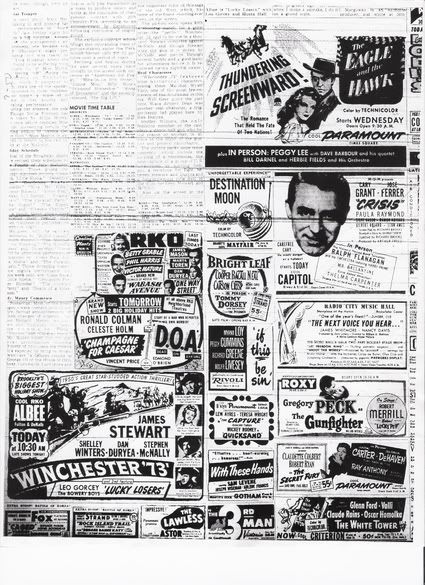


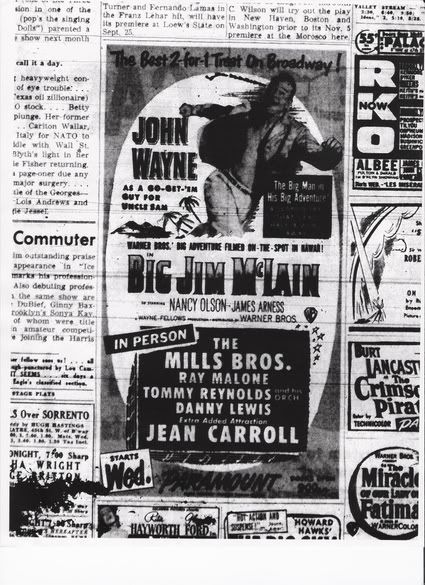
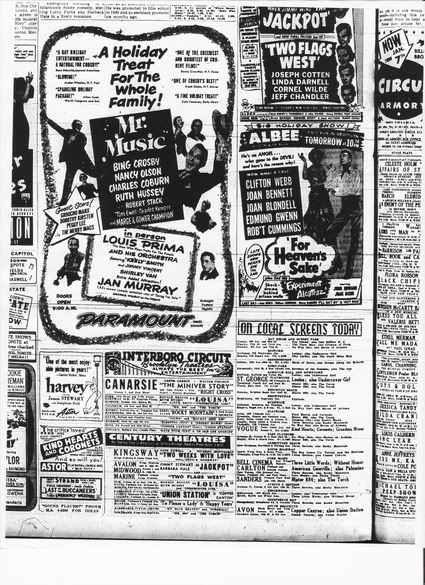

Alas, the theater's rock & roll connections concern us most here. Such events were few and far between, but fun.
Elvis never made an appearance, but his 40-foot-tall, guitar-slung likeness was mounted above the marquee for the November 15, 1956 premiere of Love Me Tender.


Although Alan Freed's association with the Brooklyn Paramount is more well-known, he did put on a few of his extravaganzas at the Manhattan location. Some researchers confuse the two venues, which has made ascertaining the correct dates a bit difficult.
- The earliest appears to have taken place in February 1957, in conjunction with the premiere of Don't Knock the Rock. The bill included the Platters, Frankie Lymon & the Teenagers, Ruth Brown, Nappy Brown, the Cleftones, the Cadillacs, and the Duponts, which featured a pre-Imperials Little Anthony Gourdine.
- Not absolutely sure of the dates for this show, but I believe it happened in early July, 1957--Chuck Berry, Clyde McPhatter, the Moonglows, Big Joe Turner, the Everly Brothers, Johnny & Joe, Paul Anka, LaVern Baker, Frankie Lymon & the Teenagers, his brother Lewis Lymon with the Teen Chords, Jodie Sands, Screamin' Jay Hawkins, and Terry Randazzo.
- From December 26, 1957 through January 6, 1958, the "Christmas Jubliee/Holiday Show of Stars" featured Fats Domino, Jerry Lee Lewis, Buddy Holly, the Everly Brothers, the Rays, Paul Anka, Danny & the Juniors, Lee Andrews & the Hearts, the Teenagers (I guess Frankie L. went solo by then), Jo Ann Campbell, and the Rays. Seems this show broke Frankie Sin's house record!


Here's a pic of the statuary management put in storage before these bookings in an effort to prevent rowdy teens from toppling them. And here's a pic of said delinquents dancing in the aisles and on seats. Be sure to consult the archives section of alanfreed.com--especially the "newspaper articles" link, loaded with vintage scans about these events.


[Side note # 2: While Freed booked most frequently at the two Paramounts, he also utilized the Brooklyn Fox (10 Flatbush Avenue), the Academy of Music, Loew's State (1540 Broadway), Loew's Paradise (2413 Grand Concourse in the Bronx--which hopefully won't meet a Stygian fate), the St. Nicholas Arena in Harlem, the Sussex Avenue Armory in Newark, and the New York Coliseum (10 Columbus Circle, demolished; now the site of the Time Warner Center).]
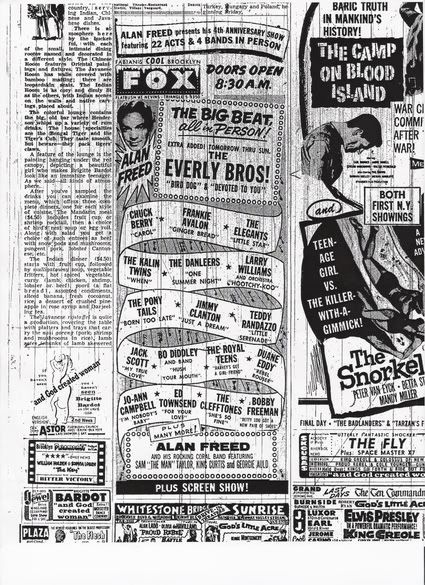
[UPDATE 2/7/2007: The Game Show Network recently aired a '50s episode of To Tell the Truth with Alan Freed as one of the contestants. It must have been originally aired around the time of the 57/58 Holiday Show of Stars, because some references were made to broken house records--not to mention broken house seats and other damage sustained by the Paramount in the wake of those raucous record-breaking delinquents. The panelists, including Polly Bergen, Ralph Bellamy, Kitty Carlisle, and Hy Gardner, clearly had an anti-rock & roll bias--I mean, jeez, the man had been in three movies by then and they didn't recognize him? Still, Bellamy and Carlisle correctly identified him as the real Freed. Polly Bergen chose one of the impostors because he knew the Paramount's manager was named Bob Shapiro.]
A cinematreasures.org regular posted the following: "For the Easter holiday period in 1964, the Paramount presented what the press reported as the theatre's first stage show in seven years. It was a Rock-N-Roll revue emceed by the radio deejays known as the 'WMCA Good Guys.' The performers included Sam Cooke, Dean & Jean, Rufus Thomas, the Devotions, the Sapphires, the Four Seasons, Terry Stafford, Chris Crosby, Diane Renay, and King Curtis & Band. There were five stage shows per day, punctuated by screenings of Zenith International's "No, My Darling Daughter," a British comedy with Juliet Mills and Michael Craig. The engagement ran from March 27 through April 5." Another cinematreasures guy remembers seeing Lesley Gore and James Brown at one of these shows. "Dandy" Dan Daniel offers some memories of those shows in this obit for his former fellow Good Guy, Dean Anthony.
Just when I thought I couldn't possibly learn anything new about the Beatles, along came another factoid. As if to commemorate the 20th anniversary of Frankie's fervent '44 fanbase, the Fab ones caused further screaming to echo off the Paramount's proscenium on September 20, 1964. Steve Lawrence and Eydie Gorme, of all people, were the opening act. All proceeds went to the United Cerebral Palsy and Retarded Infants Services charities--and this was the sole benefit concert the lads did in the U.S.


[UPDATE 7/20/2006: According to Norton Records' required-reading Mary Weiss interview, the Shangri-Las were also on this bill!!!]
[UPDATE 9/29/2007: Mary offers some further memories of this gig in a NY Sun interview.]
[UPDATE 6/9/2010: Oh my, am I late to the party on this one. Over a year ago, an NYC photo-blogger ("what about the plastic animals?") located the remnants of an old poster on the side of a Harlem building that was undergoing renovations at the time. It advertised a Dave Clark Five show at the Paramount, emceed by Murray the K. The blogger couldn't ascertain a concert date, but according to this DC5 chronology, it must have been on October 31, 1964.]
In May, 1965, coinciding with the engagement for Harlow (one of two Jean Harlow biopics released that year, this one starring Carol Lynley), local dance-party TV show host Clay Cole put on a revue featuring several soulful acts--Mary Wells, the Marvelettes, Ronnie Dove, Tony Clark, Charlie & Inez Foxx, and the Gypsies.


[UPDATE 2/14/2007: While researching an entry on the Brooklyn Fox, I came upon this auction site page featuring a number of '60s concert programs for sale, including three for shows held at the Paramount:
- The aforementioned WMCA Good Guys "Easter Parade of Stars" in 1964, with James Brown, Sam Cooke, Jackie Wilson, Bobby Rydell, Lesley Gore, the 4 Seasons, King Curtis, Chris Crosby, Dean & Jean, American Beetles, Rufus Thomas, the Sapphies, Diane Renay, Ruby & The Romantics, and Terry Stafford.
- Another WMCA Good Guys event called the "Show of Shows," with the Animals, Bobby Rydell, Del Shannon, Jan & Dean, Elkie Brooks, the Dixie Cups, Sam "The Man" Taylor, Ronnie Dove, Dee Dee Sharp, The Chartbusters, and Ronnie Dayton. The dates aren't given, but this site suggests that it occurred during Labor Day week in 1964.
- A "10-Day Easter Show" hosted by Soupy Sales in 1965, with the Hullabaloos, the Detergents, Shirley Ellis, Little Richard, the Vibrators {sic.--should probably be the Vibrations}, the Exciters, the Hollies, the Uniques, Dee Dee Warwick, Roddy Joy, Sandie Shaw, and King Curtis.] [UPDATE 3/22/2009: Found these images from the program.]
[UPDATE 5/27/2010: In a BBC Radio 2 documentary originally broadcast on 5/26/2010, Allan Clarke and Bobby Elliott recalled that Jimi Hendrix was playing for Little Richard's band at the time...but that Penniman was let go and forcibly removed from the premises at a certain point, for refusing to cut his set down to two songs.]
The Paramount closed later that year; Thunderball was the final flick shown. The auditorium and lobby sections were gutted and remodeled as office space, most of it serving as an annex to the adjacent New York Times headquarters. (The theater's renowned Wurlitzer organ survived and eventually found its way to Wichita, Kansas.) In the early aughts, the World Wrestling Federation operated a theme restaurant on the lower level of the building, where the theater's lounges and restrooms had previously been located. To spruce up the entrance, the WWF funded the construction of a replica of the Paramount's original marquee design. Though fans were presumably pleased that they now could actually smell-ell-ell-ell-ell what the Rock was cookin', the wrasslin' restaurant didn't last very long. As of August, 2005, the space became the new home of the Hard Rock Cafe. In a related-in-name-only twist, plans are afoot to convert the nearby Paramount Hotel (235 W. 46th Street) into the city's first Hard Rock Hotel by Spring 2006.
Friday, November 04, 2005
The Bow-Ties that Bond
BOND INTERNATIONAL CASINO--1530 Broadway, on the east side of Broadway between 44th and 45th Streets. (Often referred to as Bond's.) A short-lived discotheque most famous for hosting the "Clash on Broadway" residency in 1981, Bond's sat on one of the Times Square-iest spots of land in Times Square. This New York Times article summarizes its phases well, but I'll add some elaboration here, as is my wont.
Before the Times set up shop in the area, Longacre Square was the horse dung-scented center of New York's carriage trade. An unseemly spot indeed for the future Crossroads of the World, but as the city's entertainment districts had been inexorably migrating ever further uptown along Broadway throughout the 19th century, the Square's eventual colonization by the theater crowd was inevitable. Oscar Hammerstein I was the earliest impresario to venture there. In 1895, on the site of the former 71st Regiment Armory (destroyed in a fire), he opened the Olympia Theatre, a massive Beaux Arts complex comprising a 2,800-seat Music Hall, a 1,850-seat playhouse called the Lyric Theatre, a smaller Concert Hall, and a roof garden theater. According to Anthony Bianco's Ghosts of 42nd Street (New York: HarperCollins, 2004), admission was fifty cents, and patrons could wander between the theaters at will. "[T]he Olympia did not style itself as a family entertainment venue," writes Bianco. "Content to leave the middle of the road to others, Hammerstein experimented with provocative new acts and formats that expanded vaudeville's boundaries." Hammerstein's adventurous fare included operas (some of which were his own compositions), "Living Pictures" (tableaus presented partially in the nude), Isham's Octaroons (an African-American song-and-dance troupe), and a notoriously so-bad-they're-good act called the Cherry Sisters. Unfortunately, not every production he put on was a financial success, which led to a foreclosure on the property after only three years of operation. The building was auctioned off, and the theaters became separate entities under the auspices of different producers. Hammerstein's next local enterprises, the smaller-in-scale Victoria and Republic Theatres, were more lucrative. Meanwhile, the Music Hall was renamed the New York Theater, and was converted into a movie/vaudeville house when Loew's took it over in 1915. The Lyric was first renamed the Criterion, then became a movie house called the Vitagraph in 1914, only to revert to the Criterion moniker a couple of years later. In 1907, Flo Ziegfeld staged his first production of Follies at the rooftop garden theater, renamed Le Jardin de Paris. When he decamped for the New Amsterdam in 1913, the roof garden was converted into a dancehall called Jardin des Danses. Despite its many virtues, the magnificent Olympia building did not outlast the Depression; it was demolished in 1935.
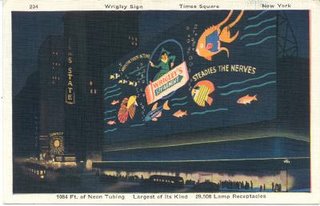
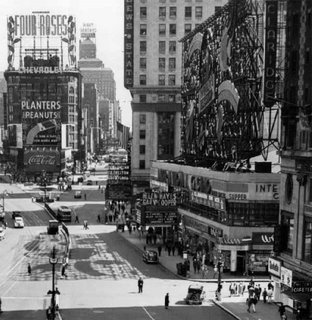
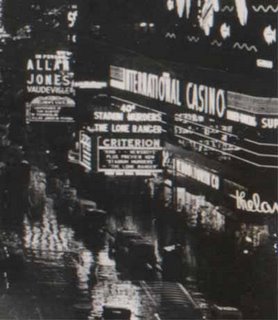
The building featured a new Criterion movie house (designed by Thomas Lamb and Eugene de Rosa), ground-level retail space, and a fabulous Art Deco nightclub/restaurant called the International Casino. According to Susan Waggoner's Nightclub Nights: Art, Legend, and Style, 1920-1960 (New York: Rizzoli, 2001), this Casino had nothing to do with gambling:
Once one passed through the solid brass doors and into the red and gold mosaic lobby, there was no shortage of amusements. The Cosmopolitan Salon was fitted with a small stage and littered with settees that could accommodate nearly eight hundred. Another one hundred and sixty could quench their thirst at the Spiral Bar, a curved slide of polished mahogany that swept from the ground floor up to the mezzanine. All this was a mere warm-up for the main room, where tiered platforms assured all fifteen hundred diners an unobstructed view of the show.
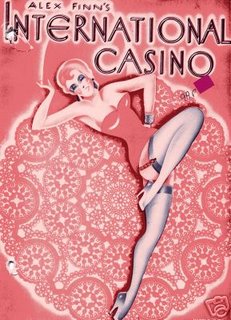
The show, mounted on an elaborately high-tech motorized stage, featured such delights as "novelties from five continents and the beauties of ten countries," an orchestra "whose reed section might suddenly plunge from sight, like riders on a parachute drop," a fanciful "Ice Frolics" revue, comedians like Milton Berle, and gorgeous chorines with gams for days. The swank Streamline Moderne surroundings were "designed by Donald Deckie, who later designed the Radio City Music Hall," according to Anthony Haden-Guest's The Last Party (New York: William Morrow, 1997). However, the Casino may have been too gloriously grandiose for its own good; much like the Olympia, it closed after a mere three years in business.
Bond Clothes took over the Casino's space in 1940, moving from its previous location adjacent to the Palace Theater a couple of blocks north. In its new digs Bond styled itself as the world's largest men's haberdashery, and offered some women's wear as well. As if the store's famous "TWO TROUSER SUITS" neon sign weren't enough, beginning in 1948 it also boasted the most splendid spectacular ever to grace the Great White Way, designed by Douglas Leigh for Artkraft-Strauss. As described in Leigh's 1999 Times obituary:
At the base of the Bond sign was an electric news zipper, about five feet high, running along the entire facade. In Mr. Leigh's design, twin 50-foot-high figures, one male and one female, flanked a waterfall 27 feet high and 120 feet long. Strands of electric lights seemed to clothe the chunky classical figures at night, but by day they appeared naked.
Before the Times set up shop in the area, Longacre Square was the horse dung-scented center of New York's carriage trade. An unseemly spot indeed for the future Crossroads of the World, but as the city's entertainment districts had been inexorably migrating ever further uptown along Broadway throughout the 19th century, the Square's eventual colonization by the theater crowd was inevitable. Oscar Hammerstein I was the earliest impresario to venture there. In 1895, on the site of the former 71st Regiment Armory (destroyed in a fire), he opened the Olympia Theatre, a massive Beaux Arts complex comprising a 2,800-seat Music Hall, a 1,850-seat playhouse called the Lyric Theatre, a smaller Concert Hall, and a roof garden theater. According to Anthony Bianco's Ghosts of 42nd Street (New York: HarperCollins, 2004), admission was fifty cents, and patrons could wander between the theaters at will. "[T]he Olympia did not style itself as a family entertainment venue," writes Bianco. "Content to leave the middle of the road to others, Hammerstein experimented with provocative new acts and formats that expanded vaudeville's boundaries." Hammerstein's adventurous fare included operas (some of which were his own compositions), "Living Pictures" (tableaus presented partially in the nude), Isham's Octaroons (an African-American song-and-dance troupe), and a notoriously so-bad-they're-good act called the Cherry Sisters. Unfortunately, not every production he put on was a financial success, which led to a foreclosure on the property after only three years of operation. The building was auctioned off, and the theaters became separate entities under the auspices of different producers. Hammerstein's next local enterprises, the smaller-in-scale Victoria and Republic Theatres, were more lucrative. Meanwhile, the Music Hall was renamed the New York Theater, and was converted into a movie/vaudeville house when Loew's took it over in 1915. The Lyric was first renamed the Criterion, then became a movie house called the Vitagraph in 1914, only to revert to the Criterion moniker a couple of years later. In 1907, Flo Ziegfeld staged his first production of Follies at the rooftop garden theater, renamed Le Jardin de Paris. When he decamped for the New Amsterdam in 1913, the roof garden was converted into a dancehall called Jardin des Danses. Despite its many virtues, the magnificent Olympia building did not outlast the Depression; it was demolished in 1935.


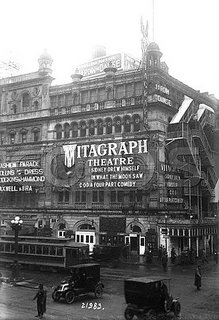
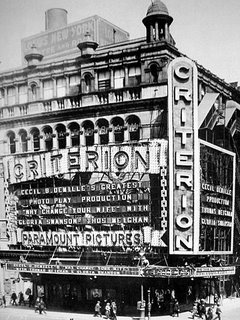
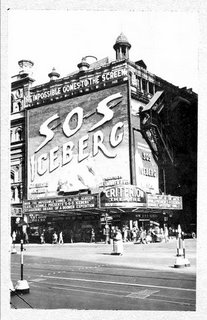
A year later, the Criterion Building rose in its stead. It occupied the same block-long frontage, but was not nearly as tall as its predecessor--unless you include the height of its huge rooftop neon sign, a fish-festooned spectacular advertising Wrigley's Spearmint Gum.

The building featured a new Criterion movie house (designed by Thomas Lamb and Eugene de Rosa), ground-level retail space, and a fabulous Art Deco nightclub/restaurant called the International Casino. According to Susan Waggoner's Nightclub Nights: Art, Legend, and Style, 1920-1960 (New York: Rizzoli, 2001), this Casino had nothing to do with gambling:
Once one passed through the solid brass doors and into the red and gold mosaic lobby, there was no shortage of amusements. The Cosmopolitan Salon was fitted with a small stage and littered with settees that could accommodate nearly eight hundred. Another one hundred and sixty could quench their thirst at the Spiral Bar, a curved slide of polished mahogany that swept from the ground floor up to the mezzanine. All this was a mere warm-up for the main room, where tiered platforms assured all fifteen hundred diners an unobstructed view of the show.
The show, mounted on an elaborately high-tech motorized stage, featured such delights as "novelties from five continents and the beauties of ten countries," an orchestra "whose reed section might suddenly plunge from sight, like riders on a parachute drop," a fanciful "Ice Frolics" revue, comedians like Milton Berle, and gorgeous chorines with gams for days. The swank Streamline Moderne surroundings were "designed by Donald Deckie, who later designed the Radio City Music Hall," according to Anthony Haden-Guest's The Last Party (New York: William Morrow, 1997). However, the Casino may have been too gloriously grandiose for its own good; much like the Olympia, it closed after a mere three years in business.
Bond Clothes took over the Casino's space in 1940, moving from its previous location adjacent to the Palace Theater a couple of blocks north. In its new digs Bond styled itself as the world's largest men's haberdashery, and offered some women's wear as well. As if the store's famous "TWO TROUSER SUITS" neon sign weren't enough, beginning in 1948 it also boasted the most splendid spectacular ever to grace the Great White Way, designed by Douglas Leigh for Artkraft-Strauss. As described in Leigh's 1999 Times obituary:
At the base of the Bond sign was an electric news zipper, about five feet high, running along the entire facade. In Mr. Leigh's design, twin 50-foot-high figures, one male and one female, flanked a waterfall 27 feet high and 120 feet long. Strands of electric lights seemed to clothe the chunky classical figures at night, but by day they appeared naked.
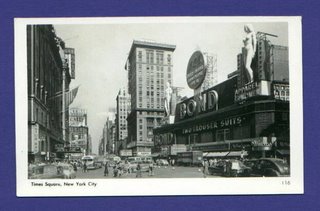
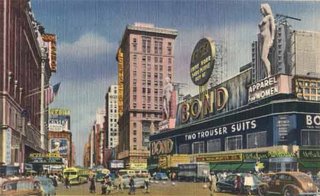
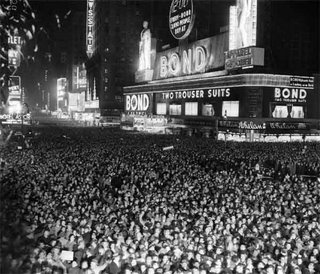
Those loincloth-lights were added only after guests at the Hotel Astor across the street complained about the statues' scandalously starkers state. A clock poised above the waterfall perpetually reminded the public, "EVERY HOUR 3,490 PEOPLE BUY AT BOND." (I suppose an even 3,500 customers per hour would have been too much to handle...)
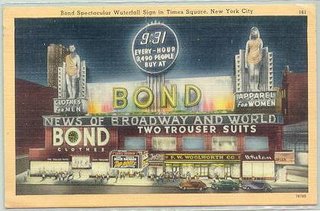
After six good-looking years, the sign was replaced with a Pepsi ad; the waterfall remained (and kept gushing until the early '60s), but was now flanked with giant Pepsi bottles. Apparently a Chevy ad was once meant to take Pepsi's place, but a garagantuan Gordon's Gin bottle and a smoking Winston man (a total Camel sign rip-off) eventually appeared there instead. The ground-level storefronts evolved over time as well--among the successive occupants were Woolworth's, Whelan Drugs, King of Slim's Ties, Loft's Candy, Regal Shoes, Disc-O-Mat Records, tourist tchotchke outlets, and those ubiquitous bad-deal '70s/'80s electronics stores.
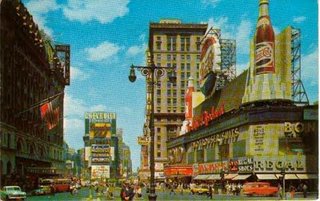
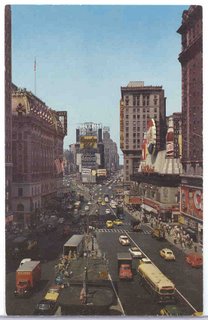
Bond Clothes sold its last two-trouser suit in 1977, and after a couple of vacant years, the space was respectfully rechristened as Bond International Casino, supposedly the largest disco the world had yet seen. As described in The Last Party, the club was co-owned by John Addison and Maurice Brahms. It opened in July 1980, and featured such accoutrements as a "musical staircase," fountains retrieved from the set of The Liberace Show (which often ended up filled with near-naked patrons), and a wide-ranging music policy (usually spun by resident DJ Kenny Carpenter). However, according to these opinionated folks on discomusic.com, the joint never quite caught on, for various reasons--bad location (Times Square at the height of its sleazy-seedy era), poor acoustics, lack of an atmospheric theme, inconsisent musical choices, and above all, too much space to fill on a nightly basis.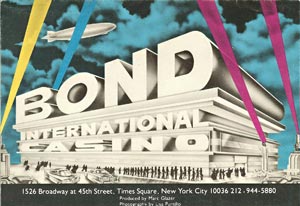
There were no such space-filling difficulties during the Clash's booking in May-June, 1981. The buzz surrounding their initial eight-night stand was so high that the shows were dangerously oversold--3,500 tickets for each night, at a venue with a legal capacity of about 1,800. The FDNY threatened to shut the place down following the first two overcrowded nights. After much negotiation with city authorities, the band worked out a deal wherein they would play as many shows as it would take to honor all ticket holders--an unprecedented seventeen concerts. Times Square hadn't seen that much commotion since Frankie at the Paramount, or V-J Day. An incredibly and obsessively detailed day-by-day account of the residency is provided at blackmarketclash.com (click on the link for 1981, then click on each Bond's date). Also check out the Westway to the World DVD, which includes Don Letts' documentary footage of Bond's. And dig these articles by Ira Robbins and Jonathan Lethem.
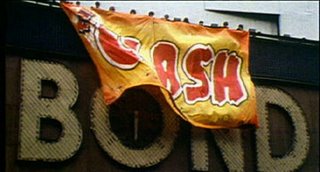
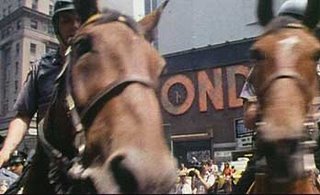
I've found references to only a few other rock shows, including Wendy O. Williams (yes, a car was blown up), the Blues Project (I don't recall Al Kooper mentioning this one in Backstage Passes and Backstabbing Bastards), Blue Oyster Cult, and a one-off night featuring members of Blondie and Chic. It's unclear just when Bond's closed, or what, if anything, occupied its space from the mid-'80s to the mid-'90s--but the neon BOND sign remained in place for quite some time.
The Criterion Building still exists, but it looks nothing like it did in the old postcards. Now called the Bow-Tie Building (a reference to the shape of the Times Square intersection when viewed from above), it's owned by members of the same Moss family who have had interests in the structure since its 1936 inception. The Roundabout Theater Company rented space in the building through much of the '90s, but I'm not sure which part they used. The Criterion Theater, which spent its last few years as a much-maligned multiplex, closed in 2000. Most of the building is now occupied by the flagship Toys R Us, a Foot Locker, and a Swatch emporium. There's no BOND sign facing Broadway anymore, but if you go around the corner on 45th, you'll find a smaller facsimile on the side of the building, attached to an old school-inspired Italian restaurant called Bond 45.


Wednesday, September 07, 2005
Midtown strutter's ball(room)
HOTEL DIPLOMAT--108-116 W. 43rd Street, just west of 6th Avenue. Haven't located any historical details on the hotel itself, though it does apparently have a file at the New-York Historical Society. I gather the place had a rather, uh, diplomatic policy when it came to events bookings and clientele. At various times it played host to jazz performers (such as Miles Davis and Albert Ayler), salsa bands, Libertarian conferences, Chilean solidarity meetings, civil rights poets, Abbie Hoffman drug busts, art exhibitions, and drag balls. On motherboardsnyc.com, Hattie Hathaway remembers, "I was friendly with the desk clerk and took many johns there, though it was a fully operational normal hotel...There was even a fully operational coffee shop that included that archaic NYC phenomenon--the soda jerk--who made fierce cherry-lime rickies and egg creams. People would come from all over the city for them." A decadent-but-classy discotheque called Le Jardin operated in the basement during the mid-'70s. But I'm most concerned with the rock shows held in the hotel's ballrooms, ca. '69-'79.
A late '60s pamphlet attributed to George Metesky entitled F*ck the System, which gave advice on how to scam free stuff in NYC, advised the following: "The Group Image--Performs every Wednesday night at the Hotel Diplomat...and you can get in free if you say you have no money (sometimes). If you promise to take your clothes off it's definitely free. If you ball on the dance floor, you get a season's pass."
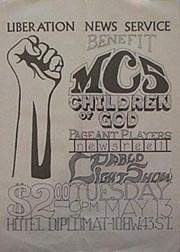
The MC5 headlined a benefit for the Liberation News Service on May 13, 1969. Also on the bill were Children of God, the Pageant Players, and the Pablo Light Show. Dig the power-to-the-people poster.
Robert Christgau mentions some kinda hippie benefit show featuring Communications Workshop and Season of the Witch in this July 30, 1970 Village Voice article.
From Nina Antonia's Too Much Too Soon (London: Omnibus, 1998): On May 29, 1972, the New York Dolls played their second date in the Palm Room of the Diplomat Hotel, where the Pox had debuted. Adjacent to the Times Square porn palaces and peep shows, the Diplomat gig was organized in conjunction with the Warhol crew and featured Jackie Curtis in a support slot. At the bottom of the bill was a band called Shaker, whose drummer, Jerry Nolan, rather impressed Billy [Murcia...how prophetic.-Ed.]. The event, advertised as an "Invitation Beyond the Valley," garnered a couple of lousy reviews in the theatrical sections of local papers. Some of the Dolls' very early appearances baffled critics who were unsure as to whether they were a theatrical troupe, a rock act, or both.
The Dolls played the venue again on March 16 the following year; openers were the Brats, featuring erstwhile Doll Rick Rivets.
KISS booked the Diplomat themselves for some of their earliest Manhattan dates--July 13 and August 10, 1973. Check out the flyers here and here. Click here for personal recollections from Paul Stanley and Gene Simmons (who describes the Diplomat as "a hotel for hookers and junkies"). Click here for fan/observer accounts and photos from the gig, offering a rare glimpse of primitively primordial KISS kostumes.


Television also played a couple of their earliest gigs ever in the hotel's Crystal Room--April 5 and 10, 1974.


Seems like the place was a haven for hip-hop's originators as well--Kurtis Blow writes of watching Grandmaster Flash DJ there ca. 1977 in the liner notes to Rhino's History of Rap Vol. 1.
The Buzzcocks, Mission of Burma, and the Monochrome Set, September 15, 1979.
The Police, with The The, in the Grand Ballroom, September 27-29, 1979.
Neon Leon, dates unknown.
That's all the names I've been able to track down thus far, though there were surely others. What became of the Diplomat is unclear; this site claims the building is "now home to many of the North African/Senegalese," whatever that means--but I'm skeptical.
UPDATE 7/20/2007--Just discovered magictramps.com, which has images of flyers for three shows the Magic Tramps played at the Diplomat Ballroom. Can't purloin them, you'll have to click on the link to see them. The years weren't clearly listed, but hints were given in fine print on each flyer; my guesstimates are in parentheses.
UPDATE 5/23/2010: I am appallingly late in discovering this, but blogger NYCDreamin' of This Ain't the Summer of Love wrote a much more detailed and exhaustive account of Hotel Diplomat history in early 1999. He kindly acknowledged my post, but truly went to research lengths that I could not achieve...or rather (perhaps more accurately), that I in my laziness could not be bothered with. Bravo!!!
UPDATE 9/17/2013: You'll want to get your mitts on the latest KISS tome by Ken Sharp, Nothin to Lose: The Making of KISS 1972-1975, which includes a lengthy discussion of the band's stint at the Dip. By the way, I located a bunch of Hotel Diplomat ads while I was perusing the Voice archives a couple years ago--just click on the Hotel Diplomat tag on the list at the right to see them. Also, get a load of these goodies I found on the Bay last night.


A late '60s pamphlet attributed to George Metesky entitled F*ck the System, which gave advice on how to scam free stuff in NYC, advised the following: "The Group Image--Performs every Wednesday night at the Hotel Diplomat...and you can get in free if you say you have no money (sometimes). If you promise to take your clothes off it's definitely free. If you ball on the dance floor, you get a season's pass."
The MC5 headlined a benefit for the Liberation News Service on May 13, 1969. Also on the bill were Children of God, the Pageant Players, and the Pablo Light Show. Dig the power-to-the-people poster.
Robert Christgau mentions some kinda hippie benefit show featuring Communications Workshop and Season of the Witch in this July 30, 1970 Village Voice article.
From Nina Antonia's Too Much Too Soon (London: Omnibus, 1998): On May 29, 1972, the New York Dolls played their second date in the Palm Room of the Diplomat Hotel, where the Pox had debuted. Adjacent to the Times Square porn palaces and peep shows, the Diplomat gig was organized in conjunction with the Warhol crew and featured Jackie Curtis in a support slot. At the bottom of the bill was a band called Shaker, whose drummer, Jerry Nolan, rather impressed Billy [Murcia...how prophetic.-Ed.]. The event, advertised as an "Invitation Beyond the Valley," garnered a couple of lousy reviews in the theatrical sections of local papers. Some of the Dolls' very early appearances baffled critics who were unsure as to whether they were a theatrical troupe, a rock act, or both.
The Dolls played the venue again on March 16 the following year; openers were the Brats, featuring erstwhile Doll Rick Rivets.
KISS booked the Diplomat themselves for some of their earliest Manhattan dates--July 13 and August 10, 1973. Check out the flyers here and here. Click here for personal recollections from Paul Stanley and Gene Simmons (who describes the Diplomat as "a hotel for hookers and junkies"). Click here for fan/observer accounts and photos from the gig, offering a rare glimpse of primitively primordial KISS kostumes.


Television also played a couple of their earliest gigs ever in the hotel's Crystal Room--April 5 and 10, 1974.


Seems like the place was a haven for hip-hop's originators as well--Kurtis Blow writes of watching Grandmaster Flash DJ there ca. 1977 in the liner notes to Rhino's History of Rap Vol. 1.
The Buzzcocks, Mission of Burma, and the Monochrome Set, September 15, 1979.
The Police, with The The, in the Grand Ballroom, September 27-29, 1979.
Neon Leon, dates unknown.
That's all the names I've been able to track down thus far, though there were surely others. What became of the Diplomat is unclear; this site claims the building is "now home to many of the North African/Senegalese," whatever that means--but I'm skeptical.
UPDATE 7/20/2007--Just discovered magictramps.com, which has images of flyers for three shows the Magic Tramps played at the Diplomat Ballroom. Can't purloin them, you'll have to click on the link to see them. The years weren't clearly listed, but hints were given in fine print on each flyer; my guesstimates are in parentheses.
- Satan's Celebration: A Rock and Occult Festival, Halloween Night ('72?), with Elephant's Memory (probably sans John or Yoko), Ruby and the Rednecks, Chris Rush, White Satin, Suzan Bader, Satan the Eternal Fireman, and various witches, occultists and psychics.
- The First International Costume Glitter Ball, Saturday, December 30 (1972?), with Satan's Angels of the Universe, Shaker, and the Harlots of 42nd Street.
- "Strut Yo' Stuff," an "Easter Parade" show on Sunday, April 14 (1974?) with Canon, Street Punk, and the Harlots of 42nd Street.
UPDATE 5/23/2010: I am appallingly late in discovering this, but blogger NYCDreamin' of This Ain't the Summer of Love wrote a much more detailed and exhaustive account of Hotel Diplomat history in early 1999. He kindly acknowledged my post, but truly went to research lengths that I could not achieve...or rather (perhaps more accurately), that I in my laziness could not be bothered with. Bravo!!!
UPDATE 9/17/2013: You'll want to get your mitts on the latest KISS tome by Ken Sharp, Nothin to Lose: The Making of KISS 1972-1975, which includes a lengthy discussion of the band's stint at the Dip. By the way, I located a bunch of Hotel Diplomat ads while I was perusing the Voice archives a couple years ago--just click on the Hotel Diplomat tag on the list at the right to see them. Also, get a load of these goodies I found on the Bay last night.


Thursday, June 09, 2005
I can always spot a Cheetah
I'll dedicate this entry to Mr. Doshna, my zany 9th grade Earth Science teacher back at good old St. Francis Prep. His droll delivery, augmented by his patented adenoidal Lawn Guyland whine, made even the dullest of geological factoids palatable. He often made fun of my ridiculous punk rock hairdo, as in, "Ms. C., your hair looks like a bird's nest." Whenever we had a test--and I seem to recall having them at least once a week--he'd pass out the Scan-tron multiple choice forms (regular Scan-trons for average-length tests, "mini"-Scan-trons for pop quizzes, and "Intergalactic-Mega-Scan-trons" for huge exams), put up "cheater boards" between our desks to prevent wandering eyes, and hang up a huge poster of a cheetah at the front of the room to serve as a constant reminder that he could "always spot a cheat-ah." A couple of times he deliberately left the poster down, just so he could cornily tell us that the cheetah was vacationing in Nairobi that week. Oh well...spot this:
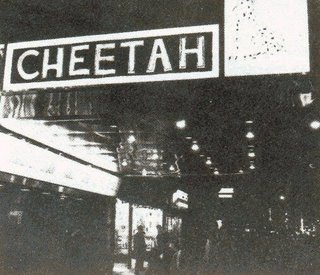
(THE) CHEETAH, Broadway and 53rd Street. The Cheetah is widely regarded as the city's first super-sized, sensory-overload, multi-media mega-club. This may have been a new concept in New York nightclubbing, but the space it occupied had a history. Its previous incarnation was as I. Jay Faggan's Arcadia Ballroom, a jazz and dancing establishment which had played host to the likes of Ray Miller, Roy Eldridge, Larry Fotine, Benny Carter, Sonny James, and Les Brown. (The Arcadia itself had been remodeled in 1924 from a prior ballroom called the Blue Bird.) I'm not sure when the Arcadia closed, but the Cheetah took its place in April, 1966. According to Steven Watson's Factory Made: Warhol and the Sixties (New York: Pantheon, 2003), it "was the granddaddy of the big commercial disco":
The most elaborate discotheque was Cheetah, on Broadway and 53rd Street, where everybody, according to Life, looked like "a kook in a Kubla Khanteen." The three thousand colored lightbulbs dimmed and flicked and popped into an infinity of light patterns, reflecting off shiny aluminum sheets. Cheetah held two thousand people and offered not only dancing but a library, a movie room, and color television. "The Cheetah provides the most curious use of the intermedia," wrote Jonas Mekas. "Whereas the Dom shows are restricted (or became restricted) to the In-circle, Cheetah was designed for the masses. An attempt was made to go over the persona, over the ego to reach the impersonal, abstract, universal."
Brewster and Broughton's Last Night A DJ Saved My Life (New York: Grove Press, 1999) describes the place as follows:
[T]his had been opened by Le Club's staid Frenchman, Oliver Coquelin. Situated on the site of the Arcadia Ballroom near Broadway's theatre district, it threw its doors open on May 28, 1966. The cavernous space had a dancefloor with circular podiums scattered randomly like outsized polka dots. Each supported a girl frugging. Above, a cavalcade of 3,000 colored lights palpitated gently, while a boutique at the back sold the latest Carnaby Street fashions. And there was smooth and soft black velvet everywhere--except the bar, which was covered in fake fur. In the basement there was a TV room and on the upper floor a cinema showed the latest, strangest, underground movies. Variety got rather excited about this new boite: "GOTHAM'S NEW CHEETAH A KINGSIZED WATUSERY WITH A FORT KNOX POTENTIAL." A striking Puerto Rican teenager, Yvon Leybold, clad in hot pants and fishnets, ventured down from Spanish Harlem. "Cheetah was the first real disco club I went to," she recalls. "That was a lot of fun. It was a very mixed atmosphere. It was the first time I went into a place and you see lights and you see atmosphere, instead of the rinky-dink places I was used to."
Joel Lobenthal's Radical Rags: Fashions of the Sixties (New York: Abbeville Press, 1990) offers this description:
By the time Cheetah opened near Times Square in April 1966, the discotheque had become a self-contained Aladdin's Cave, in which the visitor surrendered his or her everyday identity in search of Dionysian transport. Cheetah employed many conspiring elements to bedazzle its switched-on congregation. Banks of colored lights shone on its patrons. Suspended high above the writhing crowds, huge sheets of chrome--a giant mobile created by industrial designer Michael Lax--undulated rhythmically, while at the club's opening night the customers echoed the mise en scene: "each girl was more electric than the next," Eugenia Sheppard reported. "The swinging hair. The wild colors. The mini-mini-skirts."...Cheetah initated a trend by selling earmarked discotheque attire in a boutique included in a multi-level complex consisting of dance floor, underground-film screening room, and hot dog stand. The proprietor of Cheetah's boutique noticed that many customers were purchasing clothes to exchange for those they had arrived in, so the checkrooms were specially expanded.
There were distractions a-plenty at the Cheetah, including the obligatory late-'60s light shows, but music (both live and discotheque), dancing, and partying were the club's main raisons d'etre. A few examples thereof:
Apparently the club had its own dance, according to this guy named Larry: He had to pay for the dance classes, but he learned more about moving his feet from his job at the Cheetah - New York's first discotheque. In between checking coats, Larry got his feet wet - so to speak - on the dance floor at the hottest of hot spots in the hottest of hot cities on the planet. "It's time for ... the Cheetah Shuffle!" That was the rallying cry - an approximation of it, anyway. Gangs of dancers would hit the floor at the call and perform the line-dance like moves and grooves that constituted the Cheetah Shuffle. The regulars, such as they were, got so attuned to the fancy footwork that they actually gave their motions names and numbers. "Cheetah 1!" "Cheetah 2,3!" "Cheetah Cheetah!" With a word or two and a number or two or three - and don't forget the exclamation point - the gangs would move in sequence. And Larry, because he was there every night, checking coats, was soon their leader.
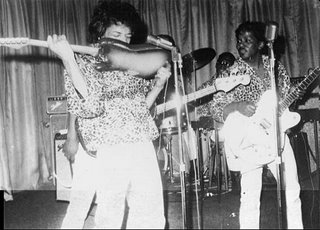
The Squires played there in 1966, featuring Curtis Knight and pre-fame Jimi Hendrix (dig those site-specific cheetah-print shirts!). Richie Havens reminisces about young Jimi's performance here.
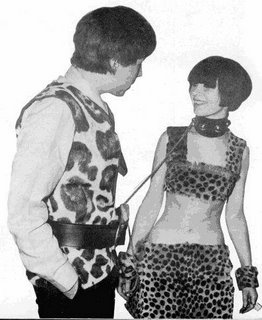
The Velvet Underground and Tiny Tim played the Cheetah on April 11, 1967. This event, a benefit for WBAI, was billed as "An Imperial Happening" to mark "the coronation of his Serene Highness, Prince Robert, first American Emperor of the Eastern Byzantine Roman Empire."
A Dark Shadows costume party was held there, possibly on a Halloween night, with cast members in attendance.
Between its Public Theater debut and its long Broadway run at the Biltmore Theater, HAIR had an engagement at the Cheetah from December 22, 1967 through January 28, 1968.
[I'll try to locate more examples in the future--somehow Cheetah is not the easiest club name in the world to google.]
Suzanne de Passe was the Cheetah's talent booker before embarking on careers as a Motown executive and later as head of her own television production company. Some cool images/epherma from the club are available at the Groovy Times site, or here, here, and here to be specific. WABC-TV supposedly filmed a documentary entitled "Cheetah, The Mod Mecca"--I wonder if the videotape survived?
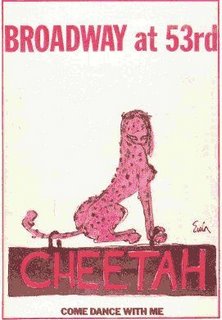
There were also Cheetah clubs in Los Angeles (in the former Aragon Ballroom on Lick Pier in Venice Beach) and Chicago (I believe it was in Chi-town's Aragon Ballroom). I'm not certain if they were financially affiliated with the New York Cheetah, but they did utilize the same half cheetah, half long-haired/well-endowed girl-creature logo.
Whither the Cheetah? I'm not absolutely sure when it closed down. I've come across numerous references to a Cheetah in midtown Manhattan that specialized in boogaloo and salsa music in the early '70s--but I haven't been able to ascertain whether that was an evolution in the B'way and 53rd Cheetah or a different club altogether. I'm not even sure which corner at 53rd the Cheetah was on, nor what stands in its place today. It's either an office building or a hotel, I would reckon.
UPDATE 10/15/2007: Apparently the Box Tops played the Cheetah around Halloween of 1967, according to this rare clip from Zacherle's Disc-O-Teen. Dig Alex Chilton back when he was all young and raspy!

UPDATE 1/2/2008: This past weekend, Domenic Priore's Riot on Sunset Strip program (Sunday afternoons on luxuriamusic.com) featured music from the NYC '60s scene, including a couple of tracks from a heretofore unknown to me live album recorded at the Cheetah called Where It's At. Three bands are featured on the LP--The Esquires (doing Paint It Black, Get Off My Cloud, Goin' Out of My Head, and Uptight), Mike St. Shaw and the Prophets (Good Lovin' and Papa's Got a Brand New Bag), and the Thunder Frog Ensemble (Baby Please Don't Put Me On and Everybody Needs Somebody to Love).
UPDATE 1/19/2010: A while back I received a lovely e-mail from a Cheetah regular named Valerie who offered some wonderful recollections of the club--read it here.
UPDATE 5/27/2010: NYC Dreamin' of This Ain't the Summer of Love posted a cool 1968 article about the club a while back.
UPDATE 6/4/2010: I posted a bunch of 1967 Cheetah ads here.
UPDATE 11/16/2011: Here's a revised and improved post with 1967 Cheetah ads.
UPDATE 6/2/2014: Howie Pyro did a post about the Cheetah on Dangerous Minds, incorporating some of the info gathered here by yours truly. He found that someone uploaded the aforementioned "Cheetah: The Mod Mecca" film on Youtube over a year ago.
UPDATE 12/20/2014: The College No. 9 tumblr did a piece about Cheetah earlier this year. One of my other posts about the club was quoted at length.
(THE) CHEETAH, Broadway and 53rd Street. The Cheetah is widely regarded as the city's first super-sized, sensory-overload, multi-media mega-club. This may have been a new concept in New York nightclubbing, but the space it occupied had a history. Its previous incarnation was as I. Jay Faggan's Arcadia Ballroom, a jazz and dancing establishment which had played host to the likes of Ray Miller, Roy Eldridge, Larry Fotine, Benny Carter, Sonny James, and Les Brown. (The Arcadia itself had been remodeled in 1924 from a prior ballroom called the Blue Bird.) I'm not sure when the Arcadia closed, but the Cheetah took its place in April, 1966. According to Steven Watson's Factory Made: Warhol and the Sixties (New York: Pantheon, 2003), it "was the granddaddy of the big commercial disco":
The most elaborate discotheque was Cheetah, on Broadway and 53rd Street, where everybody, according to Life, looked like "a kook in a Kubla Khanteen." The three thousand colored lightbulbs dimmed and flicked and popped into an infinity of light patterns, reflecting off shiny aluminum sheets. Cheetah held two thousand people and offered not only dancing but a library, a movie room, and color television. "The Cheetah provides the most curious use of the intermedia," wrote Jonas Mekas. "Whereas the Dom shows are restricted (or became restricted) to the In-circle, Cheetah was designed for the masses. An attempt was made to go over the persona, over the ego to reach the impersonal, abstract, universal."
Brewster and Broughton's Last Night A DJ Saved My Life (New York: Grove Press, 1999) describes the place as follows:
[T]his had been opened by Le Club's staid Frenchman, Oliver Coquelin. Situated on the site of the Arcadia Ballroom near Broadway's theatre district, it threw its doors open on May 28, 1966. The cavernous space had a dancefloor with circular podiums scattered randomly like outsized polka dots. Each supported a girl frugging. Above, a cavalcade of 3,000 colored lights palpitated gently, while a boutique at the back sold the latest Carnaby Street fashions. And there was smooth and soft black velvet everywhere--except the bar, which was covered in fake fur. In the basement there was a TV room and on the upper floor a cinema showed the latest, strangest, underground movies. Variety got rather excited about this new boite: "GOTHAM'S NEW CHEETAH A KINGSIZED WATUSERY WITH A FORT KNOX POTENTIAL." A striking Puerto Rican teenager, Yvon Leybold, clad in hot pants and fishnets, ventured down from Spanish Harlem. "Cheetah was the first real disco club I went to," she recalls. "That was a lot of fun. It was a very mixed atmosphere. It was the first time I went into a place and you see lights and you see atmosphere, instead of the rinky-dink places I was used to."
Joel Lobenthal's Radical Rags: Fashions of the Sixties (New York: Abbeville Press, 1990) offers this description:
By the time Cheetah opened near Times Square in April 1966, the discotheque had become a self-contained Aladdin's Cave, in which the visitor surrendered his or her everyday identity in search of Dionysian transport. Cheetah employed many conspiring elements to bedazzle its switched-on congregation. Banks of colored lights shone on its patrons. Suspended high above the writhing crowds, huge sheets of chrome--a giant mobile created by industrial designer Michael Lax--undulated rhythmically, while at the club's opening night the customers echoed the mise en scene: "each girl was more electric than the next," Eugenia Sheppard reported. "The swinging hair. The wild colors. The mini-mini-skirts."...Cheetah initated a trend by selling earmarked discotheque attire in a boutique included in a multi-level complex consisting of dance floor, underground-film screening room, and hot dog stand. The proprietor of Cheetah's boutique noticed that many customers were purchasing clothes to exchange for those they had arrived in, so the checkrooms were specially expanded.
There were distractions a-plenty at the Cheetah, including the obligatory late-'60s light shows, but music (both live and discotheque), dancing, and partying were the club's main raisons d'etre. A few examples thereof:
Apparently the club had its own dance, according to this guy named Larry: He had to pay for the dance classes, but he learned more about moving his feet from his job at the Cheetah - New York's first discotheque. In between checking coats, Larry got his feet wet - so to speak - on the dance floor at the hottest of hot spots in the hottest of hot cities on the planet. "It's time for ... the Cheetah Shuffle!" That was the rallying cry - an approximation of it, anyway. Gangs of dancers would hit the floor at the call and perform the line-dance like moves and grooves that constituted the Cheetah Shuffle. The regulars, such as they were, got so attuned to the fancy footwork that they actually gave their motions names and numbers. "Cheetah 1!" "Cheetah 2,3!" "Cheetah Cheetah!" With a word or two and a number or two or three - and don't forget the exclamation point - the gangs would move in sequence. And Larry, because he was there every night, checking coats, was soon their leader.
The Squires played there in 1966, featuring Curtis Knight and pre-fame Jimi Hendrix (dig those site-specific cheetah-print shirts!). Richie Havens reminisces about young Jimi's performance here.
The Velvet Underground and Tiny Tim played the Cheetah on April 11, 1967. This event, a benefit for WBAI, was billed as "An Imperial Happening" to mark "the coronation of his Serene Highness, Prince Robert, first American Emperor of the Eastern Byzantine Roman Empire."
A Dark Shadows costume party was held there, possibly on a Halloween night, with cast members in attendance.
Between its Public Theater debut and its long Broadway run at the Biltmore Theater, HAIR had an engagement at the Cheetah from December 22, 1967 through January 28, 1968.
[I'll try to locate more examples in the future--somehow Cheetah is not the easiest club name in the world to google.]
Suzanne de Passe was the Cheetah's talent booker before embarking on careers as a Motown executive and later as head of her own television production company. Some cool images/epherma from the club are available at the Groovy Times site, or here, here, and here to be specific. WABC-TV supposedly filmed a documentary entitled "Cheetah, The Mod Mecca"--I wonder if the videotape survived?


There were also Cheetah clubs in Los Angeles (in the former Aragon Ballroom on Lick Pier in Venice Beach) and Chicago (I believe it was in Chi-town's Aragon Ballroom). I'm not certain if they were financially affiliated with the New York Cheetah, but they did utilize the same half cheetah, half long-haired/well-endowed girl-creature logo.
Whither the Cheetah? I'm not absolutely sure when it closed down. I've come across numerous references to a Cheetah in midtown Manhattan that specialized in boogaloo and salsa music in the early '70s--but I haven't been able to ascertain whether that was an evolution in the B'way and 53rd Cheetah or a different club altogether. I'm not even sure which corner at 53rd the Cheetah was on, nor what stands in its place today. It's either an office building or a hotel, I would reckon.
UPDATE 10/15/2007: Apparently the Box Tops played the Cheetah around Halloween of 1967, according to this rare clip from Zacherle's Disc-O-Teen. Dig Alex Chilton back when he was all young and raspy!
UPDATE 1/2/2008: This past weekend, Domenic Priore's Riot on Sunset Strip program (Sunday afternoons on luxuriamusic.com) featured music from the NYC '60s scene, including a couple of tracks from a heretofore unknown to me live album recorded at the Cheetah called Where It's At. Three bands are featured on the LP--The Esquires (doing Paint It Black, Get Off My Cloud, Goin' Out of My Head, and Uptight), Mike St. Shaw and the Prophets (Good Lovin' and Papa's Got a Brand New Bag), and the Thunder Frog Ensemble (Baby Please Don't Put Me On and Everybody Needs Somebody to Love).
UPDATE 1/19/2010: A while back I received a lovely e-mail from a Cheetah regular named Valerie who offered some wonderful recollections of the club--read it here.
UPDATE 5/27/2010: NYC Dreamin' of This Ain't the Summer of Love posted a cool 1968 article about the club a while back.
UPDATE 6/4/2010: I posted a bunch of 1967 Cheetah ads here.
UPDATE 11/16/2011: Here's a revised and improved post with 1967 Cheetah ads.
UPDATE 6/2/2014: Howie Pyro did a post about the Cheetah on Dangerous Minds, incorporating some of the info gathered here by yours truly. He found that someone uploaded the aforementioned "Cheetah: The Mod Mecca" film on Youtube over a year ago.
UPDATE 12/20/2014: The College No. 9 tumblr did a piece about Cheetah earlier this year. One of my other posts about the club was quoted at length.
Friday, April 29, 2005
Opening salvo
When I visit a city with a great rock & roll past (and ideally, a present and a future), rock & roll sightseeing usually takes up more of my itinerary than traditional touristy trappings. It often occupies my armchair traveling as well, and it always informs long walks through my hometown, New York. Books like Art Fein's L.A. Musical History Tour, Joel Selvin's San Francisco: The Musical History Tour, Kreature Comforts Lowlife Guide to Memphis, Tony Bacon's London Live, John Platt's London's Rock Routes, and Marcus Gray's London's Rock Landmarks have aided my travels--but I've yet to find a book that thoroughly documents the rock & roll sites of New York. There are decent sections on NYC in the few published rock & roll tour guides with nationwide coverage (A. M. Nolan's Rock & Roll Road Trip, Dave Walker's American Rock & Roll Tour, Fodor's Rock & Roll Traveler USA), but none of them go into the kind of detail I crave. And my search for a website on this topic has proved elusive.
I've sometimes thought of taking up the gauntlet and writing such a book myself, but I'm not a professional writer or researcher, and I doubt there's much of a market for this kind of book anyway. However, for years I've been accumulating tidbits of info on this field, and lately I've felt the need to coalesce my disparate chicken-scratch notes into some kind of cohesive form, if only to channel my perpetual homesickness for NYC (I'm currently a resident of Toronto) into a productive pursuit. Hence, I'm hopping onto the blog bandwagon. [And perhaps someday I'll build this into a more organized database/website.]
I'm neither an authority nor a well-connected scenester--I'm just a lone, lowly peon fan. And since I'm not in the vicinity of the NYPL, I can't do all that much fact-checking or microfilmed periodical-perusing. But I'm going to attempt to be as thorough and accurate as possible, within the parameters of my own interests/idiosyncrasies/knowledge base. Ideally I want to cover the full gamut of NYC's rich rock & roll landscape, from the five boroughs to some environs beyond in the tri-state area, and from the '50s to the present. Yet since my own fave periods of rock & roll largely happened pre-1980 (pre-1970 in most cases!), the emphasis will probably be on historical sites, oftentimes of the vanished variety. Then again, as I was born post-1970, whatever personal reminiscences I can offer would have occurred from the '80s to the present--obviously not thee greatest era (sigh), but one in which I managed to have a plethora of cool rock & roll experiences nonetheless. And I don't intend to go into much detail about obvious joints like CB's or Max's, as they've already been well-documented elsewhere--I'd rather focus on the near-forgotten, under-the-radar sites.
My amateur research is ongoing, culled from such sources as books, 'zine/newspaper articles, liner notes, various websites/listservs, and my own scatterbrained memories. I'll make every attempt to give credit where credit is due, and point out rumors and hearsay where applicable. But I doubt I could ever achieve the level of comprehensiveness I'm aiming for all on my own. No matter what I'm interested in, there are always a slew of folks who are ten times more obsessive/passionate/knowledgeable about it than I ever could be. So I'll gladly take whatever info I can get from the general public, especially you "I was there" types. I welcome any and all comments, questions, criticisms, corrections, additions, suggestions, factoids or anecdotes.
Here's my first entry--a place dear to my heart, though seemingly forgotten these days 'cause I never see it mentioned anywhere:
THE ACADEMY--234 W. 43rd Street between 7th and 8th Avenues. In the mid-1990s (ca. '92-97) the Academy picked up where the Ritz left off as one of the best venues in town for well-known (albeit not mega-star) touring bands. I love it when disused theaters and ballrooms get a new lease on life as rock & roll halls, and this establishment, with its Times Square locale, dusty chandelier, chipped plaster moldings, and shab-fab balcony, echoed with the lullaby of old Broadway's faded grandeur/grind-eur. Most events were general admission, so one could venture from the pit to the balcony as one pleased for good sightlines or feet relief--always a plus. I saw some memorable shows there, including the Kinks, Ray Davies' first solo outing, the Go-Gos, the Cramps, and one of the Ramones' numerous farewell gigs. [While I was approaching the venue shortly before this show, Johnny Ramone exited a porn video shop down the street and, not looking where he was going, bumped right into me--one of my very few brushes with greatness.]
Years ago I read an article that stated the Academy's original name; unfortunately I can't recall exactly which name was revealed, but I do know it was either the Lyric (built in 1903) or the Apollo (built in 1920). Both were former legitimate theaters that later operated as classic Times Square grindhouses (see Sleazoid Express by Bill Landis and Michelle Clifford for evocative descriptions of their movie-theater incarnations). They were torn down in the late '90s to make way for the massive Ford Center for the Performing Arts (213 W. 42nd Street), which sensitively incorporated both the Lyric's facade and many interior appointments from the Apollo.
UPDATE 6/8/2005: Seems the correct original name was the Apollo and it actually dated back to 1910--I knew I'd learn the truth someday. Bless the fine folks at cinematreasures.org for solving the mystery.
I've sometimes thought of taking up the gauntlet and writing such a book myself, but I'm not a professional writer or researcher, and I doubt there's much of a market for this kind of book anyway. However, for years I've been accumulating tidbits of info on this field, and lately I've felt the need to coalesce my disparate chicken-scratch notes into some kind of cohesive form, if only to channel my perpetual homesickness for NYC (I'm currently a resident of Toronto) into a productive pursuit. Hence, I'm hopping onto the blog bandwagon. [And perhaps someday I'll build this into a more organized database/website.]
I'm neither an authority nor a well-connected scenester--I'm just a lone, lowly peon fan. And since I'm not in the vicinity of the NYPL, I can't do all that much fact-checking or microfilmed periodical-perusing. But I'm going to attempt to be as thorough and accurate as possible, within the parameters of my own interests/idiosyncrasies/knowledge base. Ideally I want to cover the full gamut of NYC's rich rock & roll landscape, from the five boroughs to some environs beyond in the tri-state area, and from the '50s to the present. Yet since my own fave periods of rock & roll largely happened pre-1980 (pre-1970 in most cases!), the emphasis will probably be on historical sites, oftentimes of the vanished variety. Then again, as I was born post-1970, whatever personal reminiscences I can offer would have occurred from the '80s to the present--obviously not thee greatest era (sigh), but one in which I managed to have a plethora of cool rock & roll experiences nonetheless. And I don't intend to go into much detail about obvious joints like CB's or Max's, as they've already been well-documented elsewhere--I'd rather focus on the near-forgotten, under-the-radar sites.
My amateur research is ongoing, culled from such sources as books, 'zine/newspaper articles, liner notes, various websites/listservs, and my own scatterbrained memories. I'll make every attempt to give credit where credit is due, and point out rumors and hearsay where applicable. But I doubt I could ever achieve the level of comprehensiveness I'm aiming for all on my own. No matter what I'm interested in, there are always a slew of folks who are ten times more obsessive/passionate/knowledgeable about it than I ever could be. So I'll gladly take whatever info I can get from the general public, especially you "I was there" types. I welcome any and all comments, questions, criticisms, corrections, additions, suggestions, factoids or anecdotes.
Here's my first entry--a place dear to my heart, though seemingly forgotten these days 'cause I never see it mentioned anywhere:
THE ACADEMY--234 W. 43rd Street between 7th and 8th Avenues. In the mid-1990s (ca. '92-97) the Academy picked up where the Ritz left off as one of the best venues in town for well-known (albeit not mega-star) touring bands. I love it when disused theaters and ballrooms get a new lease on life as rock & roll halls, and this establishment, with its Times Square locale, dusty chandelier, chipped plaster moldings, and shab-fab balcony, echoed with the lullaby of old Broadway's faded grandeur/grind-eur. Most events were general admission, so one could venture from the pit to the balcony as one pleased for good sightlines or feet relief--always a plus. I saw some memorable shows there, including the Kinks, Ray Davies' first solo outing, the Go-Gos, the Cramps, and one of the Ramones' numerous farewell gigs. [While I was approaching the venue shortly before this show, Johnny Ramone exited a porn video shop down the street and, not looking where he was going, bumped right into me--one of my very few brushes with greatness.]
Years ago I read an article that stated the Academy's original name; unfortunately I can't recall exactly which name was revealed, but I do know it was either the Lyric (built in 1903) or the Apollo (built in 1920). Both were former legitimate theaters that later operated as classic Times Square grindhouses (see Sleazoid Express by Bill Landis and Michelle Clifford for evocative descriptions of their movie-theater incarnations). They were torn down in the late '90s to make way for the massive Ford Center for the Performing Arts (213 W. 42nd Street), which sensitively incorporated both the Lyric's facade and many interior appointments from the Apollo.
UPDATE 6/8/2005: Seems the correct original name was the Apollo and it actually dated back to 1910--I knew I'd learn the truth someday. Bless the fine folks at cinematreasures.org for solving the mystery.
Subscribe to:
Posts (Atom)