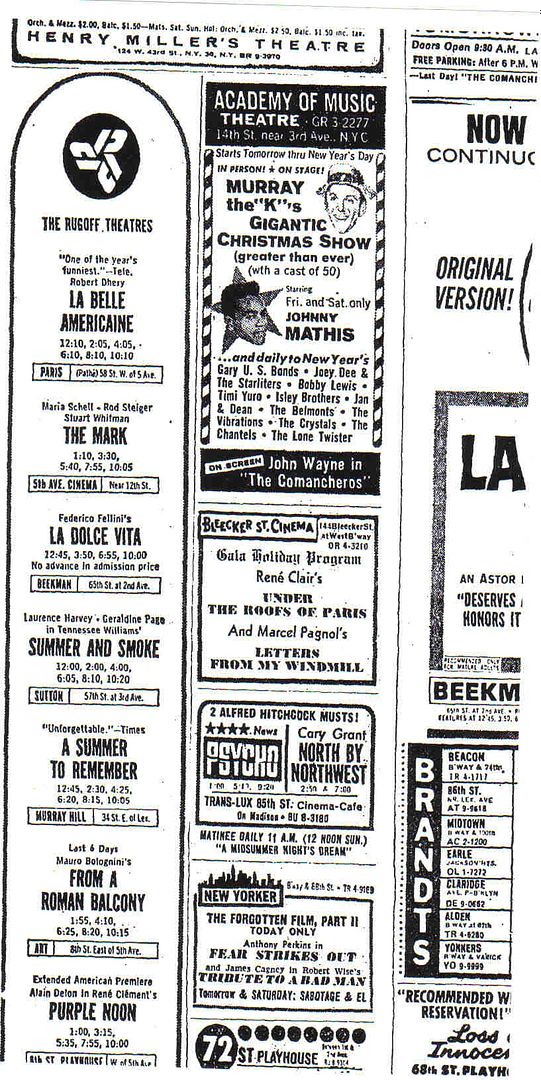
--126 E. 14th Street, between 3rd and 4th Avenues. A major rock venue of the '70s, and a humongous high-tech dance club in the '80s, this was the second theater building on 14th Street to bear the Academy of Music name.
The original Academy stood across the street at the northeast corner of 14th and Irving Place, and was "the city's first successful opera house," according to Terry Miller's
(New York: Crown, 1990). Designed by architect
. The Academy also has a
of American musical theater. In May of 1866, a
at the theater left a French ballet troupe stranded without a place to perform. The company, its scenery, and its elaborate stage effects were hastily added to a production of
; the resulting bizarre combination of Faustian drama and tutu-and-tights dance routines became a major hit and is widely considered to be the first full-fledged Broadway musical.
The Academy was restored after the fire, but it didn't last much longer as an opera house. In the Whartonesque high society of the times, one was looked down upon if one did not have a box at the opera--and to the frustration of newer Gilded Age millionaires, Old New York's most aristocratic families had long kept a tight hold on the Academy's eighteen boxes. In protest, the nouveaux riches decided to build their own palace of prestige further uptown--the original
near 39th Street, opened in 1883. This new house not only had ample boxes, it also had its own resident company and musical director--aspects which the Academy had always lacked. Old money was forced to admit
, and soon defected to the boxes at the Metropolitan. The Academy presented its last opera in 1885, and thereafter offered the public a mixture of theater, vaudeville, and later, films. [Click
for a cartoon depicting an 1871 ball held there in honor of the Grand Duke of Russia.
are essays about an early experiment in widescreen film shown there in 1897. Click
to see a program from December, 1909. Sammy Cahn was inspired to take up songwriting after witnessing a vaudeville show there, according to an anecdote presented on
. And
is a picture of the building's exterior taken sometime in the early 1900s--I can't discern if the
on the marquee refers to a live production or the 1914 DeMille film.] The theater was torn down in 1926; the
now stands in its place.
While the second Academy of Music was obviously named after its predecessor, music was not its original raison d'etre. According to one frequent and knowledgeable poster on
.
Another contributor remembers it as being "mostly a Fox or Universal programmed grindhouse." Unfortunately I haven't found any details about said films, or of possible vaudeville performers who may have graced the Academy's stage--but I did learn that the place was also used for the occasional
.
, the Valentines, the Heartbeats, the Wrens, the 3 Chuckles, the Bonnie Sisters, and the Count Basie Orchestra. The next rock act I've confirmed is the Rolling Stones, who played the hall on October 24,
.
(New York: Bantam, 1999 reprint)].
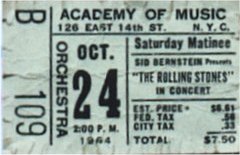
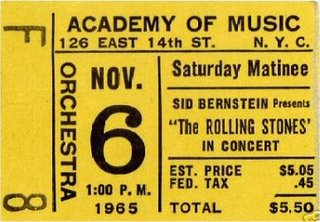
Another cinematreasures guy remembers seeing the Kinks and the Dave Clark 5--most likely that was on June 19, 1965, if
this Kinks info site is correct. Impresario
Sid Bernstein orchestrated these British Invasions. There were probably other shows, but such concerts seem to have been sporadic, isolated events--the Academy wouldn't hit its stride as a rock & roll stronghold until a few years later.
[UPDATE 7/13/2006: Add the Beach Boys to the list of mid-'60s Academy biggies--they played the hall on February 13, 1965. Glen Campbell had prior session commitments, so Brian fulfilled his old bass duties. This tidbit of info was culled from Brad Elliot's "Do You Remember?: A Chronology of the Beach Boys, 1964-65," an article in the ultra-fab
Dumb Angel Gazette # 4: All Summer Long.]
[UPDATE 7/17/2006: I should check the
cinematreasures.org page on the Academy more often...I just found out about Murray the K's "
Gigantic Christmas Show" over the 1961 holiday season. Headliners included Johnny Mathis from December 22-23, Bobby Vee from the 24th through the 29th, and Dion from December 30 through January 1. Other acts were nothing to sniff at, including Joey Dee & the Starliters, Gary U.S. Bonds, Timi Yuro, Bobby Lewis, the Isley Brothers, Jan & Dean, the Belmonts, the Vibrations, the Crystals, the Chantels...and the Lone Twister!]
[UPDATE 5/30/2010: Found this poster (on
britishinvasionradio.com) which might clear up a few things about other Invaders who played there. However, I've heard that the Moody Blues didn't get immigration clearance to play the show with the Kinks. There's a variation of the poster on
sidbernsteinpresents.com, a site for an upcoming documentary on the man.]

A fellow named
Howard Stein turned the Academy into the city's leading '70s rockitorium. Don't know very much about him apart from this colorful characterization in Anthony Haden-Guest's
The Last Party: Studio 54, Disco, and the Culture of the Night (New York: William Morrow, 1997):
Howard Stein is a New Yorker. A springy, dapper man, his black hair slick as polish on a balding pate, he has a bright grin but can switch from charm to chill in a nanosecond. Some attribute this to like father like son--Howard's father, Jack "Ruby" Stein, had been a loan shark, who ended up floating down the Hudson, sans head. About this, Stein is overly sensitive, although most of the grand young Euros in New York had family histories at least as baroque. Stein was one of New York's main producers of rock concerts in the late sixties. "Bill Graham was my major competitor," Stein says..."I was doing shows at a theater in Westchester County. I was like Castro. In the hills. Taking little shots, making forays, while he controlled the market in New York City. I did a Sonny and Cher concert when they were still wearing alpaca vests
."
That venue was the
Capitol Theater in
Port Chester; he also promoted shows at
Gaelic Park in the
Bronx's Riverdale section, and at the
New York State Pavilion in Flushing Meadow. Shortly after Graham closed the Fillmore East, Stein seized the opportunity to take over the Academy.
Apparently the place was even renamed Howard Stein's Academy of Music, but I haven't located a photo of any marquee signage that would corroborate this. Some notable performers/performances of the early to mid-'70s include:
A series of "Rock and Roll Revival"
oldies shows, featuring such groups as
Danny & the Juniors,
the Moonglows,
the Harptones, and
the Fleetwoods.
Alice Cooper with Wet Willie, late 1971.
Black Sabbath,
October 22, 1971.
The Band closed out 1971 with three shows, culminating in a special appearance by Bob Dylan at the stroke of midnight on New Year's Eve. This engagement was later documented on a live album,
Rock of Ages.
Hot Tuna played the Academy at least once a year through much of the decade--check out the dates
here.
The Grateful Dead, March 1972 (and the Spring of 1977).
New Riders of the Purple Sage, November 22 and 23, 1972.
Hawkwind had their U.S. debut there in November, 1973.
Lou Reed's pivotal live album
Rock and Roll Animal was
recorded there on December 21, 1973.
KISS,
Teenage Lust, Iggy and the Stooges and Blue Oyster Cult played on New Year's Eve, 1973. Iggy's set wound up on a 2000 live album,
Double Danger.
KISS opened for Argent and Redbone a few weeks later on January 26. [UPDATE 10/14/2008: A former Academy employee named Michael recently wrote to inform me that the Stooges didn't play on this bill. There is a scan of a newspaper ad for this show on the wonderful
Teenage Lust myspace page which lists BOC, Teenage Lust, and Iggy, but no KISS, so go figure. Also check out the fab page for
Harold's Loft.] [UPDATE 3/7/2009: I'm a little slow on the uptake but the fabulous Harold from Teenage Lust set me straight that this gig did go off as originally listed! Retina-searing pics from this show are on
Teenage Lust's myspace! GO THERE NOW!!!]
The New York Dolls' February 15, 1974 gig was dubbed the "St. Valentine's Day Massacre" (er, Mascara?). After opening acts Elliott Murphy and KISS were done, a special Bob Gruen film was screened. Entitled
The Lipstick Killers and styled like an old newsreel, it depicted the five Dolls as '30s gangsters, their natty suits offset by full makeup. "The film ends with them riding up 14th Street firing off machine guns, then running into the theater," recalls Gruen in Nina Antonia's
Too Much Too Soon: The Makeup and Breakup of the New York Dolls (London: Omnibus, 1998). "Then they would suddenly appear for real, running down the aisles wearing the same gangster costumes, shooting the audience. Now for some people in the audience who were on the right drugs and peaking at the right time, this worked amazingly well. I know some people for whom this was the experience of a lifetime! There was this one kid who got beaten up by the guards because he got so hysterically excited." [However, according to one
eyewitness the PA crapped out on every other song. And according to one commenter, KISS didn't play this show. The Gruen film can be seen in his Dolls DVD,
All Dolled Up.]
Fleetwood Mac, January 26 and October 5, 1974.
Soft Machine, with Renaissance and Larry Coryell's Eleventh House, March 23, 1974. [This conflicts with info on
kissfaq.com, which states that KISS, Renaissance, Eleventh House, and Argent were on the bill.]
[NOTE: Some of the above KISS dates are incorrect--please see the comment below.]
Poco, with the James Cotton Band, April 5, 1974.
Genesis,
May 4, 1974.
Gentle Giant shared a bill with those yodelin' fools Focus on November 1 and 3, 1974, and played there again with Alvin Lee on January 18, 1975.
Robin Trower wah-wahed his way through an April 18, 1975 gig.
Aerosmith are said to have frequently played the hall, but I haven't been able to confirm any dates.
According to
this article, many of the shows broadcast on ABC's
In Concert series were filmed there. And speaking of films, the cinematreasures.org page states that the place still operated as a B-movie theater by day throughout the decade. But by 1976, Howard Stein was out of the picture. Like Graham before him, he had found himself frustrated by the economics, and ego-nomics, of rock promotion. More quotes from
The Last Party:
"It was a secret that a small number of us know. About this new industry. The British Invasion. Where you could pay a band between $500 and $5,000 and it could make you $10,000...$25,000...$50,000...I remember paying $2,500 to Pink Floyd. On their last American tour I think they grossed $65 million...Suddenly all these obscure rock and roll bands had very powerful attorneys, very powerful business managers, and agents, and the deals they were offering were terrible...They were delegating promoters to being caterers, limousine orderers, drug dealers, and pimps...You got paid $25,000 while they grossed millions of dollars. And when you booked a marginal band there was an unlimited downside...It all changed...I remember Cat Stevens telling me that he wasn't coming onstage because the crabs on his backstage menu were not Alaskan King crabs. Or Alice Cooper complaining because the beer had to be in cans, not in bottles. Some promoter saying we had to take the green M&Ms out of the batches. Nobody appreciated This Is Spinal Tap
more than I did. I knew that it was time to leave. I had a little omen...I was doing a Grateful Dead concert. The marquee sign said HOWARD STEIN PRESENTS THE GRATEFUL DEAD. And it dropped its P. When I went to work that morning I saw HOWARD STEIN RESENTS THE GRATEFUL DEAD. And I knew the whole world had now discovered my secret. That I hated this industry...having no input into the musical productions...into the sounds...into the lights...into the advertising campaigns..." [B]ut he also hated being taken for a sucker, and thought he might effect a change by whaling into the agents...The agents said, "Fine!" They didn't call him anymore. Other suckers were beating their doors down. "Then when I decided I needed them, I called...They didn't take my calls...[I'd been] quasi-blackballed by the industry...I was stupid enough--I'm glad I was stupid enough--to think that rock and roll was dying. And that it was being replaced by disco."
[UPDATE 5/31/2011: The administrator of the
Academy/Palladium Facebook page pointed out that the ABC
In Concert shows filmed in New York were actually done at the Brooklyn
46th St. Rock Palace--a fact I did come across long after writing this post, but forgot to come back and fix here. Also, despite Stein's evocative anecdote about the dropped "P," he says there's no way a letter would have fallen off the marquee sign. "I was the one who would go out and change the letters on the marquee and trust me the letters were made of wrought iron and weighed about a pound a piece and locked in solid."]
Stein later re-emerged with clubs like
Xenon, the Rock Lounge, and Au Bar. Meanwhile, ravenous rock freaks still had use for the old hall--and so the Academy was renamed the Palladium, with superpromoter
Ron Delsener assuming the booking duties. Here's yet another non-exhaustive list of notable bands/shows--don't worry, it's got more coolness per capita than the one above:
The Band did a multi-night stand in September, 1976--their penultimate shows before the Last Waltz at Winterland.
Jeff Beck, October 18, 1976.
Bruce Springsteen & the E Street Band, October 28 through November 4, 1976, and September 15 through 17, 1978.
Here's a pic of him and Little Steven at the stage door.
Lou Reed again, November 13, 1976.
Neil Young and Crazy Horse, November 18 through 20, 1976. Neil's
Rust Never Sleeps concert film was also screened there in August, 1979.
Foghat, December 11, 1976--check out these
photos.
Frank Zappa, Christmas week 1976--recorded live for
Zappa in New York. He also did a Halloween gig in 1977, much of which wound up in the film
Baby Snakes--plus
another Halloween show in 1981.
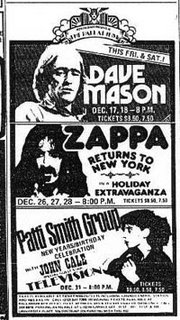
The Patti Smith Group, John Cale, and Television, New Year's Eve 1976--check out the
advert (which also shows dates for Dave Mason).
 Bob Seger
, with Rush as openers, March 6, 1977.
Rush played later that year on November 12 with UFO, Cheap Trick, and
Max Webster, and again on January 13 & 14, 1979. And Cheap Trick shared a bill with the Cars on
September 22, 1978.
Procol Harum had their 10th anniversary show there on May 15, 1977.
AC/DC made their New York debut supporting
the Dictators on August 24, 1977 (Michael Stanley was the opener), and apparently this was the first show in which Angus Young used a liberating
cordless guitar set-up. They
returned to open for Rainbow on August 24, 1978, and for UFO on June 9, 1979. The band finally headlined--sadly sans the late Bon Scott--on August 1, 1980, with support from Def Leppard and Humble Pie. Have a gander at some
great photos of that gig, including rare shots of the Palladium's
exterior and interior.
Thin Lizzy, October 22, 1977. The boys were back in town (sorry, couldn't resist) from September 29 through October 1, 1978, sharing the bill with Blue Oyster Cult.
Fresh from their New Year's Eve '77
It's Alive show in London, the Ramones headlined the Palladium on January 7, 1978, with
the Runaways and Suicide as openers. The show, recorded for the
King Biscuit Flower Hour, was recently released on
CD. It's nearly identical to
It's Alive, except the crowd noises reflect a certain Manhattan vibe, and Joey doesn't pronounce "Beach" as "Baych" or "DDT" as "D-Day-Tay." The band's other Palladium dates include October 6, 1977 (with Iggy Pop),
March 9, 1979 (with Lester Bangs' Birdland), and New Year's Eve 1979.
Angel, the Godz, and
Judas Priest, March 10, 1978.
Priest played there again at least three other times--April 21 and November 4, 1979, and July 22, 1981.
Elvis Costello was a fairly frequent Palladium Attraction--May 6, 1978, March 31, 1979, January 31 to February 2, 1981, New Year's Eve 1981, and August 27, 1989. At this last one, the vegetarian Declan apparently refused to go on until a banner reading "Burger King Presents Elvis Costello" was removed.
The Kinks,
June 2, 1978 and
New Year's Eve 1980.
The Rolling Stones similarly returned to the scene of some of their earliest NYC triumphs on June 19, 1978.
Blondie headlined on November 12, 1978;
Robert Fripp provided some Frippertronics to their set, and Mitch Ryder & the Detroit Wheels opened.
Blondie's previous Palladium dates include March 18, 1977 (opening for
David Bowie and Iggy Pop) and May 11, 1978 (with Robert Gordon and Link Wray).
The Clash played several
legendary Palladium shows:
February 17, 1979 with
the Cramps and
Bo Diddley opening (that was my 8th birthday--why didn't somebody take me???);
September 20 and 21 later that year, with support from the Undertones, Sam and Dave, and Siouxsie and the Banshees; and
finally on March 7,
1980. The
iconic cover image for
London Calling was taken at the 9/21/79 show.
Graham Parker and the Rumour, May 11, 1979.
The Boomtown Rats, sometime in May 1979.
Dire Straits, September 11, 1979.
Devo,
July 21, 1979 and
November 19 and 20, 1982.
Rory Gallagher, November 17, 1979.
The Buzzcocks, with the Fall and the Sports, December 1, 1979.
There was a power pop extravaganza on
December 13, 1979, featuring 20/20, the Sinceros, the Beat, and Bruce Woolley.
The Jam, February 29, 1980 and
May 15 and 18, 1982.
Public Image, Ltd., April 20, 1980.
The Pretenders, sometime in May, 1980.
Tom Petty and the Heartbreakers, July 4 and 5, 1980--betcha he opened with "American Girl."
Tom Waits, November 18, 1980.
Pat Benatar, November 22, 1980.
Squeeze, January 31 to February 2, 1981.
Ozzy Osbourne, with the late
Randy Rhoads on guitar, May 2, 1981.
U2,
May 29, 1981, and
May 11, 1983 with the Dream Syndicate.
I'd go on, but my research time is limited. Basically it seems like most well-known late-'70s touring acts not big enough for the Garden--or who wished to avoid the Garden altogether--trod the Palladium's boards at some point in their careers. More names and dates are listed on
this ticket stub site--looks like an awful lot of Palladium shows were sponsored by
Mateus wine. What I'd really love to add are descriptions of the Palladium's general atmosphere and decor--but pertinent anecdotes have been hard to find.
Sometime around '83/'84, concerts stopped and the building was shopped around to other developers.
Steve Rubell and Ian Schrager, then searching for a place to build upon the legacy of
Studio 54, inspected the site. At first they were wary--opening a club in yet another old theater would inevitably invite comparisons to Studio. But when the other locations they scouted proved unsuitable--including "bus garages on Ninth Avenue, the East 68th Street heliport, the disused train station under the Waldorf-Astoria...the
Cloud Club in the
Chrysler Building...[and] a savings bank on W. 36th Street," according to
The Last Party--they cast their lot with the Palladium. The name was retained, and "when
architect Arata Isozaki was asked to adapt the classic theater for use as a slick disco...he did [so] by honoring rather than obliterating its staid interior," as described in
Greenwich Village and How It Got That Way. The balcony, plaster moldings, and stage were cleaned up a bit and left intact; the orchestra pit was leveled for dancefloor use, and a multilevel cubic grid with lights and video screens galore was built around it. To add to the
visual overload, downtown artists like Keith Haring, Francesco Clemente, Eric Fischl, David Salle, Laurie Anderson, Kenny Scharf, and Jean-Michel Basquiat were commissioned to create paintings, installations, and videos. The design-conscious building was so vast it could hold clubs-within-the-club--such as the Mike Todd Room, a "VIP" lounge housed in what was said to have been the private screening room of the eponymous producer/Liz Taylor Husband #3. (In turn, the Todd Room was itself large enough to have its own separate VIP areas, nicknamed Betty Ford In-Patients and Out-Patients.) The Palladium opened in May 1985; its ensuing fortunes and
phases ebbed and flowed throughout its existence, finally petering out in the late '90s after several years as part of Peter Gatien's scandalous empire.
Here's a picture of the marquee, probably taken near the end. It was always mainly a DJ-fied dance club, but the occasional live show was held there--including
Einsturzende Neubauten,
Elvis Costello,
Neil Young,
Debbie Harry, and
the Dictators. I was there exactly one time that I can recall, ca. '89/'90, for a show with Fishbone, the Dead Milkmen, and an unannounced "special guest." As I'd surmised, it was 2 Live Crew, then at the height of their PMRC infamy. I don't remember much from the show, save for marveling at the still-extant plaster wall details up in the balcony.
The Palladium--along with Julian's Pool Hall on the second floor--was demolished in 1998. NYU soon planted its ubiquitous purple flag on the
empty lot, and by 2001 the massive
Palladium Residence Hall and
Athletic Facility loomed overhead. Seems like 14th Street is not as pronounced a border between Uptown and Downtown anymore.
[UPDATE 1/6/2007: Manhattan's first branch of Trader Joe's was installed in the ground floor retail space of NYU's complex in the spring of 2006. I recently located both a
NY Times article and a
myspace page devoted to the Palladium's dance club era. I was also recently contacted by a good fellow who worked at the Academy of Music during the Howard Stein era...if
I'm real good, maybe he'll share some memories of his stint there. This person had a query about the name of the promoter who organized the Academy's oldies shows in the late '60s and early '70s. I'm stumped--any takers?]

[ADDENDUM: A while back I came across this photo (and can't recall which site I pilfered it from--forgive me). Obviously these are all '60s acts, but I assume this was probably a '70s-era oldies show. Haven't located any info on it, though.]
[ADDENDUM 4/24/2009: A fellow named Kevin kindly sent me a night-vision photo of the same marquee, and confirms that "Murray Kaufman's last-known musical extravaganza" took place in July, 1978.]

UPDATE 12/19/2010: The cinematreasures.org page for the
Academy of Music has a lot more posts now than when I first consulted it to write this entry, and many of them are rock and roll-related. One guy on there seems to be on a mission to track down the dates for every rock show held there. His list as of his 2008 post isn't complete, but he was well on his way. There are also lots of cool comments about the Academy's/Palladium's atmosphere (the general consensus being that it was kind of a dump), plus some insightful behind-the-scenes anecotes from people who worked there. (The site has also established a page for the
original Academy of Music, since it did operate as a movie theater near the end of its existence.) I've found some ads for late '60s and early '70s Academy shows in the
Village Voice archives, and the Getty Images site has some cool pics of the Beach Boys and the Stones playing there in the mid-'60s--check 'em out
here. There's also a yahoogroup and a
Facebook group for the joint (and a
FB group for its dance-club era too). Here are a few pics from cinematreasures depicting the Academy in its earlier days (the first one shows firefighters putting out a small fire there while a crowd watches from across 14th Street).
UPDATE 7/15/2012: Over the last couple of years I've gathered as many Academy/Palladium ads from the Village Voice as I could find. Use the search function or click on the Academy or Palladium labels to locate the posts featuring these ads.
UPDATE 9/18/2013: The Bedford + Bowery blog recently did a couple of posts about the Academy/Palladium.
The first one includes some tales from a few folks who played there, and
the second includes a tribute to Sid Bernstein.