I'm back--hopefully on a far more prolific basis than I was throughout 2006. Sorry, my head was just in a whole 'nother place, so the best I could manage were various little updates here and there. Thanks to all the fine folks who left comments, corrections, and encouragements--your input is most appreciated.
A while back, and I'm ashamed to say it was well over a year ago, Peter Crowley--former booker for Mother's and Max's Kansas City and manager of W/Jayne County--stumbled upon my sketchy entry on Mother's and contacted me about it. Deeming it "pretty accurate but incomplete," he kindly offered some further background details on the joint, which I shall henceforth paraphrase.
Crowley's association with Mother's began in 1974. He had been attempting to get Wayne County and the Back Street Boys a gig at CBGB to no avail, and asked a friend named Mike Umbers if he knew of any other bars where he could put on shows. Umbers recommended Mother's, a gay bar that was struggling to make a go of things. The management were amenable to Crowley's ideas and allowed him to turn the place into a rock & roll club.
Mother's occupied two narrow storefronts on 23rd. They shared a common disused kitchen area at the back, which served as a makeshift dressing room. Entry to the club was through the right-hand/eastern storefront, where the bar and jukebox were located. At the rear by the end of the bar you'd find the entrance to the "back room," or the left-hand storefront, where the shows would take place; admission, usually 3 bucks or so, was collected at this doorway. There had been a tiny stage by the blacked-out front window when Crowley arrived, but he enlarged it to accommodate bands.
During the first week Wayne County and the Backstreet Boys played two shows a night, with rotating support from the Fast and the Outkids--and the response was so good punters sometimes had to be turned away. Crowley stayed on at Mother's until a point in 1975 when he was hired to be the music and art director of Max's Kansas City. Some Mother's regulars took the place over and changed its name to ZEPPS. They continued to book bands there for a couple of years afterwards, but I have been unable to locate any reference to this incarnation of the club.
Showing posts with label Peter Crowley. Show all posts
Showing posts with label Peter Crowley. Show all posts
Wednesday, February 07, 2007


Monday, October 03, 2005
Mother's ilk
MOTHER'S--267 W. 23rd Street, between Seventh and Eighth Avenues. A gay bar that briefly served as an early punk club in the mid-'70s. Clinton Heylin writes in From the Velvets to the Voidoids (New York: Penguin, 1993), "In the spring of 1975 Mother's, a gay bar on 23rd Street, began competing for the best new bands...[it soon became] the main alternative to the CBGBs/Max's duopoly." Peter Crowley, who was then Wayne County's manager, handled the bar's booking duties. Among the bands he booked were:
Blondie, October 3-5 and November 13, 1975, and an unspecified date in January, 1977. In Making Tracks (New York: Da Capo, 1998), Debbie Harry remembers, "The first gig we played together [with Jimmy Destri] was at Mother's, which was a bar made into a small club on W. 23rd Street across from the Chelsea Hotel, where everyone played at least once."
The Ramones shared those October dates with Blondie, and also played December 5-7, 1975 according to this ad (accessible from the Blondie gig list above if this link doesn't work). An A&R-hunting Linda Stein checked out the band on one of these nights, and later gave a full report and thumbs-up to her flu-stricken hubby, Sire Records owner Seymour Stein. As she recalls in Jim Bessman's Ramones: An American Band (New York: St. Martin's Press, 1993), "It was a gay bar for elderly gays. It was really a cold, winter, snowy night. Of course, they did 'Blitzkrieg Bop' and all the standards. I was fascinated by the simplicity of the lyrics and the beat, and by Dee Dee, who was always so sexy and cute! I came home and told Seymour, 'You gotta sign them!'" He auditioned them soon thereafter, and the rest is gabba gabba history.
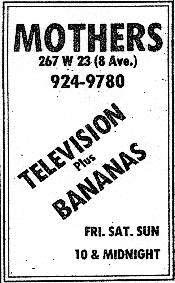
Television, with Bananas, October 17-18, 1975. Richard Lloyd describes the place as a "little teeny crappy club" in this article.
I kinda figured Nancy Spungen would have been a regular there, since she lived about a block west on 23rd Street during this time. Her mother Deborah makes no mention of it in the essential And I Don't Want To Live This Life (New York: Ballantine, 1983; reprint, 1996), but McNeil & McCain's Please Kill Me (New York: Grove, 1996) does have an anecdote from the Senders' Philippe Marcade about the night she introduced herself and asked him to teach her how to shoot up properly.
That's all I've been able to find thus far. Peter Crowley went on to book shows at the second incarnation of Max's. Reports in Yvonne Sewell-Ruskin's High On Rebellion: Inside the Underground at Max's Kansas City (New York: Thunder's Mouth Press, 1998) state that new owner Tommy Dean was attempting to give the place a misguided T.G.I.F.'s-style makeover, replete with stained glass decor and bow-tied waitresses, when Crowley stepped in to bring rock & roll back. "He basically came on board as Wayne County's manager, and since Wayne was the DJ and was an attraction at Max's, Crowley became insinuated and sold himself to the Deans, who I think really didn't know the music at that point," says musician/writer Jim Lalumia. Under Crowley's direction, Max's shared--or rivaled for, depending on your P.O.V.--punk prominence with CBs, until its 1981 closure.
Not sure when Mother's closed, but the space is currently a branch of Ricky's, the beauty-supply chain.
[UPDATE 2/7/2007: Here's some further info, generously provided by Peter Crowley!]
Blondie, October 3-5 and November 13, 1975, and an unspecified date in January, 1977. In Making Tracks (New York: Da Capo, 1998), Debbie Harry remembers, "The first gig we played together [with Jimmy Destri] was at Mother's, which was a bar made into a small club on W. 23rd Street across from the Chelsea Hotel, where everyone played at least once."
The Ramones shared those October dates with Blondie, and also played December 5-7, 1975 according to this ad (accessible from the Blondie gig list above if this link doesn't work). An A&R-hunting Linda Stein checked out the band on one of these nights, and later gave a full report and thumbs-up to her flu-stricken hubby, Sire Records owner Seymour Stein. As she recalls in Jim Bessman's Ramones: An American Band (New York: St. Martin's Press, 1993), "It was a gay bar for elderly gays. It was really a cold, winter, snowy night. Of course, they did 'Blitzkrieg Bop' and all the standards. I was fascinated by the simplicity of the lyrics and the beat, and by Dee Dee, who was always so sexy and cute! I came home and told Seymour, 'You gotta sign them!'" He auditioned them soon thereafter, and the rest is gabba gabba history.

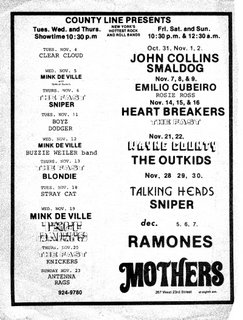
Dig some of the other bands listed in the ad, including Mink DeVille, Sniper (so they did continue after Joey's departure after all), the Fast, Tuff Darts, Knickers (Jimmy Destri's pre-Blondie band, also featuring future Trouser Press scribe Ira Robbins), Rosie Ross (formerly with the Stillettoes), the Heartbreakers, Talking Heads, and Wayne County. The ad's heading reads, "County Line presents New York's hottest rock & roll bands"--I guess Crowley named his company after Wayne.
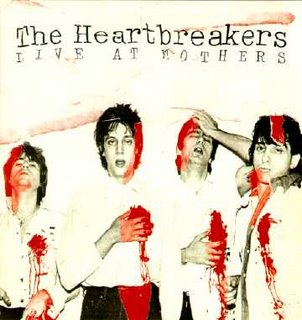
Speaking of the Heartbreakers, their 1976 Live at Mother's is available from New Rose/Fan Club Records.
Television, with Bananas, October 17-18, 1975. Richard Lloyd describes the place as a "little teeny crappy club" in this article.
I kinda figured Nancy Spungen would have been a regular there, since she lived about a block west on 23rd Street during this time. Her mother Deborah makes no mention of it in the essential And I Don't Want To Live This Life (New York: Ballantine, 1983; reprint, 1996), but McNeil & McCain's Please Kill Me (New York: Grove, 1996) does have an anecdote from the Senders' Philippe Marcade about the night she introduced herself and asked him to teach her how to shoot up properly.
That's all I've been able to find thus far. Peter Crowley went on to book shows at the second incarnation of Max's. Reports in Yvonne Sewell-Ruskin's High On Rebellion: Inside the Underground at Max's Kansas City (New York: Thunder's Mouth Press, 1998) state that new owner Tommy Dean was attempting to give the place a misguided T.G.I.F.'s-style makeover, replete with stained glass decor and bow-tied waitresses, when Crowley stepped in to bring rock & roll back. "He basically came on board as Wayne County's manager, and since Wayne was the DJ and was an attraction at Max's, Crowley became insinuated and sold himself to the Deans, who I think really didn't know the music at that point," says musician/writer Jim Lalumia. Under Crowley's direction, Max's shared--or rivaled for, depending on your P.O.V.--punk prominence with CBs, until its 1981 closure.
Not sure when Mother's closed, but the space is currently a branch of Ricky's, the beauty-supply chain.
[UPDATE 2/7/2007: Here's some further info, generously provided by Peter Crowley!]
Subscribe to:
Posts (Atom)