I can't believe I missed this one--the Village Voice blog did a wonderful Q and A with Allan Arkush in May, during their week-long salute to what would have been Joey Ramone's 60th birthday. Thanks to my Bomp buddy Ted L. for the link. Here's my fave quote, in a piece with a million of 'em:
"Riff Randell was based on three women I knew at the Fillmore East, when I was an usher and backstage hand there, while I went to New York Film School. Diane, Gayle, and, uh, I can't remember the third one. Just three girls from Brooklyn and Queens who used to hang out, and we'd talk about music. And they had different taste than I did. They were much more into the flash English bands than I was, like Bowie and T. Rex. And whenever there was an open seat, I'd get them good ones. And they were such avid rock fans--they were Riff Randell. And in 1969, they got on line for tickets for a Rolling Stones show in town, and got their picture in the paper. And that's where I got that stuff in the movie, with Riff sleeping on line for the tickets to the Ramones show."
I knew he must have worked there--you can see him sporting a Fillmore jersey during the ticket-taking scene. Here's my DVD booklet cover, with Mary Woronov's autograph:
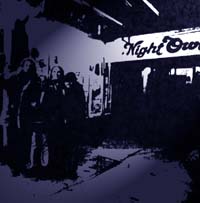
The latest issue of Shindig has a cool piece by Domenic Priore on John Sebastian's Village days. Here's a moody shot of him most likely taken at the Night Owl--I think it was scanned from an ancient teen mag by my pal Allison.
Lastly, I just finished Steven Tyler's memoir. As I'd been forewarned, it's mainly full of anecdotes about sex, drugs, rock and roll, and still more drugs (severe later-in-life painkiller dependencies from over-medicating his numerous aging rocker stage injuries). But I read it mostly for his account of his early years on the NYC scene, and while he doesn't linger in that part of his past for very long, I did enjoy his recollections. However, I've been advised that his Left Banke story leaves much to be desired in terms of validity...and later I was stunned to see him take a writing credit for "Big Ten Inch Record." So while the book is an entertaining read on the whole, it's probably best to take much of what he says with a surfeit of sodium. I'm told another book on Aerosmith called Walk This Way goes into greater detail about the Chain Reaction, so I may check that out at some point.
I'd also be discussing the new 33 1/3 volume on Television's Marquee Moon here, were it not for the Canada Post strike of the last couple of weeks. Thanks Bryan!
In a feeble attempt to combat my constant homesickness, I compile tales of New York City rock & roll landmarks, most of 'em long gone. Moronic musings on various other enthusiasms are also thrown in for good measure.
Showing posts with label Lovin' Spoonful. Show all posts
Wednesday, June 29, 2011
Wednesday, July 14, 2010
Now they know how many holes it takes to fill the Albert's halls
ALBERT HOTEL--East side of University Place between 10th and 11th Streets. Most famed for its phase a flea-bag flop that fostered a number of '60s rock luminaries and other creative eccentrics, the Albert started out as a fairly fancy hotel/residence. Its original section at 42 E. 11th Street (or 75 University Place) was built by William Ryder, who named it in honor of his brother, painter Albert Pinkham Ryder. Luther S. Harris offers a description of its architecture in Around Washington Square: An Illustrated History of Greenwich Village (Baltimore: John Hopkins U. Press, 2003):
[I]n 1883, the Albert Hotel opened on the southeast corner of 11th Street and University Place. This was a new building designed by up-and-coming architect Henry Hardenbergh, who was simultaneously working on his famous Dakota apartment house at 72nd Street and Central Park West. Hardenbergh chose bright red brick and white stone for the Albert's facades, to which he deftly added rounded balconies intermingling with squared ones, iron balconies intermingling with stone balustrades, and fanciful ornamentation. Delicately carved shells and leaves, pendants and cartouches, Corinthian colonnettes and geometrical forms, and even a few neo-Gothic monster masks were applied with the mastery of composition that brought him fame. It was--and is--a wonderful addition to the neighborhood.


Via.
[UPDATE 8/12/2011: William Ryder was actually the hotel's manager, not owner...and the name Albert comes from the original owner/investor, Albert S. Rosenbaum, not Albert Ryder. All this and much more is revealed at the fabulous Hotel Albert site, truly the last word on Albert Hotel history--which wasn't yet online at the time I was writing this piece! See more in my note at the end.]
The place must have done pretty good business for a few decades there, as it was solvent enough to undergo two expansions. A 12-story Beaux-Arts addition just south of the building (at 65-67 University Place) was opened in 1905, and a 6-story neo-Georgian annex south of that (at 23 E. 10th Street, or 63 University Place) was opened in 1923. Some notable guests, residents, and/or visitors included P.T. Barnum, General George McClellan, Mark Twain, Robert Louis Stevenson, Leo Tolstoy, and Thomas Wolfe. You can see part of the 10th Street building and the south side of the 12-story addition in this mid-1940s home movie (starting around the 8:31 mark). Speaking of movies, the Albert is apparently also mentioned as a pivotal plot device in Rear Window.
Considering its largely literary clientele, I suppose the Albert must have had a long reputation as an artist's haven. But at some indeterminate mid-century point, its stature seems to have slid from a bastion of genteel bohemia into a full-blown down and dirty dump. Al Hansen, father of Warholite Bibbe Hansen and grandfather of Beck, sets the hotel's '60s scene well in this 1984 article on the Andy Warhol shooting:
Also in the 1880's there was a family in Lower Manhattan who owned a lot of hotels. Each hotel was named after a son. Albert Pinkham Ryder, a famous painter, had the good fortune to be born to them and not many of the crazy artists in the HOTEL ALBERT realize it is named after him. Artists, writers, filmers and rock groups on the way up stay at the CHELSEA HOTEL on West 23rd Street. The damaged and the losers on the way down stay at the ALBERT HOTEL on University Place in the Village. Chelsea is uppers; the Albert is downers. Coke in the penthouse; smack in the ghetto. I live a yo-yo life. After a few economic disasters I had to move to the Albert with my main woman Valerie Herouvis...Some people got so fucked up the "Albert" is on the way UP for them. Einstein wasn't kidding when he thought up the theory of relativity. We never could have had the Twentieth Century without it.
In a recent post on thegearspot.net, a pal of Mike Bloomfield sums up the Albert's particular appeal to musicians thusly:
There was a flea bag hotel called the Albert Hotel on 11th Street where many of the rock musicians touring in New York would stay at because it was really cheap, and also because the hotel management would let bands rehearse in the basement. There used to be all night jam sessions at the Albert after the clubs in Greenwich Village closed.
Whether management charged extra for basement rehearsal privileges is unclear--but so many cash-strapped rockers and folkniks took advantage of the facilities that they may well have been included in the daily room rate as a basic amenity. Of course, this underground lair was decidedly not the "best of cellars," as it lacked even the barest creature comforts typical of your modern rehearsal space. Since thee most famed denizens of that den of musiquity were the Lovin' Spoonful, let's visit some Lovin' Albert lore. Here's how Steve Boone remembers it, from the website of the Spoons' current incarnation:
In the winter of of '65 we played our first gig at Joe Mara's Night Owl Cafe on West 3rd St in Greenwich Village and were told by Mr. Mara to go back and practice some more and come back and he would give us another chance. Well that was some good advice. Practice we did at the Albert Hotel on W. 10th St. in the basement alongside the laundry room, the trash chute, the cockroaches and oh yeah the Paul Butterfield Blues Band.
Apparently the Spoons and the Butterfields hung out and talked plenty of shop during this time, and Mike Bloomfield came to admire John Sebastian's '59 sunburst Les Paul Standard so much he eventually had to get one for himself. (The Albert would also later play a role in the formation of the Electric Flag.) I'm wondering how Sebastian was able to afford such a nice axe (which he may not have used that much anyway--didn't he usually play the autoharp onstage?) when the Spoons were living a rather hand-to-mouth existence at the Albert, if Joe Butler's quote in the Do You Believe in Magic? reissue's liner notes is to be believed:
"The first time I met Denny Doherty and Cass Elliot we would up in bed together," Butler chuckles. "It had nothing to do with sex--we were cold, staying up all night in a room at the Albert Hotel, huddled together watching TV movies, trying to keep warm. The woman who was the night manager loved Denny, and whenever the bills would pile up, we'd send him down to pitch a little woo in her direction. She'd tear up our bills and we could stay another week. We didn't have a nickel. We were literally going around scrounging for pop bottles to return to get some money." At one point most of the band plus their equipment wound up crashing in one room belonging to a woman named Butchie, immortalized in "Butchie's Tune" on the Daydream album.
Speaking of Denny and Cass, Denny Doherty's site features a humorous history of the Mamas and the Papas, in which the Albert is mentioned several times. NY Songlines says John Phillips wrote "California Dreaming" at the Albert, but most accounts I've found say it was written at the Earle (now the Washington Square). But getting back to the Spoons...the original liner notes to the Do You Believe in Magic? LP paint an even less luxurious picture of the Albert's subterranean squalor:
Firmly they retreated to the basement of the Albert Hotel. Each day they would take the freight elevator down, the electric stuff filling a laundry cart. They had to cross an enormous black pool every day in the basement, which was full of water bugs, centipedes, and sightless fish. Ancient flakes would be vibrated loose from everything and a soft rain of plaster covered The Lovin' Spoonful like dandruff. They started wearing different funny hats to keep their hair clean. The lower echelons of the hotel staff cheered them on neglecting all work for a period of days, then the boss cracked. After two months they emerged, pale and blinking, and marched on the Night Owl. Their new professionalism so impressed the owner that he cheerfully rehired them for an indefinite period of time and at his own expense had printed up 1000 balloons saying "I LOVE YOU - THE LOVIN' SPOONFUL." "It had to happen," said John.
This description of the basement's ecosystem, from an article on Tom Pacheco, is not for the squeamish either. Pacheco lived at the Albert for a spell while his band the Ragamuffins did a residency at the Night Owl, alongside the Lost Sea and the Flying Machine.
Tom lived for a while with [band member] Sharon Alexander at the Albert Hotel. He liked to do his songwriting all night (and still does). Because he didn't want to wake Sharon up, he'd ride the old freight elevator to the basement. He had to squeeze through tight crawl spaces to a center room where he would write until 6am. Huge cockroaches by the thousands inhabited the basement, making his passage there more than uncomfortable. They'd scatter when he turned the light on. [The author knows from personal experience, the way they also drop from overhead--are we squirming yet?] Now, that's dedication.
The aforementioned Flying Machine included James Taylor, who has offered his memories of the Albert in such fine publications Billboard and Mojo:
"Zack and I lived in the Albert Hotel in Greenwich Village on a floor that was burned out except for this one room," recalls Taylor. "Getting to the room was a little smoky, a charred experience, but the room itself. . .wasn't great either, haha. Yet the rodent and cockroach population had at least been discouraged by the fire. We rehearsed in the basement of the Albert, and shortly thereafter we became the house band at the Night Owl Cafe on West Third Street off MacDougal, doing three, four sets a night in between stands by Turtles and Lothar And The Hand People. Things were going OK until we made the mistake of trying to cut a record in 1966..."
The Mothers of Invention bunked at the Albert several times, and there are a couple of surreal and sexy anecdotes about their stays in Google Books. In a 1989 Q Magazine interview, Zappa mentioned the Albert during a discussion on drummer Billy Mundi's decision to decamp for Rhinoceros in '69: "I don't blame Billy for taking the job, because at that time we were so poor he was living in the Albert Hotel and he couldn't get enough to eat—he used to come in and tell us how he'd quell his appetite by drinking the hot water in the shower in the Albert Hotel, which could be a life endangering experience. When somebody comes up to you and says, you're going to get something to eat, and not only that, you'll be in a super-group called Rhinoceros, I couldn't even advise him to stick around."
Numerous garageniks and psychsters, both local and touring, found the Albert's accommodations to be among the few in town that fell within their budget. Here are some references I've found via various sites and online fanzines.
The Blues Magoos (from an interview with Ralph Scala): "We were playing for food, friendship and a place to play. Eight bucks a night a piece, ten bucks a night a piece...You put all your money together and we're crashing Hotel Albert. So, that's all you do. And then, when you really get desperate and starving, we'd take a day or two off and go back to our parents house and crash." Some legends have it that the Magoos committed one of the the earliest known hotel-window TV chuckings at the Albert in '66.
The Sopwith Camel: "While staying in "the Village," they played the Night Owl Cafe, stayed at the Albert Hotel and toured the East Coast with the Lovin' Spoonful."
The Shadows of Knight (interview with Jim Sohns): "We were staying at the Albert Hotel in New York where most of the bands stayed. After that, I met Janis Joplin wandering through the hallways. She had no room or place to stay. I bopped her. But, I don't feel like The Lone Ranger. She was pretty attainable there for a while."
The Random Concept. From an interview with Garry Higgins: "It was basically a music hotel and they allowed us to rehearse in the basement. I don’t know about everybody but several bands were there for a while…they rented rooms as well, and they had suites. I know that there were some [bands] that came to town and would rehearse while they were in town, I’m not sure about other folks. I think we lived there for about 6 months or so. We were centered there and we would go play wherever we could play." Member Simeon Cox, who would eventually go on to form the Silver Apples, recalls: "We decided that maybe it was time to try our luck in New York--the scary Big Apple--so we contacted a booking agent named Max and drove down to the Albert Hotel on 10th Street and rented 3 rooms by the week. A five piece band, plus girlfriends, roadies and other hanger-ons made for a constant party on the 7th floor of the Albert Hotel. Frank Zappa's Mothers of Invention were also staying there as were a group from the midwest called Ill Wind, a coffee house band called The Lovin' Spoonful, and Mike Bloomfield and his guys. It was an active hotel. They let groups rehearse in a room in the basement and we all got to know each other because of that--using each other's equipment and so forth."
The Birth of Spring, a short-lived group featuring former Left Banke guitarist Jeff Winfield and Banke associates Alan Wauters and future Arrow Alan Merrill. No juicy anecdotes to speak of, but here are the only interior photos of the Albert that I've managed to find (Wauters in the first, Winfield in the second), courtesy of the leftbankism yahoogroup and leftbanke.nu.


Truth (Dallas band, including members of the Briks and Kenny and the Kasuals. From an interview with guitarist Richard Borgens): "The most memorable time with Truth was part of a summer spent in New York City playing clubs in Manhattan like Scott Muni’s Rolling Stone Club. Being naïve, we decided we wanted to stay at a musician hotel in the village. So we all had a big room in this absolute dump, The Albert Hotel, where some of The Lovin’ Spoonful and Tim Buckley were to have lived. Right across the street was a gay bar called The Stirrup 77. So in I went thinking I had found a little piece of the southwest in The Village of all places…not knowing anything about cowboy “code” in those early days of the gay scene in New York City. My! Everyone was really nice to me, buying me cigarettes and beer, and me with my long red hair, cowboy boots, and fringe jacket. Being basically clueless, it took me a while to figure out there were no girls in the bar. Talk about a panicked, yet measured, departure." [I have a feeling Kenny & the Kasuals might have stayed there during their earlier visit as well.]
Kaleidoscope (interview with Chris Darrow): "We were all huddled into two rooms in the Albert Hotel in Greenwich Village. Some of us had women, there were instruments everywhere - it was awful. To go from living in the middle of a sunny litle lemon grove in California to being marooned in the middle of New York at the beginning of winter just shook me to pieces."
Clear Light: "The group is met by Danny Fields, who checks the musicians into Albert’s Hotel. The band initially plays at Steve Paul’s Scene East in the Delmonico Hotel but on the first night Schuckett lambasts the crowd for not paying attention to the group’s performance and it is fired. The next day, Steve Paul places the group at his main club, The Scene." From their official page: "In December they then embarked on a tour of the East Coast, playing at the Boston Tea party before arriving in New York, where they stayed at the Albert Hotel, a notorious hang out popular with many visiting rock groups and a focus for the groupies that followed them." And from an interview with Dallas Taylor: "We all lived in one room of the Albert Hotel. Our road manager Lee Housekeeper would run across the street at 4:00 am to the corner deli after the delivery truck would carelessly leave the morning pastries right out in the open for Lee to steal. We actually 'ate cake' to keep from starving."
Moby Grape stayed at the Albert while working on their second album, and unfortunately their home away from home was the site of Skip Spence's ultimate freak-out, an axe-wielding horror story after which he was never the same. Read about it elsewhere, it's too heartbreaking for me to quote here.
Since I want to conclude this band list on a positive note, I'll leave you with a link to the most amusing Albert anecdote I've found to date, from Richard X. Heyman's memoirs, Boom Harangue. It's a bit lengthy to quote here, but let's just say it involves Tampax and Townshend in equal measure.
Speaking of...the man who first turned Townshend on to the blues and the demon weed, Tom Wright, lived at the Albert for a while, sharing the "presidential suite" with the Blues Magoos' drummer. He writes evocatively of his time there in his memoirs, Roadwork: Rock & Roll Turned Inside Out (New York: Hal Leonard, 2007). I'll poach a few good quotes here:
[The] Albert Hotel was a secret. Muddy Waters could tell you about it. Bob Dylan could tell you about it. The Moby Grape could make a mini-series on it...[It was] about thirty blocks from classy hotels and about ten blocks from the really shitty ones. The Albert was about fifty years past her prime; at one time posh, when I got there it was rundown and cheap. It had roughly twenty floors and didn't really look that bad from the outside, all granite and stone. It was the seedy characters wandering the sidewalk that gave it away. Bob Dylan used to practice there, but when I lived there in 1968, after I'd road-managed the Who's first headlining U.S. tour, it was folk rock singer Tim Hardin in the basement. But mostly it was Moby Grape...[A]t night, if you got real quiet at your place and lay down, you could hear them in the basement. And nine times out of ten it'd be great...Since the Albert was in the gray area, it was hard to book. No wandering family of tourists would ever just stroll by, and it was too expensive for bums and people who were actually broke for real. So the management let rooms to selected renegades--certain musicians, hookers (if they were beautiful and discreet), drug salesmen, artists, gangsters.
In the interest of shedding some light on the Albert's camp element, here's a link to the memories of a pre-Stonewall transsexual who stayed there, and here's a link to a front-page 7/31/69 Voice article on Jackie Curtis' "wedding that wasn't" at the hotel. [Speaking of local newspapers, apparently The Villager had office space on the Albert's ground floor during the '70s.] And the Cockettes stayed there during the run of their show at the Anderson Theater. I remember seeing some footage of the place in the Cockettes documentary, and "Sweet" Pam Tent wrote quite a bit about it in Midnight at the Palace: My Life as a Fabulous Cockette (Los Angeles: Alyson Publications, 2004). Here is her initial impression:
The lobby of the Albert was about as inviting as any low-end residential hotel, only the walls were painted an institutional green and covered with signed photographs of traveling celebrities who had graced the rooms of the once-renowned "rock star hotel." Having seen a number of better days, the images of entertainers--including Buffalo Springfield, the Youngbloods, and the Turtles--hung unceremoniously on the cracked walls. A trio of elderly residents stood in attendance for our arrival, and the air was stale with the smell of old carpet, disinfectant, and boiled potatoes. The Albert had become a derelict hotel with a history of drugs and debauchery. It was now due for yet another chapter. We got our first hint of things to come as we dragged our bags into the creaky elevator cage to go up to our "suites"...The bare bulbs hanging from the ceiling, the old stained wallpaper, and the cracked bathroom tile looked hellish compared to the fantasyland we'd built for ourselves on the West Coast.
By then, and for the rest of the decade, the Albert had joined the ranks of the Greenwich, the Broadway Central, the Earle, and the Marlton as one of the Village's notorious SRO's. But in 1985, it was completely renovated and converted into a cooperative apartment building--presumably with a comprehensive pest control program in place, and with no woodshedding allowed in its nether regions.
UPDATE 10/17/2010: I just finished reading Eddi Fiegel's Dream a Little Dream of Me: The Life of "Mama" Cass Elliot (London: Sidgwick and Jackson, 2005), and found a few more more Albert Hotel details therein. The Mugwumps initially based themselves in Washington, D.C., but when their manager booked them for an engagement at the Peppermint Lounge, they relocated to New York to maximize their music biz opportunities.
Piling their belongings into the Buick, they headed back to New York, this time to the Albert Hotel, one of the most widely used rock 'n roll lodgings at the time. Situated just off Washington Square in the heart of the Village, the Albert was an old grande dame of a fin de siecle building, complete with ballroom and grand staircase, which had now become somewhat grouchy with old age. In contrast to the earlier comfort of her apartment in Gramercy Park, Cass now had to make do, like the rest of the band, with the less salubrious cockroach-ridden faded grandeur of the Albert. But down at heel as it may have been, the hotel was not without its own charm and came complete with its own cast of eccentrics including Hallelujah, the bellboy and resident artist Noel, who lived on the ground floor and tried to sell his dubious landscapes by hanging them out of the window on the wrought-iron railing around the building....Without any money to pay the rent, Denny was regularly sent downstairs to see the hotel manageress to offer her payment in kind, but despite their lack of money, there was nevertheless an almost constant party scene at the hotel. Cass, Zal, Denny and Jim and his girlfriend Vanessa were all officially living in the apartment's three bedrooms but guests would regularly include any number of fellow Village folkies such as Tim Hardin, John Sebastian, Peter Tork, Barry McGuire and Jerry Yester, any or all of whom would often end up crashed on mattresses on the floor after a night's smoking and singing. "It was nuts being around them," Jerry Yester later remembered. "It was like the Mad Tea Party. Lots of noise; Cass baking weird and wonderful-smelling illegal baked goods and Zally with no shirt, running around the place joking, playing pranks."
UPDATE 8/12/2011: It looks as if the truly splendid thehotelalbert.com has been up and running since April 2011, but I've only gotten wind of it today. The entire site is manna from heaven for NYC/Village history buffs, but you music types might wanna make a beeline for the "Rock and Roll Years" page. Thanks and much lust to Harold Black for the link. (Christopher Gray also did a "Streetscapes" article about the Albert and the website in the NY Times back in April...jeez, I feel so dense for missing both the site and the article until now.)
[I]n 1883, the Albert Hotel opened on the southeast corner of 11th Street and University Place. This was a new building designed by up-and-coming architect Henry Hardenbergh, who was simultaneously working on his famous Dakota apartment house at 72nd Street and Central Park West. Hardenbergh chose bright red brick and white stone for the Albert's facades, to which he deftly added rounded balconies intermingling with squared ones, iron balconies intermingling with stone balustrades, and fanciful ornamentation. Delicately carved shells and leaves, pendants and cartouches, Corinthian colonnettes and geometrical forms, and even a few neo-Gothic monster masks were applied with the mastery of composition that brought him fame. It was--and is--a wonderful addition to the neighborhood.

Via.

Via.
[UPDATE 8/12/2011: William Ryder was actually the hotel's manager, not owner...and the name Albert comes from the original owner/investor, Albert S. Rosenbaum, not Albert Ryder. All this and much more is revealed at the fabulous Hotel Albert site, truly the last word on Albert Hotel history--which wasn't yet online at the time I was writing this piece! See more in my note at the end.]
The place must have done pretty good business for a few decades there, as it was solvent enough to undergo two expansions. A 12-story Beaux-Arts addition just south of the building (at 65-67 University Place) was opened in 1905, and a 6-story neo-Georgian annex south of that (at 23 E. 10th Street, or 63 University Place) was opened in 1923. Some notable guests, residents, and/or visitors included P.T. Barnum, General George McClellan, Mark Twain, Robert Louis Stevenson, Leo Tolstoy, and Thomas Wolfe. You can see part of the 10th Street building and the south side of the 12-story addition in this mid-1940s home movie (starting around the 8:31 mark). Speaking of movies, the Albert is apparently also mentioned as a pivotal plot device in Rear Window.
Considering its largely literary clientele, I suppose the Albert must have had a long reputation as an artist's haven. But at some indeterminate mid-century point, its stature seems to have slid from a bastion of genteel bohemia into a full-blown down and dirty dump. Al Hansen, father of Warholite Bibbe Hansen and grandfather of Beck, sets the hotel's '60s scene well in this 1984 article on the Andy Warhol shooting:
Also in the 1880's there was a family in Lower Manhattan who owned a lot of hotels. Each hotel was named after a son. Albert Pinkham Ryder, a famous painter, had the good fortune to be born to them and not many of the crazy artists in the HOTEL ALBERT realize it is named after him. Artists, writers, filmers and rock groups on the way up stay at the CHELSEA HOTEL on West 23rd Street. The damaged and the losers on the way down stay at the ALBERT HOTEL on University Place in the Village. Chelsea is uppers; the Albert is downers. Coke in the penthouse; smack in the ghetto. I live a yo-yo life. After a few economic disasters I had to move to the Albert with my main woman Valerie Herouvis...Some people got so fucked up the "Albert" is on the way UP for them. Einstein wasn't kidding when he thought up the theory of relativity. We never could have had the Twentieth Century without it.
In a recent post on thegearspot.net, a pal of Mike Bloomfield sums up the Albert's particular appeal to musicians thusly:
There was a flea bag hotel called the Albert Hotel on 11th Street where many of the rock musicians touring in New York would stay at because it was really cheap, and also because the hotel management would let bands rehearse in the basement. There used to be all night jam sessions at the Albert after the clubs in Greenwich Village closed.
Whether management charged extra for basement rehearsal privileges is unclear--but so many cash-strapped rockers and folkniks took advantage of the facilities that they may well have been included in the daily room rate as a basic amenity. Of course, this underground lair was decidedly not the "best of cellars," as it lacked even the barest creature comforts typical of your modern rehearsal space. Since thee most famed denizens of that den of musiquity were the Lovin' Spoonful, let's visit some Lovin' Albert lore. Here's how Steve Boone remembers it, from the website of the Spoons' current incarnation:
In the winter of of '65 we played our first gig at Joe Mara's Night Owl Cafe on West 3rd St in Greenwich Village and were told by Mr. Mara to go back and practice some more and come back and he would give us another chance. Well that was some good advice. Practice we did at the Albert Hotel on W. 10th St. in the basement alongside the laundry room, the trash chute, the cockroaches and oh yeah the Paul Butterfield Blues Band.
Apparently the Spoons and the Butterfields hung out and talked plenty of shop during this time, and Mike Bloomfield came to admire John Sebastian's '59 sunburst Les Paul Standard so much he eventually had to get one for himself. (The Albert would also later play a role in the formation of the Electric Flag.) I'm wondering how Sebastian was able to afford such a nice axe (which he may not have used that much anyway--didn't he usually play the autoharp onstage?) when the Spoons were living a rather hand-to-mouth existence at the Albert, if Joe Butler's quote in the Do You Believe in Magic? reissue's liner notes is to be believed:
"The first time I met Denny Doherty and Cass Elliot we would up in bed together," Butler chuckles. "It had nothing to do with sex--we were cold, staying up all night in a room at the Albert Hotel, huddled together watching TV movies, trying to keep warm. The woman who was the night manager loved Denny, and whenever the bills would pile up, we'd send him down to pitch a little woo in her direction. She'd tear up our bills and we could stay another week. We didn't have a nickel. We were literally going around scrounging for pop bottles to return to get some money." At one point most of the band plus their equipment wound up crashing in one room belonging to a woman named Butchie, immortalized in "Butchie's Tune" on the Daydream album.
Speaking of Denny and Cass, Denny Doherty's site features a humorous history of the Mamas and the Papas, in which the Albert is mentioned several times. NY Songlines says John Phillips wrote "California Dreaming" at the Albert, but most accounts I've found say it was written at the Earle (now the Washington Square). But getting back to the Spoons...the original liner notes to the Do You Believe in Magic? LP paint an even less luxurious picture of the Albert's subterranean squalor:
Firmly they retreated to the basement of the Albert Hotel. Each day they would take the freight elevator down, the electric stuff filling a laundry cart. They had to cross an enormous black pool every day in the basement, which was full of water bugs, centipedes, and sightless fish. Ancient flakes would be vibrated loose from everything and a soft rain of plaster covered The Lovin' Spoonful like dandruff. They started wearing different funny hats to keep their hair clean. The lower echelons of the hotel staff cheered them on neglecting all work for a period of days, then the boss cracked. After two months they emerged, pale and blinking, and marched on the Night Owl. Their new professionalism so impressed the owner that he cheerfully rehired them for an indefinite period of time and at his own expense had printed up 1000 balloons saying "I LOVE YOU - THE LOVIN' SPOONFUL." "It had to happen," said John.
This description of the basement's ecosystem, from an article on Tom Pacheco, is not for the squeamish either. Pacheco lived at the Albert for a spell while his band the Ragamuffins did a residency at the Night Owl, alongside the Lost Sea and the Flying Machine.
Tom lived for a while with [band member] Sharon Alexander at the Albert Hotel. He liked to do his songwriting all night (and still does). Because he didn't want to wake Sharon up, he'd ride the old freight elevator to the basement. He had to squeeze through tight crawl spaces to a center room where he would write until 6am. Huge cockroaches by the thousands inhabited the basement, making his passage there more than uncomfortable. They'd scatter when he turned the light on. [The author knows from personal experience, the way they also drop from overhead--are we squirming yet?] Now, that's dedication.
The aforementioned Flying Machine included James Taylor, who has offered his memories of the Albert in such fine publications Billboard and Mojo:
"Zack and I lived in the Albert Hotel in Greenwich Village on a floor that was burned out except for this one room," recalls Taylor. "Getting to the room was a little smoky, a charred experience, but the room itself. . .wasn't great either, haha. Yet the rodent and cockroach population had at least been discouraged by the fire. We rehearsed in the basement of the Albert, and shortly thereafter we became the house band at the Night Owl Cafe on West Third Street off MacDougal, doing three, four sets a night in between stands by Turtles and Lothar And The Hand People. Things were going OK until we made the mistake of trying to cut a record in 1966..."
The Mothers of Invention bunked at the Albert several times, and there are a couple of surreal and sexy anecdotes about their stays in Google Books. In a 1989 Q Magazine interview, Zappa mentioned the Albert during a discussion on drummer Billy Mundi's decision to decamp for Rhinoceros in '69: "I don't blame Billy for taking the job, because at that time we were so poor he was living in the Albert Hotel and he couldn't get enough to eat—he used to come in and tell us how he'd quell his appetite by drinking the hot water in the shower in the Albert Hotel, which could be a life endangering experience. When somebody comes up to you and says, you're going to get something to eat, and not only that, you'll be in a super-group called Rhinoceros, I couldn't even advise him to stick around."
Numerous garageniks and psychsters, both local and touring, found the Albert's accommodations to be among the few in town that fell within their budget. Here are some references I've found via various sites and online fanzines.
The Blues Magoos (from an interview with Ralph Scala): "We were playing for food, friendship and a place to play. Eight bucks a night a piece, ten bucks a night a piece...You put all your money together and we're crashing Hotel Albert. So, that's all you do. And then, when you really get desperate and starving, we'd take a day or two off and go back to our parents house and crash." Some legends have it that the Magoos committed one of the the earliest known hotel-window TV chuckings at the Albert in '66.
The Sopwith Camel: "While staying in "the Village," they played the Night Owl Cafe, stayed at the Albert Hotel and toured the East Coast with the Lovin' Spoonful."
The Shadows of Knight (interview with Jim Sohns): "We were staying at the Albert Hotel in New York where most of the bands stayed. After that, I met Janis Joplin wandering through the hallways. She had no room or place to stay. I bopped her. But, I don't feel like The Lone Ranger. She was pretty attainable there for a while."
The Random Concept. From an interview with Garry Higgins: "It was basically a music hotel and they allowed us to rehearse in the basement. I don’t know about everybody but several bands were there for a while…they rented rooms as well, and they had suites. I know that there were some [bands] that came to town and would rehearse while they were in town, I’m not sure about other folks. I think we lived there for about 6 months or so. We were centered there and we would go play wherever we could play." Member Simeon Cox, who would eventually go on to form the Silver Apples, recalls: "We decided that maybe it was time to try our luck in New York--the scary Big Apple--so we contacted a booking agent named Max and drove down to the Albert Hotel on 10th Street and rented 3 rooms by the week. A five piece band, plus girlfriends, roadies and other hanger-ons made for a constant party on the 7th floor of the Albert Hotel. Frank Zappa's Mothers of Invention were also staying there as were a group from the midwest called Ill Wind, a coffee house band called The Lovin' Spoonful, and Mike Bloomfield and his guys. It was an active hotel. They let groups rehearse in a room in the basement and we all got to know each other because of that--using each other's equipment and so forth."
The Birth of Spring, a short-lived group featuring former Left Banke guitarist Jeff Winfield and Banke associates Alan Wauters and future Arrow Alan Merrill. No juicy anecdotes to speak of, but here are the only interior photos of the Albert that I've managed to find (Wauters in the first, Winfield in the second), courtesy of the leftbankism yahoogroup and leftbanke.nu.


Truth (Dallas band, including members of the Briks and Kenny and the Kasuals. From an interview with guitarist Richard Borgens): "The most memorable time with Truth was part of a summer spent in New York City playing clubs in Manhattan like Scott Muni’s Rolling Stone Club. Being naïve, we decided we wanted to stay at a musician hotel in the village. So we all had a big room in this absolute dump, The Albert Hotel, where some of The Lovin’ Spoonful and Tim Buckley were to have lived. Right across the street was a gay bar called The Stirrup 77. So in I went thinking I had found a little piece of the southwest in The Village of all places…not knowing anything about cowboy “code” in those early days of the gay scene in New York City. My! Everyone was really nice to me, buying me cigarettes and beer, and me with my long red hair, cowboy boots, and fringe jacket. Being basically clueless, it took me a while to figure out there were no girls in the bar. Talk about a panicked, yet measured, departure." [I have a feeling Kenny & the Kasuals might have stayed there during their earlier visit as well.]
Kaleidoscope (interview with Chris Darrow): "We were all huddled into two rooms in the Albert Hotel in Greenwich Village. Some of us had women, there were instruments everywhere - it was awful. To go from living in the middle of a sunny litle lemon grove in California to being marooned in the middle of New York at the beginning of winter just shook me to pieces."
Clear Light: "The group is met by Danny Fields, who checks the musicians into Albert’s Hotel. The band initially plays at Steve Paul’s Scene East in the Delmonico Hotel but on the first night Schuckett lambasts the crowd for not paying attention to the group’s performance and it is fired. The next day, Steve Paul places the group at his main club, The Scene." From their official page: "In December they then embarked on a tour of the East Coast, playing at the Boston Tea party before arriving in New York, where they stayed at the Albert Hotel, a notorious hang out popular with many visiting rock groups and a focus for the groupies that followed them." And from an interview with Dallas Taylor: "We all lived in one room of the Albert Hotel. Our road manager Lee Housekeeper would run across the street at 4:00 am to the corner deli after the delivery truck would carelessly leave the morning pastries right out in the open for Lee to steal. We actually 'ate cake' to keep from starving."
Moby Grape stayed at the Albert while working on their second album, and unfortunately their home away from home was the site of Skip Spence's ultimate freak-out, an axe-wielding horror story after which he was never the same. Read about it elsewhere, it's too heartbreaking for me to quote here.
Since I want to conclude this band list on a positive note, I'll leave you with a link to the most amusing Albert anecdote I've found to date, from Richard X. Heyman's memoirs, Boom Harangue. It's a bit lengthy to quote here, but let's just say it involves Tampax and Townshend in equal measure.
Speaking of...the man who first turned Townshend on to the blues and the demon weed, Tom Wright, lived at the Albert for a while, sharing the "presidential suite" with the Blues Magoos' drummer. He writes evocatively of his time there in his memoirs, Roadwork: Rock & Roll Turned Inside Out (New York: Hal Leonard, 2007). I'll poach a few good quotes here:
[The] Albert Hotel was a secret. Muddy Waters could tell you about it. Bob Dylan could tell you about it. The Moby Grape could make a mini-series on it...[It was] about thirty blocks from classy hotels and about ten blocks from the really shitty ones. The Albert was about fifty years past her prime; at one time posh, when I got there it was rundown and cheap. It had roughly twenty floors and didn't really look that bad from the outside, all granite and stone. It was the seedy characters wandering the sidewalk that gave it away. Bob Dylan used to practice there, but when I lived there in 1968, after I'd road-managed the Who's first headlining U.S. tour, it was folk rock singer Tim Hardin in the basement. But mostly it was Moby Grape...[A]t night, if you got real quiet at your place and lay down, you could hear them in the basement. And nine times out of ten it'd be great...Since the Albert was in the gray area, it was hard to book. No wandering family of tourists would ever just stroll by, and it was too expensive for bums and people who were actually broke for real. So the management let rooms to selected renegades--certain musicians, hookers (if they were beautiful and discreet), drug salesmen, artists, gangsters.
In the interest of shedding some light on the Albert's camp element, here's a link to the memories of a pre-Stonewall transsexual who stayed there, and here's a link to a front-page 7/31/69 Voice article on Jackie Curtis' "wedding that wasn't" at the hotel. [Speaking of local newspapers, apparently The Villager had office space on the Albert's ground floor during the '70s.] And the Cockettes stayed there during the run of their show at the Anderson Theater. I remember seeing some footage of the place in the Cockettes documentary, and "Sweet" Pam Tent wrote quite a bit about it in Midnight at the Palace: My Life as a Fabulous Cockette (Los Angeles: Alyson Publications, 2004). Here is her initial impression:
The lobby of the Albert was about as inviting as any low-end residential hotel, only the walls were painted an institutional green and covered with signed photographs of traveling celebrities who had graced the rooms of the once-renowned "rock star hotel." Having seen a number of better days, the images of entertainers--including Buffalo Springfield, the Youngbloods, and the Turtles--hung unceremoniously on the cracked walls. A trio of elderly residents stood in attendance for our arrival, and the air was stale with the smell of old carpet, disinfectant, and boiled potatoes. The Albert had become a derelict hotel with a history of drugs and debauchery. It was now due for yet another chapter. We got our first hint of things to come as we dragged our bags into the creaky elevator cage to go up to our "suites"...The bare bulbs hanging from the ceiling, the old stained wallpaper, and the cracked bathroom tile looked hellish compared to the fantasyland we'd built for ourselves on the West Coast.
By then, and for the rest of the decade, the Albert had joined the ranks of the Greenwich, the Broadway Central, the Earle, and the Marlton as one of the Village's notorious SRO's. But in 1985, it was completely renovated and converted into a cooperative apartment building--presumably with a comprehensive pest control program in place, and with no woodshedding allowed in its nether regions.
UPDATE 10/17/2010: I just finished reading Eddi Fiegel's Dream a Little Dream of Me: The Life of "Mama" Cass Elliot (London: Sidgwick and Jackson, 2005), and found a few more more Albert Hotel details therein. The Mugwumps initially based themselves in Washington, D.C., but when their manager booked them for an engagement at the Peppermint Lounge, they relocated to New York to maximize their music biz opportunities.
Piling their belongings into the Buick, they headed back to New York, this time to the Albert Hotel, one of the most widely used rock 'n roll lodgings at the time. Situated just off Washington Square in the heart of the Village, the Albert was an old grande dame of a fin de siecle building, complete with ballroom and grand staircase, which had now become somewhat grouchy with old age. In contrast to the earlier comfort of her apartment in Gramercy Park, Cass now had to make do, like the rest of the band, with the less salubrious cockroach-ridden faded grandeur of the Albert. But down at heel as it may have been, the hotel was not without its own charm and came complete with its own cast of eccentrics including Hallelujah, the bellboy and resident artist Noel, who lived on the ground floor and tried to sell his dubious landscapes by hanging them out of the window on the wrought-iron railing around the building....Without any money to pay the rent, Denny was regularly sent downstairs to see the hotel manageress to offer her payment in kind, but despite their lack of money, there was nevertheless an almost constant party scene at the hotel. Cass, Zal, Denny and Jim and his girlfriend Vanessa were all officially living in the apartment's three bedrooms but guests would regularly include any number of fellow Village folkies such as Tim Hardin, John Sebastian, Peter Tork, Barry McGuire and Jerry Yester, any or all of whom would often end up crashed on mattresses on the floor after a night's smoking and singing. "It was nuts being around them," Jerry Yester later remembered. "It was like the Mad Tea Party. Lots of noise; Cass baking weird and wonderful-smelling illegal baked goods and Zally with no shirt, running around the place joking, playing pranks."
UPDATE 8/12/2011: It looks as if the truly splendid thehotelalbert.com has been up and running since April 2011, but I've only gotten wind of it today. The entire site is manna from heaven for NYC/Village history buffs, but you music types might wanna make a beeline for the "Rock and Roll Years" page. Thanks and much lust to Harold Black for the link. (Christopher Gray also did a "Streetscapes" article about the Albert and the website in the NY Times back in April...jeez, I feel so dense for missing both the site and the article until now.)
Labels:
Albert Hotel,
Blues Magoos,
Greenwich Village,
Lovin' Spoonful
Tuesday, June 22, 2010
Back o' my neck gettin' dirt n' gritty
Friday, September 30, 2005
Fame, set and match
Our next site got a prominent mention in No Direction Home on PBS earlier this week. How timely--since I've been in Queens mode over the last couple of posts, I was already planning on covering it...
FOREST HILLS TENNIS STADIUM--1 Tennis Place (off Burns Street, north of 71st Avenue), Forest Hills, Queens. Founded in 1892, the West Side Tennis Club operated at several inadequate Manhattan locations over a twenty-year period before planting permanent roots in then-pastoral Forest Hills. The well-appointed new club, opened in 1913, became so highly regarded that the U.S. Lawn Tennis Association decided to hold its National Championship there two years later. These games--later renamed the U.S. Open--continued to be held annually at West Side until 1978 (whereupon they were moved to Louis Armstrong Stadium in Flushing). To accomodate spectators, a 14,000-seat stadium (some reports say 15,000) was built on the grounds in 1923. For highlights of the site's role in tennis history, check out these links.
Ron Delsener is given credit for establishing the stadium as a music venue. According to an article in the Wharton Journal, he came up with the idea one summer while employed there (presumably in a non-musical capacity) in the early '60s: "You didn't have to pay for heat or air-conditioning. Kids were out of school. And with the exception of the Hollywood Bowl and maybe one or two other places, no one else was doing this [outdoor pop-music concerts]." The earliest concert dates I've found are the Kingston Trio on August 5, 1960, Judy Garland on July 1, 1961, and Joan Baez on August 17, 1963 (at which Bob Dylan joined her for a couple of numbers). There must have been other early '60s shows, but it seems like the ball really got rolling over the summer of '64.
Put aside whatever personal vendetta you may have against Barbra Streisand for a sec (I dig her, OK?) and check out this page documenting her FHTS appearances on July 12, 1964 and August 8, 1965. You'll see a couple of ads for the Forest Hills Music Festival, as the summer concert series was then dubbed. In addition to Barbra, the '64 ad lists the following shows (most dates are difficult to read): Trini Lopez, Count Basie and Woody Allen (stand-up, not clarinet); Harry Belafonte and Miriam Makeba; Joan Baez (August 8; Dylan again sang with her for part of the set); Johnny Mathis; and, in the ultimate '64 booking coup, the Beatles on August 28-29. The '65 ad is much harder to decipher, but I can make out the likenesses of Peter, Paul & Mary, Judy Garland, Count Basie, Frank Sinatra, and Barbra and Woody again, among others. One Forest Hills resident on cinematreasures.org remembers the era fondly: "Besides the US Open playing 3 blocks from my house, the Forest Hills Tennis Stadium once played incredible concerts. The summer of '64 must have had the most star studded lineup ever. Sinatra played with Count Basie. There was Judy Garland, Barbra Streisand, Louis Armstrong, Peggy Lee and Chet Baker to name a few. And lets not forget the Beatles who caused so much mania they landed in a helicopter on the courts of the West Side Tennis club. My folks took home movies of the mobs packing Burns Street all the way to Continental Avenue. The other great thing was you could hear the shows from the Street if you could not get tickets."
The Beatles' dates were their first New York appearances since Ed Sullivan and Carnegie Hall in February '64. Leslie West offers some memories of the show, and of growing up in Forest Hills, here. During the afterparty at the Hotel Delmonico on that first night, Al Aronowitz introduced the lads to Bob Dylan--who in turn introduced them to the demon weed, according to legend (though I've always found it hard to believe they hadn't already encountered pot in tough Liverpool or the wild Reeperbahn).
[UPDATE 8/25/2010: Read Binky Philips' fab memories of this show here.]
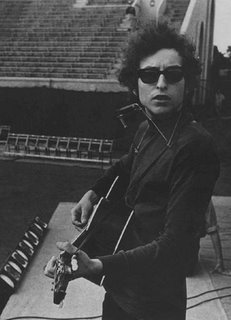
Speaking of Dylan, his August 28, 1965 FHTS date is almost as notorious as the Newport "goes electric" appearance a month previous--and probably received an even more hostile crowd reaction. Al Kooper gives a great account in his Backstage Passes and Backstabbing Bastards (New York: Billboard, 1998). It's too lengthy for me to quote here, but he summed it up well in No Direction Home--to wit, the crowd basically booed, heckled, and cussed all through the electric portion of the show, stopped to sing along with "Like a Rolling Stone" (#1 on the charts that very week), then continued to boo afterwards. Eyewitness reports and photos are available at these links. I'm assuming this pic was taken at the soundcheck.
As if seeking to complete some kind of Ultimate Sixties Band trifecta, the Rolling Stones played FHTS on July 2, 1966. Enjoy these fan reminiscences--one notes thatMartha and the Vandellas and the Standells opened. [UPDATE 4/6/2012: Apparently that fan's memories were a bit faulty, and it was actually the Ronettes who were among the openers.]
[UPDATE 5/25/2010: The Life archives have about three pages of fab fotos from the show!]
[UPDATE 4/2/2012: Why yes, I was indeed thrilled to have this show play a major part in Mad Men episode 503, "Tea Leaves"!!! The Trade Winds connection was a completely new factoid to me...and the reference to a sack of 20 from the White Castle on Queens Boulevard was a killer touch. A color poster for the '66 summer show lineup appears here, and here's a setlist.]
[UPDATE 4/6/2012: Mad Men fansite Basket of Kisses did a post about the '66 Stones tour, and Gothamist also did a post on the FHTS Stones show. I just started reading Johnny Ramone's memoirs, and his ticket to this show is reproduced in the book.]
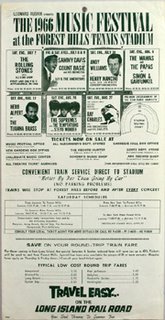
This terrific ad lists the rest of that summer's line-up:
[UPDATE 5/21/2009: I was just perusing some '66 issues of Billboard that Google has recently added to their Book Search archive. There's a short article in the 8/20/66 ish about the Mamas and Papas/Simon and Garfunkel show which reports that the M and Ps' set was cut short when a gang of 20 or so unruly teens attempted to rush the stage. The group split the scene after their last song and wouldn't come back for an encore despite Good Guy Dandy Dan Daniels' pleas for more.]
The Lovin' Spoonful played with Judy Collins on June 24, 1967--possibly the last show with the original lineup.
The infamous Monkees tour with the Jimi Hendrix Experience as openers rolled in from July 14-16, 1967. Contrary to a crafty Lillian Roxon press release, Hendrix was not kicked off the tour due to pressure from the DAR--rather, he split simply out of frustration with the teeny-boppers' constant Monkee-chants during his sets. The Forest Hills crowd may have been particularly annoying, for legend has it he gave them the finger before storming offstage.
I wish all complete line-ups of the Forest Hills Music Festival were as easy to find as that of 1968--though admittedly that season wasn't quite as rockin' as previous ones. According to pophistorynow.com, that summer's roster featured:
Janis Joplin played the FHTS twice--July 19, 1969 with the Kozmic Blues Band, and August 2, 1970 with the Full Tilt Boogie Band.
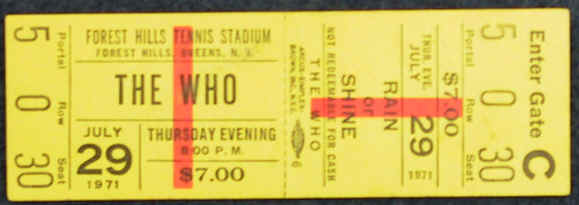
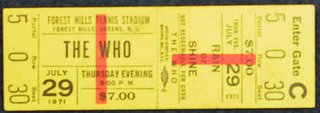
The Who's two-night stand on July 29 and 31, 1971 included a few aberrations. For one, Keith Moon's headphones--which he used to hear the pre-taped synth tracks on "Baba O'Reilly" and "Won't Get Fooled Again"--caught fire and had to be doused by a water bucket from a quick-thinking roadie. At another point Keith accidentally broke the head off John Entwistle's bass (it had been leaning against an amp when he tripped over it), which inspired a rare fit of bass-smashing from John. Furthermore, a security guard was stabbed to death by an ex-con who had been denied entry to the second show.
Few other '70s shows were quite as, ahem, eventful as those. So far I've found references only for the likes of Neil Diamond, Frank Sinatra, Barry Manilow, Linda Ronstadt, and Joni Mitchell. The Neil article states that his show was the first concert at the stadium in five years; perhaps the stabbing incident had led to the hiatus, and to the subsequent booking of more M.O.R.-type acts. Things were marginally better in the '80s--but for every Elvis Costello (8/27/82 and 8/18/84) or Talking Heads (8/21/82), you also had acts like Genesis and ASIA. Full geek disclosure--in my sole Forest Hills concert experience, I got physical with Olivia Newton-John on August 13, 1982, accompanied by my older sister. I was 11--no accounting for taste at that age.
The stadium has seen only very sporadic concert use since then--including K-ROCK's first Dysfunctional Family Picnic on July 1, 1997 (with Blur, Bush, Luscious Jackson, the Foo Fighters, Soul Coughing, and Echo & the Bunnymen), the Furthur Festival on July 3 (with various Grateful Dead offshoots, Jorma Kaukonen, Arlo Guthrie, the Black Crowes, and Moe) and the first two Reggae Carifest shows in '98 and '99. Since the place is plopped down right in the midst of a residential area, I would imagine that many locals frown upon potentially loud and rowdy events like these. This 2003 article reported that the stadium was in dire need of repair, but tennis tournaments are still regularly held on the premises.
UPDATE 5/25/2010: I found a few more lineup posters, for 1964 (from Beatlesbible.com), 1967 (Wolfgang's Vault), and 1970 (from a Simon and Garfunkel fanblog). I can't believe I failed to find any Doors show references (8/12/67, with Simon and Garfunkel) back when I first researched this entry! And lookee here at some fantastic Life photos from the Stones show!!!]


Forest Hills Tennis Stadium Youtube videos.
Article from Feb. 2011: "Will Forest Hills Stadium Rock Again in the 21st Century?"
UPDATE 3/14/2013: According to an article in the Forest Hills-Rego Park Times, concerts may return to the stadium this summer.
UPDATE 6/24/2013: Big news in the 6/23/2013 New York Times, in an article written by Corey Kilgannon. "After decades of languishing in obscurity and disrepair, one of the most famous sports and concert sites in New York will again reverberate with the sound of live music. The Forest Hills Tennis Stadium in Queens, which opened in 1923 and has played host to Jimmy Connors and John Lennon, sits next to an expanse of grass and clay tennis courts at the West Side Tennis Club, the stadium’s owner. Club officials and a promoter have an agreement to hold 19 concerts over the next three years. The stadium is still in shoddy condition, and after an accelerated renovation to make it ready, one concert is planned there this summer — an Aug. 28 show by Mumford and Sons — followed by six in each of the next three summers. This summer’s concert will serve as something of a pilot, to convince residents of Forest Hills Gardens, the exclusive neighborhood of elegant Tudor homes around the stadium, that the concerts will not be a nuisance, said the club’s president, Roland Meier. Concerts have not been welcomed in the neighborhood in the past. Mr. Meier said he hoped the concerts — which will begin as the club celebrates its 100th anniversary in Queens, and the stadium turns 90 — would finance the refurbishing of the stadium and lead to the return of tennis and other top events."
FOREST HILLS TENNIS STADIUM--1 Tennis Place (off Burns Street, north of 71st Avenue), Forest Hills, Queens. Founded in 1892, the West Side Tennis Club operated at several inadequate Manhattan locations over a twenty-year period before planting permanent roots in then-pastoral Forest Hills. The well-appointed new club, opened in 1913, became so highly regarded that the U.S. Lawn Tennis Association decided to hold its National Championship there two years later. These games--later renamed the U.S. Open--continued to be held annually at West Side until 1978 (whereupon they were moved to Louis Armstrong Stadium in Flushing). To accomodate spectators, a 14,000-seat stadium (some reports say 15,000) was built on the grounds in 1923. For highlights of the site's role in tennis history, check out these links.
Ron Delsener is given credit for establishing the stadium as a music venue. According to an article in the Wharton Journal, he came up with the idea one summer while employed there (presumably in a non-musical capacity) in the early '60s: "You didn't have to pay for heat or air-conditioning. Kids were out of school. And with the exception of the Hollywood Bowl and maybe one or two other places, no one else was doing this [outdoor pop-music concerts]." The earliest concert dates I've found are the Kingston Trio on August 5, 1960, Judy Garland on July 1, 1961, and Joan Baez on August 17, 1963 (at which Bob Dylan joined her for a couple of numbers). There must have been other early '60s shows, but it seems like the ball really got rolling over the summer of '64.
Put aside whatever personal vendetta you may have against Barbra Streisand for a sec (I dig her, OK?) and check out this page documenting her FHTS appearances on July 12, 1964 and August 8, 1965. You'll see a couple of ads for the Forest Hills Music Festival, as the summer concert series was then dubbed. In addition to Barbra, the '64 ad lists the following shows (most dates are difficult to read): Trini Lopez, Count Basie and Woody Allen (stand-up, not clarinet); Harry Belafonte and Miriam Makeba; Joan Baez (August 8; Dylan again sang with her for part of the set); Johnny Mathis; and, in the ultimate '64 booking coup, the Beatles on August 28-29. The '65 ad is much harder to decipher, but I can make out the likenesses of Peter, Paul & Mary, Judy Garland, Count Basie, Frank Sinatra, and Barbra and Woody again, among others. One Forest Hills resident on cinematreasures.org remembers the era fondly: "Besides the US Open playing 3 blocks from my house, the Forest Hills Tennis Stadium once played incredible concerts. The summer of '64 must have had the most star studded lineup ever. Sinatra played with Count Basie. There was Judy Garland, Barbra Streisand, Louis Armstrong, Peggy Lee and Chet Baker to name a few. And lets not forget the Beatles who caused so much mania they landed in a helicopter on the courts of the West Side Tennis club. My folks took home movies of the mobs packing Burns Street all the way to Continental Avenue. The other great thing was you could hear the shows from the Street if you could not get tickets."
The Beatles' dates were their first New York appearances since Ed Sullivan and Carnegie Hall in February '64. Leslie West offers some memories of the show, and of growing up in Forest Hills, here. During the afterparty at the Hotel Delmonico on that first night, Al Aronowitz introduced the lads to Bob Dylan--who in turn introduced them to the demon weed, according to legend (though I've always found it hard to believe they hadn't already encountered pot in tough Liverpool or the wild Reeperbahn).
[UPDATE 8/25/2010: Read Binky Philips' fab memories of this show here.]
Speaking of Dylan, his August 28, 1965 FHTS date is almost as notorious as the Newport "goes electric" appearance a month previous--and probably received an even more hostile crowd reaction. Al Kooper gives a great account in his Backstage Passes and Backstabbing Bastards (New York: Billboard, 1998). It's too lengthy for me to quote here, but he summed it up well in No Direction Home--to wit, the crowd basically booed, heckled, and cussed all through the electric portion of the show, stopped to sing along with "Like a Rolling Stone" (#1 on the charts that very week), then continued to boo afterwards. Eyewitness reports and photos are available at these links. I'm assuming this pic was taken at the soundcheck.

As if seeking to complete some kind of Ultimate Sixties Band trifecta, the Rolling Stones played FHTS on July 2, 1966. Enjoy these fan reminiscences--one notes that
[UPDATE 5/25/2010: The Life archives have about three pages of fab fotos from the show!]
[UPDATE 4/2/2012: Why yes, I was indeed thrilled to have this show play a major part in Mad Men episode 503, "Tea Leaves"!!! The Trade Winds connection was a completely new factoid to me...and the reference to a sack of 20 from the White Castle on Queens Boulevard was a killer touch. A color poster for the '66 summer show lineup appears here, and here's a setlist.]
[UPDATE 4/6/2012: Mad Men fansite Basket of Kisses did a post about the '66 Stones tour, and Gothamist also did a post on the FHTS Stones show. I just started reading Johnny Ramone's memoirs, and his ticket to this show is reproduced in the book.]

This terrific ad lists the rest of that summer's line-up:
- Sammy Davis Jr. and the Count Basie Orchestra, with Jay and the Americans opening, July 8 and 9
- Andy Williams and Henry Mancini, July 30
- The Mamas and the Papas and local boys Simon and Garfunkel, August 6
- Herb Alpert and the Tijuana Brass, August 13
- Three of Motown's finest--the Supremes, the Temptations, and Steve Wonder--on August 20
- Ray Charles, August 27.
[UPDATE 5/21/2009: I was just perusing some '66 issues of Billboard that Google has recently added to their Book Search archive. There's a short article in the 8/20/66 ish about the Mamas and Papas/Simon and Garfunkel show which reports that the M and Ps' set was cut short when a gang of 20 or so unruly teens attempted to rush the stage. The group split the scene after their last song and wouldn't come back for an encore despite Good Guy Dandy Dan Daniels' pleas for more.]
The Lovin' Spoonful played with Judy Collins on June 24, 1967--possibly the last show with the original lineup.
The infamous Monkees tour with the Jimi Hendrix Experience as openers rolled in from July 14-16, 1967. Contrary to a crafty Lillian Roxon press release, Hendrix was not kicked off the tour due to pressure from the DAR--rather, he split simply out of frustration with the teeny-boppers' constant Monkee-chants during his sets. The Forest Hills crowd may have been particularly annoying, for legend has it he gave them the finger before storming offstage.
I wish all complete line-ups of the Forest Hills Music Festival were as easy to find as that of 1968--though admittedly that season wasn't quite as rockin' as previous ones. According to pophistorynow.com, that summer's roster featured:
- Nancy Wilson and the Fifth Dimension, June 22
- Judy Collins and Arlo Gutrie, June 29
- Peter, Paul and Mary, July 13
- Trini Lopez and Lainie Kazan, July 20
- The Four Seasons and Bobbie Gentry, July 27
- The Supremes and Stevie Wonder, August 3
- The Bee Gees, Spanky and Our Gang, and the First Edition, August 10
- Simon and Garfunkel, August 17 (other S and G dates include 8/12/67 and 7/18/70)
- And the Four Tops, Marvin Gaye, and King Curtis on August 24
Janis Joplin played the FHTS twice--July 19, 1969 with the Kozmic Blues Band, and August 2, 1970 with the Full Tilt Boogie Band.
The Who's two-night stand on July 29 and 31, 1971 included a few aberrations. For one, Keith Moon's headphones--which he used to hear the pre-taped synth tracks on "Baba O'Reilly" and "Won't Get Fooled Again"--caught fire and had to be doused by a water bucket from a quick-thinking roadie. At another point Keith accidentally broke the head off John Entwistle's bass (it had been leaning against an amp when he tripped over it), which inspired a rare fit of bass-smashing from John. Furthermore, a security guard was stabbed to death by an ex-con who had been denied entry to the second show.

Few other '70s shows were quite as, ahem, eventful as those. So far I've found references only for the likes of Neil Diamond, Frank Sinatra, Barry Manilow, Linda Ronstadt, and Joni Mitchell. The Neil article states that his show was the first concert at the stadium in five years; perhaps the stabbing incident had led to the hiatus, and to the subsequent booking of more M.O.R.-type acts. Things were marginally better in the '80s--but for every Elvis Costello (8/27/82 and 8/18/84) or Talking Heads (8/21/82), you also had acts like Genesis and ASIA. Full geek disclosure--in my sole Forest Hills concert experience, I got physical with Olivia Newton-John on August 13, 1982, accompanied by my older sister. I was 11--no accounting for taste at that age.
The stadium has seen only very sporadic concert use since then--including K-ROCK's first Dysfunctional Family Picnic on July 1, 1997 (with Blur, Bush, Luscious Jackson, the Foo Fighters, Soul Coughing, and Echo & the Bunnymen), the Furthur Festival on July 3 (with various Grateful Dead offshoots, Jorma Kaukonen, Arlo Guthrie, the Black Crowes, and Moe) and the first two Reggae Carifest shows in '98 and '99. Since the place is plopped down right in the midst of a residential area, I would imagine that many locals frown upon potentially loud and rowdy events like these. This 2003 article reported that the stadium was in dire need of repair, but tennis tournaments are still regularly held on the premises.
UPDATE 5/25/2010: I found a few more lineup posters, for 1964 (from Beatlesbible.com), 1967 (Wolfgang's Vault), and 1970 (from a Simon and Garfunkel fanblog). I can't believe I failed to find any Doors show references (8/12/67, with Simon and Garfunkel) back when I first researched this entry! And lookee here at some fantastic Life photos from the Stones show!!!]


Forest Hills Tennis Stadium Youtube videos.
Article from Feb. 2011: "Will Forest Hills Stadium Rock Again in the 21st Century?"
UPDATE 3/14/2013: According to an article in the Forest Hills-Rego Park Times, concerts may return to the stadium this summer.
UPDATE 6/24/2013: Big news in the 6/23/2013 New York Times, in an article written by Corey Kilgannon. "After decades of languishing in obscurity and disrepair, one of the most famous sports and concert sites in New York will again reverberate with the sound of live music. The Forest Hills Tennis Stadium in Queens, which opened in 1923 and has played host to Jimmy Connors and John Lennon, sits next to an expanse of grass and clay tennis courts at the West Side Tennis Club, the stadium’s owner. Club officials and a promoter have an agreement to hold 19 concerts over the next three years. The stadium is still in shoddy condition, and after an accelerated renovation to make it ready, one concert is planned there this summer — an Aug. 28 show by Mumford and Sons — followed by six in each of the next three summers. This summer’s concert will serve as something of a pilot, to convince residents of Forest Hills Gardens, the exclusive neighborhood of elegant Tudor homes around the stadium, that the concerts will not be a nuisance, said the club’s president, Roland Meier. Concerts have not been welcomed in the neighborhood in the past. Mr. Meier said he hoped the concerts — which will begin as the club celebrates its 100th anniversary in Queens, and the stadium turns 90 — would finance the refurbishing of the stadium and lead to the return of tennis and other top events."
Thursday, August 04, 2005
Give a hoot
I hereby dedicate this post to the anonymous loud chick in the audience at the January 22, 1967 Ed Sullivan Show, who repeatedly hollered "Zal!!!!" throughout the Lovin' Spoonful's appearance. And why not--he was dashingly decked out in a dark green velvet suit after all, plus he needed some support after having ol' Sullystone mispronounce his surname as "Yanoosky." I imagine that large-lunged lass must've been among the regulars at this most storied Greenwich Village nitery:


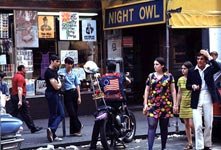
NIGHT OWL CAFE, 118 West 3rd Street b/w Macdougal Street and Sixth Avenue. I have no idea what businesses occupied this space before the Night Owl era, nor have I been able to ascertain the Night Owl's exact years of operation. Seems like it was open through much of the decade, though--specializing in folk, blues, and jazz at first in the early '60s, and gradually evolving into a rock club by '64/'65. The most vivid description of the joint by far is on Peter Sando's website--he performed there frequently with the Rahgoos, who later metamorphosed into Gandalf. These links are must-reads, but I can't resist quoting a pertinent excerpt on the club's atmosphere:
It was a very unique room, a long and narrow storefront. The stage faced straight at a wall in the center with one church pew at the foot (the "crotch watchers bench"), an aisle, and then another pew against the wall. All the other seating was to the left and right of the stage, giving a side view. The PA was very trebly and faced to the sides. The music crashed into the wall and died, leaving the vocals very bare to the bulk of the crowd to each side. You had better sing on key or else it was a disaster. Good harmony went a long way at the Night Owl! The cast of characters: "Jack the Rat" at the door, a frightening cat with teeth missing and dirty clothes; Joe Marra, the owner; Annie, head waitress (very bossy)...The waitresses all used four letter words that we had never heard from girls before...shocking to four straight, naive, suburban rockers! There was Pepe, the openly gay cook (we had never seen anyone "openly gay"); and of course, all of the great bands! An interesting and happy family indeed...Joe Marra would blink the stage lights on and off, kind of a poor man's strobe light effect...Waitress Shelly Plimpton appeared in the original cast of "Hair." [And later had a daughter with Keith Carradine--peerlessly cool actress Martha Plimpton. -Ed.] Every Thanksgiving the Night Owl had a huge feast. Everyone was there past and present--even The Spoonful...and The Mothers of Invention served the food! Yes, we "believed in magic"!
Indeed, the Lovin' Spoonful was unquestionably the most successful band to emerge from the club. Richie Unterberger traces the twisted roots of the group in this excerpt from Turn! Turn! Turn!: The '60s Folk Rock Revolution (San Francisco: Backbeat Books, 2002); elsewhere in the book he discusses their early '65 Night Owl residency:
The Night Owl, a narrow room of about 75 by 20 feet with a stage so small that [drummer Joe] Butler had to play on the floor, was the Spoonful's equivalent to the Byrds' residency at Ciro's, giving the musicians time to refine their sound and develop material as they lobbied labels for a recording contract. When they weren't at the Night Owl, they were rehearsing at the Albert Hotel, where they lived in a single room that also included all their instruments, dodging the rent by having their friend Denny Doherty sweet-talk the female bookkeeper.
They soon fielded offers from Elektra and Kama Sutra, but ultimately opted for the latter's rock & roll teen appeal over the former's folkie street cred. The band's Top Ten potential was realized later that year with a song inspired by a twinkle-toed gal in the Owl audience, according to this quote from John Sebastian:
"We were playing pretty steadily for the local people from Greenwich Village who were part of the Jazz scene or part of the kind of downtown 'in crowd.' They were 'finger poppers,' guys who played chess, 'beatniks.' But there was this one particular night as we were playing, I looked out in the audience and saw this beautiful 16-year-old girl just dancing the night away. And I remember Zal and I just elbowed each other the entire night because to us that young girl symbolized the fact that our audience was changing, that maybe they had finally found us. I wrote 'Do You Believe In Magic' the next day."
An instrumental entitled "Night Owl Blues" appeared on their first album, and Sebastian later recorded a song called "Night Owl Cafe" on his '93 solo album Tar Beach. A 1965 live set recorded at the club was supposed to be released on Varese Vintage in the late '90s, but remains in the can.
Other Night Owl notables may not have reached the same lovin' lofty heights of stardom, but most are no less esteemed by '60s garageniks and folkfiends. Here's a brief list:
The Magicians were named after the aforementioned Spoonful hit, if the liner notes to An Invitation to Cry on Sundazed are to be believed. Various Village denizens made up the band--but unlike the Spoonful, the Magicians were assembled as a recording unit first (by Bob Wyld and Art Polhemus of Longhair Productions), and actually got a contract with Columbia before settling into a regular Night Owl gig. Their alliance begat the great songwriting team of Bonner and Gordon. Garry Bonner still sings with doo-woppers Kenny Vance and the Planotones. Alan Gordon, also still in the biz, frequently contributes to the Spectropop yahoogroup, always signing his informative missives as "That Alan Gordon." Guitarist Allan "Jake" Jacobs stayed active in music through the years as well.
The Blues Magoos also made it to the Longhair Productions stable, but they did so the old fashioned way by gigging around first. And after gaining a fan base at the Night Owl, they managed to become the club's second most commercially viable success story. Here's an article about them from the February 24, 1967 issue of Billboard. Also check out Peppy Castro's site.
The Strangers are often cited as being an outstanding Owl band, but what little they recorded apparently has not been comped, and thus I cannot judge. Regardless, you can't help but dig this photo showing them, the Magicians, and the Blues Magoos (utilizing the original spelling, Bloos) all listed on the Night Owl's entrance awning. Strangers drummer Eric Eisner was the boyfriend of Woody Guthrie's daughter Nora; the two collaborated on one of the most bizarre songs of a decade filled with 'em, "Emily's Illness"--read an excellent article about that record here.
I'm no big James Taylor fan, but I'm nonetheless impressed that he paid his initial dues as part of the Albert Hotel/Night Owl scene. Following stints at a strict private boys academy and a mental institution, teenaged Taylor moved to New York in 1966 and soon formed a band called the Flying Machine. Despite an Owl residency and a recording contract, the band went nowhere, and the emotionally volatile Taylor succumbed to a heroin addiction. The experience did provide fodder for his future direction, however. In "Fire and Rain," the line "sweet dreams and flying machines in pieces on the ground" (or as The Simpsons would have it, "flying machines flying safely through the air") is a reference to his old band. You can hear some Flying Machine sound samples here (including "Night Owl," later covered by erstwhile wife Carly Simon--the club may have inspired the title, but the lyric has nothing to do with the place). I was hoping their material would be in straight-up garage mode, but they're not far removed in wimpiness from Taylor's later output. Keyboardist/Flying Machine fan/all-around character Mark "Moogy" Klingman offers some memories of the band here and here.
Taking a break from their standing residency at the Cafe Au Go Go, the Blues Project played the Night Owl from October 7-9, 1965. [Coincidentally, I'm currently reading Al Kooper's Backstage Passes and Backstabbing Bastards (New York: Billboard, 1998)--highly recommended!]
Fred Neil was a frequent fixture on the Night Owl's stage--here's a 1966 article about him from Hit Parader.
Circa '64-'65, Tim Rose, Jake Holmes, and Richie Hudson comprised an early folk-rock trio with a steady Night Owl gig. They called themselves either the Feldmans or Tim Rose and the Thorns, depending on which source you trust. The band was short-lived, but Rose and Holmes later regularly performed at the club as solo acts.
After being discovered at It's Boss on the Sunset Strip, Tim Buckley was booked for his first New York engagement at the Night Owl in mid-1966. That August Jac Holzman signed him to Elektra posthaste. Here's a picture of him performing there; the same Buckley fansite also has a great photo of the front of the building.
Lothar and the Hand People's New York debut was booked at Trude Heller's, but they were soon fired for "talking too much between numbers," according to this article. Fortunately they found a more receptive environment at the nearby Night Owl. San Francisco's Sopwith Camel later opened for them there in early '67 (and soon toured with fellow Owl alumi/Kama Sutra labelmates the Spoonful).
Other performers with Night Owl connections include Tim Hardin, Richie Havens, Dino Valenti, the First Foundation Blues Band, the Ginger Men, the Fifth Avenue Band, the Myddle Class, Random Concept, "Big Mike" DeVita, Tom Pacheco (with the Ragamuffins), Stan Penridge, Stephen Stills, and of course all the names listed on Peter Sando's page. You can read some audience member reminiscences here, here, here, and here. And here's a 1967 Tiger Beat article that mentions a visit to the club paid by Micky Dolenz and some members of the Raiders.
Not sure when the Night Owl closed, but I have not found any post-1967 references to the place. Following a '70s stint as a poster/button/head shop, for close to three decades now the storefront has been occupied by Bleecker Bob's Records. It's perhaps the most overpriced record shop in town, but apparently Bob at least has the common decency to keep a picture of the Blues Magoos onstage at the Night Owl displayed in the front window.
UPDATE 1/24/2013: The Night Owl Cafe Tribute Page has just been established on Facebook--please join and share your stories and pics. Here are some more images I've gathered over the last couple of years, mostly from my pals on tumblr.
If you can deal with the Evil Getty Watermark, there are some cool exterior shots of the club on the Getty website. I haven't seen the Jeff Buckley/Tim Buckley biopic yet, but I hear it includes a scene depicting Tim performing at the Night Owl, which was shot at Sophie's bar. A few months ago I read two memoirs which contain some Night Owl stories--Carole King's A Natural Woman, and Kathy West's A Song for You: The Quest of the Myddle Class. And as you've no doubt heard by now, the closure of Bleecker Bob's is imminent.


NIGHT OWL CAFE, 118 West 3rd Street b/w Macdougal Street and Sixth Avenue. I have no idea what businesses occupied this space before the Night Owl era, nor have I been able to ascertain the Night Owl's exact years of operation. Seems like it was open through much of the decade, though--specializing in folk, blues, and jazz at first in the early '60s, and gradually evolving into a rock club by '64/'65. The most vivid description of the joint by far is on Peter Sando's website--he performed there frequently with the Rahgoos, who later metamorphosed into Gandalf. These links are must-reads, but I can't resist quoting a pertinent excerpt on the club's atmosphere:
It was a very unique room, a long and narrow storefront. The stage faced straight at a wall in the center with one church pew at the foot (the "crotch watchers bench"), an aisle, and then another pew against the wall. All the other seating was to the left and right of the stage, giving a side view. The PA was very trebly and faced to the sides. The music crashed into the wall and died, leaving the vocals very bare to the bulk of the crowd to each side. You had better sing on key or else it was a disaster. Good harmony went a long way at the Night Owl! The cast of characters: "Jack the Rat" at the door, a frightening cat with teeth missing and dirty clothes; Joe Marra, the owner; Annie, head waitress (very bossy)...The waitresses all used four letter words that we had never heard from girls before...shocking to four straight, naive, suburban rockers! There was Pepe, the openly gay cook (we had never seen anyone "openly gay"); and of course, all of the great bands! An interesting and happy family indeed...Joe Marra would blink the stage lights on and off, kind of a poor man's strobe light effect...Waitress Shelly Plimpton appeared in the original cast of "Hair." [And later had a daughter with Keith Carradine--peerlessly cool actress Martha Plimpton. -Ed.] Every Thanksgiving the Night Owl had a huge feast. Everyone was there past and present--even The Spoonful...and The Mothers of Invention served the food! Yes, we "believed in magic"!
Indeed, the Lovin' Spoonful was unquestionably the most successful band to emerge from the club. Richie Unterberger traces the twisted roots of the group in this excerpt from Turn! Turn! Turn!: The '60s Folk Rock Revolution (San Francisco: Backbeat Books, 2002); elsewhere in the book he discusses their early '65 Night Owl residency:
The Night Owl, a narrow room of about 75 by 20 feet with a stage so small that [drummer Joe] Butler had to play on the floor, was the Spoonful's equivalent to the Byrds' residency at Ciro's, giving the musicians time to refine their sound and develop material as they lobbied labels for a recording contract. When they weren't at the Night Owl, they were rehearsing at the Albert Hotel, where they lived in a single room that also included all their instruments, dodging the rent by having their friend Denny Doherty sweet-talk the female bookkeeper.
They soon fielded offers from Elektra and Kama Sutra, but ultimately opted for the latter's rock & roll teen appeal over the former's folkie street cred. The band's Top Ten potential was realized later that year with a song inspired by a twinkle-toed gal in the Owl audience, according to this quote from John Sebastian:
"We were playing pretty steadily for the local people from Greenwich Village who were part of the Jazz scene or part of the kind of downtown 'in crowd.' They were 'finger poppers,' guys who played chess, 'beatniks.' But there was this one particular night as we were playing, I looked out in the audience and saw this beautiful 16-year-old girl just dancing the night away. And I remember Zal and I just elbowed each other the entire night because to us that young girl symbolized the fact that our audience was changing, that maybe they had finally found us. I wrote 'Do You Believe In Magic' the next day."
An instrumental entitled "Night Owl Blues" appeared on their first album, and Sebastian later recorded a song called "Night Owl Cafe" on his '93 solo album Tar Beach. A 1965 live set recorded at the club was supposed to be released on Varese Vintage in the late '90s, but remains in the can.
Other Night Owl notables may not have reached the same lovin' lofty heights of stardom, but most are no less esteemed by '60s garageniks and folkfiends. Here's a brief list:
The Magicians were named after the aforementioned Spoonful hit, if the liner notes to An Invitation to Cry on Sundazed are to be believed. Various Village denizens made up the band--but unlike the Spoonful, the Magicians were assembled as a recording unit first (by Bob Wyld and Art Polhemus of Longhair Productions), and actually got a contract with Columbia before settling into a regular Night Owl gig. Their alliance begat the great songwriting team of Bonner and Gordon. Garry Bonner still sings with doo-woppers Kenny Vance and the Planotones. Alan Gordon, also still in the biz, frequently contributes to the Spectropop yahoogroup, always signing his informative missives as "That Alan Gordon." Guitarist Allan "Jake" Jacobs stayed active in music through the years as well.
The Blues Magoos also made it to the Longhair Productions stable, but they did so the old fashioned way by gigging around first. And after gaining a fan base at the Night Owl, they managed to become the club's second most commercially viable success story. Here's an article about them from the February 24, 1967 issue of Billboard. Also check out Peppy Castro's site.
The Strangers are often cited as being an outstanding Owl band, but what little they recorded apparently has not been comped, and thus I cannot judge. Regardless, you can't help but dig this photo showing them, the Magicians, and the Blues Magoos (utilizing the original spelling, Bloos) all listed on the Night Owl's entrance awning. Strangers drummer Eric Eisner was the boyfriend of Woody Guthrie's daughter Nora; the two collaborated on one of the most bizarre songs of a decade filled with 'em, "Emily's Illness"--read an excellent article about that record here.
![]() |
| I've been told the fella in the center is Steve Martin from the Left Banke. |
I'm no big James Taylor fan, but I'm nonetheless impressed that he paid his initial dues as part of the Albert Hotel/Night Owl scene. Following stints at a strict private boys academy and a mental institution, teenaged Taylor moved to New York in 1966 and soon formed a band called the Flying Machine. Despite an Owl residency and a recording contract, the band went nowhere, and the emotionally volatile Taylor succumbed to a heroin addiction. The experience did provide fodder for his future direction, however. In "Fire and Rain," the line "sweet dreams and flying machines in pieces on the ground" (or as The Simpsons would have it, "flying machines flying safely through the air") is a reference to his old band. You can hear some Flying Machine sound samples here (including "Night Owl," later covered by erstwhile wife Carly Simon--the club may have inspired the title, but the lyric has nothing to do with the place). I was hoping their material would be in straight-up garage mode, but they're not far removed in wimpiness from Taylor's later output. Keyboardist/Flying Machine fan/all-around character Mark "Moogy" Klingman offers some memories of the band here and here.
Taking a break from their standing residency at the Cafe Au Go Go, the Blues Project played the Night Owl from October 7-9, 1965. [Coincidentally, I'm currently reading Al Kooper's Backstage Passes and Backstabbing Bastards (New York: Billboard, 1998)--highly recommended!]
Fred Neil was a frequent fixture on the Night Owl's stage--here's a 1966 article about him from Hit Parader.
Circa '64-'65, Tim Rose, Jake Holmes, and Richie Hudson comprised an early folk-rock trio with a steady Night Owl gig. They called themselves either the Feldmans or Tim Rose and the Thorns, depending on which source you trust. The band was short-lived, but Rose and Holmes later regularly performed at the club as solo acts.
After being discovered at It's Boss on the Sunset Strip, Tim Buckley was booked for his first New York engagement at the Night Owl in mid-1966. That August Jac Holzman signed him to Elektra posthaste. Here's a picture of him performing there; the same Buckley fansite also has a great photo of the front of the building.
Lothar and the Hand People's New York debut was booked at Trude Heller's, but they were soon fired for "talking too much between numbers," according to this article. Fortunately they found a more receptive environment at the nearby Night Owl. San Francisco's Sopwith Camel later opened for them there in early '67 (and soon toured with fellow Owl alumi/Kama Sutra labelmates the Spoonful).
Other performers with Night Owl connections include Tim Hardin, Richie Havens, Dino Valenti, the First Foundation Blues Band, the Ginger Men, the Fifth Avenue Band, the Myddle Class, Random Concept, "Big Mike" DeVita, Tom Pacheco (with the Ragamuffins), Stan Penridge, Stephen Stills, and of course all the names listed on Peter Sando's page. You can read some audience member reminiscences here, here, here, and here. And here's a 1967 Tiger Beat article that mentions a visit to the club paid by Micky Dolenz and some members of the Raiders.
Not sure when the Night Owl closed, but I have not found any post-1967 references to the place. Following a '70s stint as a poster/button/head shop, for close to three decades now the storefront has been occupied by Bleecker Bob's Records. It's perhaps the most overpriced record shop in town, but apparently Bob at least has the common decency to keep a picture of the Blues Magoos onstage at the Night Owl displayed in the front window.
UPDATE 5/25/2010: I recently made the tumblr acquaintance of Hip Toad and cheapocheapo, two young ladies who are positively obsessed with '60s teen mags, vintage NYC, and the Lovin' Spoonful. In turn, I'm obsessed with many of the photos and mag scans they post, including these two rare interior shots of the Night Owl. Oh yeah, the pics also happen to feature Peter Tork and Buzzy Linhart.
UPDATE 1/24/2013: The Night Owl Cafe Tribute Page has just been established on Facebook--please join and share your stories and pics. Here are some more images I've gathered over the last couple of years, mostly from my pals on tumblr.
![]() |
| Menu--pretty sure this scan came from "cheapocheapo." |
![]() |
| John Sebastian relaxing between sets. |
If you can deal with the Evil Getty Watermark, there are some cool exterior shots of the club on the Getty website. I haven't seen the Jeff Buckley/Tim Buckley biopic yet, but I hear it includes a scene depicting Tim performing at the Night Owl, which was shot at Sophie's bar. A few months ago I read two memoirs which contain some Night Owl stories--Carole King's A Natural Woman, and Kathy West's A Song for You: The Quest of the Myddle Class. And as you've no doubt heard by now, the closure of Bleecker Bob's is imminent.
Subscribe to:
Posts (Atom)