Showing posts with label Blues Project. Show all posts

Monday, June 07, 2010

1967 Ads: Steve Paul's The Scene, Part 1

Selected Voice ads for Steve Paul's the Scene, January through June, 1967. Issue dates and other pertinent info (when hard to read in the ads themselves) are in the captions.


Via.


1/5 and 1/12/67 issues. Text is much clearer in the poster above, via.


1/19, 1/25, and 2/2/67 issues
The Blues Project (January 21-February 4)
Tim Hardin with an electric group (February 6-March 4)
Also "the incredible Tiny Tim, Skipper's Scary Karate Show, Me, whatever."


2/9 and 2/16/67 issues
Tim Hardin, Jeremy Steig, February 6-March 4.


2/23/67 issue
The Youngbloods and the Free Spirits, "thru March 4."


3/9/67 issue
The Mandala (March 6 through April 7)
The Young Rascals (March 14 I think)
Eric Andersen (March 20-April 1).


3/16/67 issue (also repeated 3/23 and 3/30)


4/20/67 issue
The Siegel-Schwall Blues Band (thru April 22)
The Chambers Brothers (May 5-May 11)
Keith (May 3)
Tommy James & the Shondells (April 23)
The Mandala (April 25-May 4)
Tiny Tim and jam sessions nightly.


4/27/67 issue: The Mandala, the Chambers Brothers, Keith, as above.


5/4/67 issue: The Chambers Brothers (May 5-11)


5/10/67 issue: Diana Brooks & the Soul Searchers and Three's a Crowd, opening May 15.


5/18/67 issue
Dianne Brooks & Eric Mercury & the Soul Searchers, Three's a Crowd (May 17-21)
The Chambers Brothers ("Back by popular demand, good taste and common sense," May 22-June 3)
Tiny Tim (365 nights a year)
The Doors (opening June 12)
"Coming Soon: Scene East in Delmonico Hotel, Park Ave. & 59th Street."


5/25/67 issue, should be pretty readable.


6/8/67 issue
The Jon Lee Group ("Direct from Canada," thru June 11)
The Mandala (June 7)
Laura Nyro (June 7)
Moby Grape (June 8-10)
The Doors (June 12-July 2)

"Now open in Delmonico Hotel, Park Ave & 59th Street, SCENE EAST. Serenity of Park Avenue. Uninhibited dancing to the livest groups. Tiny Tim here, too. Eclectic Ambiance of Rudi Stern & Jackie Cassen. Photographic exhibit of Dylan by Dan Kramer. No Admission, No cover."


6/15/67 issue:
The Doors (thru July 2, except for June 16-18 when they played the Action House).
"Appearing with the Doors nightly for a completely flipped out evening: The Free Spirits and Dianne Brooks/Eric Mercury with the Soul Searchers."
The Seeds, July 3-16, "Direct from L.A., First time in N.Y."
Moby Grape, "returning after the Seeds."


6/22/67 issue.
Doors/Free Spirits/Soul Searchers as above
The Seeds (July 3-July 16)
Moby Grape, returning after the Seeds
The Mandala (July 18)
Keith (July 30--he must have not done the May date advertised above, for this is being called his "N.Y. debut.")

At Scene East, "Coming July 4 thru July 9, Direct from S. Francisco, NY Debut: Peanut Butter Conspiracy."


6/29/67 issue
Doors & Seeds as above, but no mention of Moby Grape.
The Jimi Hendrix Experience (July 3-4, "Direct from England, New York Debut."
Keith (July 30)

At Scene East, "Direct from California, N.Y. debut of an unusually exciting & creatively significant new group, the Clear Light." No dates given.

Thursday, August 04, 2005

Give a hoot

I hereby dedicate this post to the anonymous loud chick in the audience at the January 22, 1967 Ed Sullivan Show, who repeatedly hollered "Zal!!!!" throughout the Lovin' Spoonful's appearance. And why not--he was dashingly decked out in a dark green velvet suit after all, plus he needed some support after having ol' Sullystone mispronounce his surname as "Yanoosky." I imagine that large-lunged lass must've been among the regulars at this most storied Greenwich Village nitery:


NIGHT OWL CAFE, 118 West 3rd Street b/w Macdougal Street and Sixth Avenue. I have no idea what businesses occupied this space before the Night Owl era, nor have I been able to ascertain the Night Owl's exact years of operation. Seems like it was open through much of the decade, though--specializing in folk, blues, and jazz at first in the early '60s, and gradually evolving into a rock club by '64/'65. The most vivid description of the joint by far is on Peter Sando's website--he performed there frequently with the Rahgoos, who later metamorphosed into Gandalf. These links are must-reads, but I can't resist quoting a pertinent excerpt on the club's atmosphere:

It was a very unique room, a long and narrow storefront. The stage faced straight at a wall in the center with one church pew at the foot (the "crotch watchers bench"), an aisle, and then another pew against the wall. All the other seating was to the left and right of the stage, giving a side view. The PA was very trebly and faced to the sides. The music crashed into the wall and died, leaving the vocals very bare to the bulk of the crowd to each side. You had better sing on key or else it was a disaster. Good harmony went a long way at the Night Owl! The cast of characters: "Jack the Rat" at the door, a frightening cat with teeth missing and dirty clothes; Joe Marra, the owner; Annie, head waitress (very bossy)...The waitresses all used four letter words that we had never heard from girls before...shocking to four straight, naive, suburban rockers! There was Pepe, the openly gay cook (we had never seen anyone "openly gay"); and of course, all of the great bands! An interesting and happy family indeed...Joe Marra would blink the stage lights on and off, kind of a poor man's strobe light effect...Waitress Shelly Plimpton appeared in the original cast of "Hair." [And later had a daughter with Keith Carradine--peerlessly cool actress Martha Plimpton. -Ed.] Every Thanksgiving the Night Owl had a huge feast. Everyone was there past and present--even The Spoonful...and The Mothers of Invention served the food! Yes, we "believed in magic"!

Indeed, the Lovin' Spoonful was unquestionably the most successful band to emerge from the club. Richie Unterberger traces the twisted roots of the group in this excerpt from Turn! Turn! Turn!: The '60s Folk Rock Revolution (San Francisco: Backbeat Books, 2002); elsewhere in the book he discusses their early '65 Night Owl residency:

The Night Owl, a narrow room of about 75 by 20 feet with a stage so small that [drummer Joe] Butler had to play on the floor, was the Spoonful's equivalent to the Byrds' residency at Ciro's, giving the musicians time to refine their sound and develop material as they lobbied labels for a recording contract. When they weren't at the Night Owl, they were rehearsing at the Albert Hotel, where they lived in a single room that also included all their instruments, dodging the rent by having their friend Denny Doherty sweet-talk the female bookkeeper.

They soon fielded offers from Elektra and Kama Sutra, but ultimately opted for the latter's rock & roll teen appeal over the former's folkie street cred. The band's Top Ten potential was realized later that year with a song inspired by a twinkle-toed gal in the Owl audience, according to this quote from John Sebastian:

"We were playing pretty steadily for the local people from Greenwich Village who were part of the Jazz scene or part of the kind of downtown 'in crowd.' They were 'finger poppers,' guys who played chess, 'beatniks.' But there was this one particular night as we were playing, I looked out in the audience and saw this beautiful 16-year-old girl just dancing the night away. And I remember Zal and I just elbowed each other the entire night because to us that young girl symbolized the fact that our audience was changing, that maybe they had finally found us. I wrote 'Do You Believe In Magic' the next day."

An instrumental entitled "Night Owl Blues" appeared on their first album, and Sebastian later recorded a song called "Night Owl Cafe" on his '93 solo album Tar Beach. A 1965 live set recorded at the club was supposed to be released on Varese Vintage in the late '90s, but remains in the can.

Other Night Owl notables may not have reached the same lovin' lofty heights of stardom, but most are no less esteemed by '60s garageniks and folkfiends. Here's a brief list:

The Magicians were named after the aforementioned Spoonful hit, if the liner notes to An Invitation to Cry on Sundazed are to be believed. Various Village denizens made up the band--but unlike the Spoonful, the Magicians were assembled as a recording unit first (by Bob Wyld and Art Polhemus of Longhair Productions), and actually got a contract with Columbia before settling into a regular Night Owl gig. Their alliance begat the great songwriting team of Bonner and Gordon. Garry Bonner still sings with doo-woppers Kenny Vance and the Planotones. Alan Gordon, also still in the biz, frequently contributes to the Spectropop yahoogroup, always signing his informative missives as "That Alan Gordon." Guitarist Allan "Jake" Jacobs stayed active in music through the years as well.

The Blues Magoos also made it to the Longhair Productions stable, but they did so the old fashioned way by gigging around first. And after gaining a fan base at the Night Owl, they managed to become the club's second most commercially viable success story. Here's an article about them from the February 24, 1967 issue of Billboard. Also check out Peppy Castro's site.

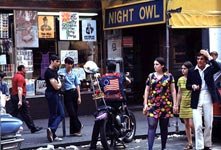
The Strangers are often cited as being an outstanding Owl band, but what little they recorded apparently has not been comped, and thus I cannot judge. Regardless, you can't help but dig this photo showing them, the Magicians, and the Blues Magoos (utilizing the original spelling, Bloos) all listed on the Night Owl's entrance awning. Strangers drummer Eric Eisner was the boyfriend of Woody Guthrie's daughter Nora; the two collaborated on one of the most bizarre songs of a decade filled with 'em, "Emily's Illness"--read an excellent article about that record here.


I've been told the fella in the center is Steve Martin from the Left Banke.


I'm no big James Taylor fan, but I'm nonetheless impressed that he paid his initial dues as part of the Albert Hotel/Night Owl scene. Following stints at a strict private boys academy and a mental institution, teenaged Taylor moved to New York in 1966 and soon formed a band called the Flying Machine. Despite an Owl residency and a recording contract, the band went nowhere, and the emotionally volatile Taylor succumbed to a heroin addiction. The experience did provide fodder for his future direction, however. In "Fire and Rain," the line "sweet dreams and flying machines in pieces on the ground" (or as The Simpsons would have it, "flying machines flying safely through the air") is a reference to his old band. You can hear some Flying Machine sound samples here (including "Night Owl," later covered by erstwhile wife Carly Simon--the club may have inspired the title, but the lyric has nothing to do with the place). I was hoping their material would be in straight-up garage mode, but they're not far removed in wimpiness from Taylor's later output. Keyboardist/Flying Machine fan/all-around character Mark "Moogy" Klingman offers some memories of the band here and here.

Taking a break from their standing residency at the Cafe Au Go Go, the Blues Project played the Night Owl from October 7-9, 1965. [Coincidentally, I'm currently reading Al Kooper's Backstage Passes and Backstabbing Bastards (New York: Billboard, 1998)--highly recommended!]

Fred Neil was a frequent fixture on the Night Owl's stage--here's a 1966 article about him from Hit Parader.

Circa '64-'65, Tim Rose, Jake Holmes, and Richie Hudson comprised an early folk-rock trio with a steady Night Owl gig. They called themselves either the Feldmans or Tim Rose and the Thorns, depending on which source you trust. The band was short-lived, but Rose and Holmes later regularly performed at the club as solo acts.

After being discovered at It's Boss on the Sunset Strip, Tim Buckley was booked for his first New York engagement at the Night Owl in mid-1966. That August Jac Holzman signed him to Elektra posthaste. Here's a picture of him performing there; the same Buckley fansite also has a great photo of the front of the building.

Lothar and the Hand People's New York debut was booked at Trude Heller's, but they were soon fired for "talking too much between numbers," according to this article. Fortunately they found a more receptive environment at the nearby Night Owl. San Francisco's Sopwith Camel later opened for them there in early '67 (and soon toured with fellow Owl alumi/Kama Sutra labelmates the Spoonful).

Other performers with Night Owl connections include Tim Hardin, Richie Havens, Dino Valenti, the First Foundation Blues Band, the Ginger Men, the Fifth Avenue Band, the Myddle Class, Random Concept, "Big Mike" DeVita, Tom Pacheco (with the Ragamuffins), Stan Penridge, Stephen Stills, and of course all the names listed on Peter Sando's page. You can read some audience member reminiscences here, here, here, and here. And here's a 1967 Tiger Beat article that mentions a visit to the club paid by Micky Dolenz and some members of the Raiders.

Not sure when the Night Owl closed, but I have not found any post-1967 references to the place. Following a '70s stint as a poster/button/head shop, for close to three decades now the storefront has been occupied by Bleecker Bob's Records. It's perhaps the most overpriced record shop in town, but apparently Bob at least has the common decency to keep a picture of the Blues Magoos onstage at the Night Owl displayed in the front window.


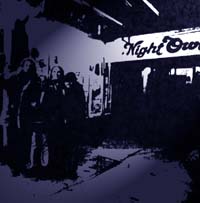
UPDATE 5/25/2010: I recently made the tumblr acquaintance of Hip Toad and cheapocheapo, two young ladies who are positively obsessed with '60s teen mags, vintage NYC, and the Lovin' Spoonful. In turn, I'm obsessed with many of the photos and mag scans they post, including these two rare interior shots of the Night Owl. Oh yeah, the pics also happen to feature Peter Tork and Buzzy Linhart.


UPDATE 1/24/2013:  The Night Owl Cafe Tribute Page has just been established on Facebook--please join and share your stories and pics.  Here are some more images I've gathered over the last couple of years, mostly from my pals on tumblr.

Menu--pretty sure this scan came from "cheapocheapo."

John Sebastian relaxing between sets.


IIRC these two came from "goodtimemusic" (formerly "hiptoad").  I don't have the full article were attached to--probably a Monkees spec issue of 16 or Tiger Beat or something like that.  They show Monkees-era Peter Tork visiting the club and sitting in with a band.  Do you recognize them?


If you can deal with the Evil Getty Watermark, there are some cool exterior shots of the club on the Getty website.  I haven't seen the Jeff Buckley/Tim Buckley biopic yet, but I hear it includes a scene depicting Tim performing at the Night Owl, which was shot at Sophie's bar.  A few months ago I read two memoirs which contain some Night Owl stories--Carole King's A Natural Woman, and Kathy West's A Song for You: The Quest of the Myddle Class.  And as you've no doubt heard by now, the closure of Bleecker Bob's is imminent.  

Thursday, May 12, 2005

Go Go forth

All this talk about go-go-ing inspired me to investigate a NY club which incorporated one of thee key phrases of the '60s in its name. Might be a bit of a misnomer as I don't believe go-go dancing took place there...but if you ponder the original French derivation of "a-go-go," which as I understand it means something like "galore," "as much as you like," or "to the nth degree," you can see how the appellation applies to this venue. The list of performers who graced its stage represents a staggering gathering of grooviness...galore!

CAFE AU GO GO--152 Bleecker Street. Owned by one Howard Solomon, about whom I know next to nothing except that he also managed Fred Neil, and passed away on June 3, 2004. The name certainly conjures images of fringed, frugging females, but this club was more serious, offering a varied mix of blues, jazz, folk, stand-up comedy, avant-garde performance and film, and, by the late '60s, psychedelia. Presumably established sometime in the early '60s (couldn't pinpoint an exact year), the club was on the lower level of a building which also housed the Garrick Theater upstairs. I had a hard time finding descriptions of its atmosphere until I came upon an interview with Greg Shaw, author of The Doors on the Road. This fellow is not the same Greg Shaw of Bomp/Mojo Navigator legend--he has more of a New York background: "My brother and friends frequented the Cafe au Go Go in Greenwich Village, which was a long rectangular club that couldn't have accommodated much more than 100 people. The stage dimensions were so narrow that the bands practically played into the opposite wall while the majority of patrons were seated on either side." He may be a little off on the seating capacity, which most accounts gauge at 300 or so. Still, that's quite small in relation to the caliber of many acts who enjoyed bookings there. [On the other hand, when big names played there, they were usually booked for several nights in a row, two shows per night.]

Johnny Ace, NYC blues bassist, has fond memories of the place:

I think the Cafe Au Go Go on Bleeker Street in the West Village was my favorite place to go hear blues. They didn't have a liquor license-so no liquor. This meant that at the ages of 15, 16 or 17, I could go in and see Muddy Waters with Otis Spann. I would also see James Cotton with his great band: the late Luther Tucker on guitar who played with everyone in Chicago (Sonny Boy Williamson II too, Little Walter, etc.) the late, crazy Alberto Gianquinto on piano who told me he had a try out with the New York Baseball Giants when he was 16, Francis Clay, Muddy Water's x-drummer, the gentleman of the blues who dressed so elegantly in his suits and scarves and who played so great on drums, and little Bobby Anderson, the heart beat of the group on bass. Bobby had a heart of gold and was my mentor. When I first met him at the cafe Au Go Go, he asked me if I was hungry and took me outside for a hot dog. I got to know them and I would get into all their gigs at the Au Go Go and the Fillmore East for free.
[Side note: A while ago I read somewhere that a more dance-oriented club operated in the building from the mid-to-late-'60s--maybe it took over the Garrick Theater's space? I cannot recall the name of this phantom club, and lately I haven't been able to find any references to it on the web, in books, or in my notes. Maybe I dreamed this factoid, or I'm thinking of some other place. A senior moment at 34? I'll have to dig further to find out...]

George Carlin, Lily Tomlin, and, most infamously, Lenny Bruce (apparently with Tiny Tim as the opening act), were among the innovative comics who wowed 'em at the Au Go Go. (These links offer more details on the Bruce obscenity trial.) Andy Warhol premiered his film Harlot at the club on January 10, 1965, and in October '65 Nam June Paik screened one of his earliest video works there. But alas, it's music which concerns us most, so here are just a few of the musicians with CAGG gigs under their belts:

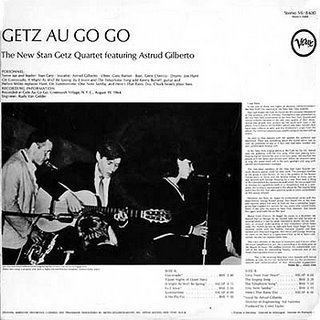
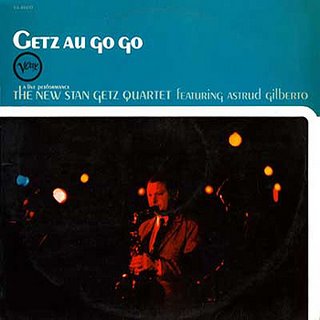
Stan Getz with Joao and Astrid Gilberto on August 19, 1964, which resulted in a live album, Getz Au Go Go (Verve). (See the front and back covers here.)


The Blues Project were practically the house band throughout '65-67. Their Live at the Cafe Au Go Go (Verve/Folkways) was supposedly recorded during the "Blues Bag," a series of shows over Thanksgiving weekend '65--an event which yielded another live album on Folkways, Living Legends, featuring Son House, Skip James, Bukka White and Big Joe Williams.
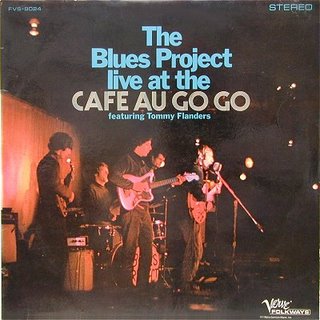

Speaking of live blues albums, John Lee Hooker was backed by Muddy Water's band for his own Live at the Cafe Au Go Go, released on ABC-Bluesway in 1967.

The Paul Butterfield Blues Band played a few shows in July 1966.

John Hammond, Jr. enlisted the back-up aid of Jimmy James and the Blue Flames during some Go Go gigs ca. 1966. The Flames were simultaneously booked at the Cafe Wha? over on MacDougal, so they'd have to hightail it between the clubs to make their sets on time--can you picture Jimi Hendrix running down Bleecker, guitar case in hand? Randy California, later of Spirit, was also in the Flames, but was too young to accompany Hendrix on his star-making journey across the pond. Hendrix later headlined at the Au Go Go in July 1967, and occasionally sat in on after-hours jam sessions there when in town, like this one from March 17, 1968.

Folkies at the Au Go Go included Fred Neil, Tim Buckley, Tim Hardin, Tom Pacheco, Dave Van Ronk, Ian and Sylvia, Richie Havens, Chuck & Mary, Joni Mitchell, and the Au Go-Go Singers, a folkie troupe which included Stephen Stills and Richie Furay.

On to the rockers and psych-meisters. Here's a short list--click on the links for specific dates and other pertinent details if they're available.
  • Blood, Sweat & Tears (or, as my old buddy Bruno used to call them, the Excretions).
  • The Jefferson Airplane
  • Country Joe & the Fish
  • The Youngbloods (see also this article).
  • Frank Zappa and the Mothers of Invention, though some of these shows were upstairs the Garrick Theater (with Sandy Hurvitz, a.k.a Uncle Meat)
  • Procol Harum
  • The Doors
  • Cream (see some pics here and here. According to an article on rollingstone.com by Little Steven, "I first saw Clapton with Cream, at the Cafe Au Go Go in New York in 1967 -- sort of. I stood outside. It was sold out. I couldn't get in. But you could see them -- the band was right in the window. And it was loud, even outside." Hmm...was the stage set-up similar to that of the Lakeside Lounge?).
  • The Nazz
  • Moby Grape
  • Them
  • The Grateful Dead (who evidently didn't care for the place. According to an excerpt from Blair Jackson's Garcia: An American Life published here, "That place was really strange," says Laird Grant. "You're jammed into this brick, low-ceilinged tube — this room — where they served ice cream and everyone was sitting down instead of dancing like we were used to. That was a weird trip..." "We hated the Cafe Au Go-Go," adds Mountain Girl. "It was all painted black inside and it smelled really bad. The ceiling was about 7-feet high; you could reach up and touch it. It seemed like we'd come a long way for such a small gig. The stage was tiny and all the equipment had to be wedged in there.")
  • Rhinoceros
  • Soft White Underbelly (precursors to Blue Oyster Cult)
  • The Fugs
  • The Jagged Edge
  • Silver Apples
  • The Chambers Brothers
  • The Godz [News flash: the Godz' Paul Thornton has been doing some musical stuff lately with two former members of the Left Banke, according to the leftbankism yahoogroup. He's also been establishing an acting career and word is he'll appear on The Sopranos next season--I wonder if the aforementioned Li'l Steven helped him get that gig...]
  • The Paupers (opening for Cream) and Luke and the Apostles (two bands from Toronto's Yorkville scene).
Cafe Au Go Go closed sometime in the early '70s. The space was reopened as the second location of the Gaslight, which had moved its operations from 116 MacDougal. (Apparently in the mid-'70s there was also a strange private club called the Cockroach Club in a loft on an upper floor of the building). I'm not sure how long the Gaslight Mk II survived, nor am I sure what occupies the site now. But I'm visiting NYC next week, and if I get a chance maybe I'll take a ghost-stroll down ol' Bleecker.

[UPDATE 5/24/2005: It appears that the original buildings at the southeast corner of Bleecker and Thompson Streets were torn down and replaced by an apartment building which, judging from its architecture, was probably built sometime in the '80s. The ground floor of this building has a few storefronts facing Bleecker; the one occupying 152 is a nail salon.]

[UPDATE 1/14/2010: I've recently made the e-mail acquaintance of a fellow blogger named Corry, co-author Rock Prosopography 101 and a couple of other blogs devoted mainly to exploring the lost venues and bands of the Bay Area. His purview often reaches beyond the West Coast though, as in this fine roundup of practically every gig known to have taken place at the Cafe Au Go Go. Corry has heaped much praise on yours truly, but my efforts pale in comparison to the research skills of him, his co-author "The Yellow Shark," and his friend Marc who compiled the list. Bravo!]

[UPDATE 5/23/2010: Check out psychlops' post delving deeper into the background history of the Au Go Go/Garrick Theater building, at his blog They're Dancing in Chicago, down in New Orleans, Dead-icated to exploring various Grateful Dead venues.]


[UPDATE 11/16/2011: I posted a whole bunch of 1967 Cafe au Go Go ads from the Village Voice here.]