I'll dedicate this entry to Mr. Doshna, my zany 9th grade Earth Science teacher back at good old St. Francis Prep. His droll delivery, augmented by his patented adenoidal Lawn Guyland whine, made even the dullest of geological factoids palatable. He often made fun of my ridiculous punk rock hairdo, as in, "Ms. C., your hair looks like a bird's nest." Whenever we had a test--and I seem to recall having them at least once a week--he'd pass out the Scan-tron multiple choice forms (regular Scan-trons for average-length tests, "mini"-Scan-trons for pop quizzes, and "Intergalactic-Mega-Scan-trons" for huge exams), put up "cheater boards" between our desks to prevent wandering eyes, and hang up a huge poster of a cheetah at the front of the room to serve as a constant reminder that he could "always spot a cheat-ah." A couple of times he deliberately left the poster down, just so he could cornily tell us that the cheetah was vacationing in Nairobi that week. Oh well...spot this:
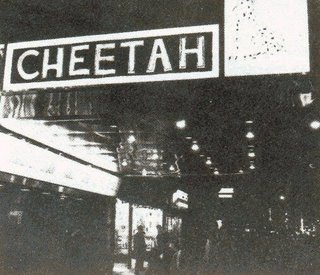
(THE) CHEETAH, Broadway and 53rd Street. The Cheetah is widely regarded as the city's first super-sized, sensory-overload, multi-media mega-club. This may have been a new concept in New York nightclubbing, but the space it occupied had a history. Its previous incarnation was as I. Jay Faggan's
Arcadia Ballroom, a jazz and dancing establishment which had played host to the likes of Ray Miller,
Roy Eldridge,
Larry Fotine,
Benny Carter,
Sonny James, and
Les Brown. (The Arcadia itself had been remodeled in 1924 from a prior ballroom called the Blue Bird.) I'm not sure when the Arcadia closed, but the Cheetah took its place in
April, 1966. According to Steven Watson's
Factory Made: Warhol and the Sixties (New York: Pantheon, 2003), it "was the granddaddy of the big commercial disco":
The most elaborate discotheque was Cheetah, on Broadway and 53rd Street, where everybody, according to Life
, looked like "a kook in a Kubla Khanteen." The three thousand colored lightbulbs dimmed and flicked and popped into an infinity of light patterns, reflecting off shiny aluminum sheets. Cheetah held two thousand people and offered not only dancing but a library, a movie room, and color television. "The Cheetah provides the most curious use of the intermedia," wrote Jonas Mekas. "Whereas the Dom shows are restricted (or became restricted) to the In-circle, Cheetah was designed for the masses. An attempt was made to go over the persona, over the ego to reach the impersonal, abstract, universal."
Brewster and Broughton's
Last Night A DJ Saved My Life (New York: Grove Press, 1999) describes the place as follows:
[T]his had been opened by Le Club's staid Frenchman, Oliver Coquelin. Situated on the site of the Arcadia Ballroom near Broadway's theatre district, it threw its doors open on May 28, 1966. The cavernous space had a dancefloor with circular podiums scattered randomly like outsized polka dots. Each supported a girl frugging. Above, a cavalcade of 3,000 colored lights palpitated gently, while a boutique at the back sold the latest Carnaby Street fashions. And there was smooth and soft black velvet everywhere--except the bar, which was covered in fake fur. In the basement there was a TV room and on the upper floor a cinema showed the latest, strangest, underground movies. Variety
got rather excited about this new boite: "GOTHAM'S NEW CHEETAH A KINGSIZED WATUSERY WITH A FORT KNOX POTENTIAL." A striking Puerto Rican teenager, Yvon Leybold, clad in hot pants and fishnets, ventured down from Spanish Harlem. "Cheetah was the first real disco club I went to," she recalls. "That was a lot of fun. It was a very mixed atmosphere. It was the first time I went into a place and you see lights and you see atmosphere, instead of the rinky-dink places I was used to."
Joel Lobenthal's
Radical Rags: Fashions of the Sixties (New York: Abbeville Press, 1990) offers this description:
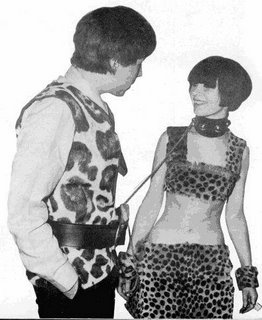
By the time Cheetah opened near Times Square in April 1966, the discotheque had become a self-contained Aladdin's Cave, in which the visitor surrendered his or her everyday identity in search of Dionysian transport. Cheetah employed many conspiring elements to bedazzle its switched-on congregation. Banks of colored lights shone on its patrons. Suspended high above the writhing crowds, huge sheets of chrome--a giant mobile created by industrial designer Michael Lax--undulated rhythmically, while at the club's opening night the customers echoed the mise en scene: "each girl was more electric than the next," Eugenia Sheppard reported. "The swinging hair. The wild colors. The mini-mini-skirts."...Cheetah initated a trend by selling earmarked discotheque attire in a boutique included in a multi-level complex consisting of dance floor, underground-film screening room, and hot dog stand. The proprietor of Cheetah's boutique noticed that many customers were purchasing clothes to exchange for those they had arrived in, so the checkrooms were specially expanded.
There were distractions a-plenty at the Cheetah, including the obligatory late-'60s
light shows, but music (both live and discotheque), dancing, and partying were the club's main raisons d'etre. A few examples thereof:
Apparently the club had its own dance, according to
this guy named Larry:
He had to pay for the dance classes, but he learned more about moving his feet from his job at the Cheetah - New York's first discotheque. In between checking coats, Larry got his feet wet - so to speak - on the dance floor at the hottest of hot spots in the hottest of hot cities on the planet. "It's time for ... the Cheetah Shuffle!" That was the rallying cry - an approximation of it, anyway. Gangs of dancers would hit the floor at the call and perform the line-dance like moves and grooves that constituted the Cheetah Shuffle. The regulars, such as they were, got so attuned to the fancy footwork that they actually gave their motions names and numbers. "Cheetah 1!" "Cheetah 2,3!" "Cheetah Cheetah!" With a word or two and a number or two or three - and don't forget the exclamation point - the gangs would move in sequence. And Larry, because he was there every night, checking coats, was soon their leader.
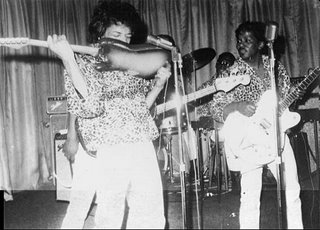
The Squires played there in 1966, featuring Curtis Knight and pre-fame
Jimi Hendrix (dig those site-specific cheetah-print shirts!). Richie Havens reminisces about young Jimi's performance
here.
 The Velvet Underground
 and Tiny Tim played the Cheetah on April 11, 1967. This event, a benefit for WBAI, was billed as "An Imperial Happening" to mark "the coronation of his Serene Highness, Prince Robert, first American Emperor of the Eastern Byzantine Roman Empire."
A
Dark Shadows costume party was held there, possibly on a Halloween night, with cast members in attendance.
Between its Public Theater debut and its long Broadway run at the Biltmore Theater,
HAIR had an engagement at the Cheetah from December 22, 1967 through January 28, 1968.
[I'll try to locate more examples in the future--somehow Cheetah is not the easiest club name in the world to google.]
Suzanne de Passe was the Cheetah's talent booker before embarking on careers as a Motown executive and later as head of her own television production company. Some cool images/epherma from the club are available at the
Groovy Times site, or
here,
here, and
here to be specific. WABC-TV supposedly filmed a
documentary entitled "Cheetah, The Mod Mecca"--I wonder if the videotape survived?
There were also Cheetah clubs in Los Angeles (in the
former Aragon Ballroom on Lick Pier in Venice Beach) and Chicago (I believe it was in Chi-town's
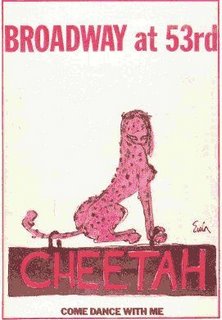
Aragon Ballroom). I'm not certain if they were financially affiliated with the New York Cheetah, but they did utilize the same half cheetah, half long-haired/well-endowed girl-creature logo.
Whither the Cheetah? I'm not absolutely sure when it closed down. I've come across
numerous references to a Cheetah in midtown Manhattan that specialized in
boogaloo and
salsa music in the early '70s--but I haven't been able to ascertain whether that was an evolution in the B'way and 53rd Cheetah or a different club altogether. I'm not even sure which corner at 53rd the Cheetah was on, nor what stands in its place today. It's either an office building or a hotel, I would reckon.
UPDATE 10/15/2007: Apparently the Box Tops played the Cheetah around Halloween of 1967, according to
this rare clip from
Zacherle's Disc-O-Teen. Dig Alex Chilton back when he was all young and raspy!

UPDATE 1/2/2008: This past weekend,
Domenic Priore's Riot on Sunset Strip program (Sunday afternoons on
luxuriamusic.com) featured music from the NYC '60s scene, including a couple of tracks from a heretofore unknown to me
live album recorded at the Cheetah called
Where It's At. Three bands are featured on the LP--The Esquires (doing Paint It Black, Get Off My Cloud, Goin' Out of My Head, and Uptight), Mike St. Shaw and the Prophets (Good Lovin' and Papa's Got a Brand New Bag), and the Thunder Frog Ensemble (Baby Please Don't Put Me On and Everybody Needs Somebody to Love).
UPDATE 1/19/2010: A while back I received a lovely e-mail from a Cheetah regular named Valerie who offered some wonderful recollections of the club--
read it here.
UPDATE 5/27/2010: NYC Dreamin' of This Ain't the Summer of Love posted a
cool 1968 article about the club a while back.
UPDATE 6/4/2010: I posted a bunch of 1967 Cheetah ads
here.
UPDATE 11/16/2011:
Here's a
revised and improved post with 1967 Cheetah ads.
UPDATE 6/2/2014: Howie Pyro did a post about the Cheetah on
Dangerous Minds, incorporating some of the info gathered here by yours truly. He found that someone uploaded the aforementioned "Cheetah: The Mod Mecca" film
on Youtube over a year ago.
UPDATE 12/20/2014: The College No. 9 tumblr did
a piece about Cheetah earlier this year. One of my other posts about the club was
quoted at length.


