In loving memory of
avant le deluge fabulousness.
CLUB 82--82 E. 4th Street between 2nd Avenue and the Bowery. As glam evolved into punk, its musical mutants found an early home at Club 82. What more appropriate locale could there have been for the waning glitter scene than a slightly down-at-heels drag bar? Throughout the '50s and '60s, Club 82 was the NYC equivalent of San Francisco's famed Finocchio's;
click on these links for history and memorabilia on the place and its performers. Club 82's drag revue had been well-attended by gays and straights, locals and tourists, celebs and plebs alike for years--but by the early '70s business had begun to slow, setting the stage for another kind of sex change. Ronnie Cutrone explains the situation in McNeil and McCain's
Please Kill Me (New York: Grove, 1996):
The 82 Club was a famous old drag place where Errol Flynn used to whip out his dick and play the piano with it. It was a wild place, then it completely died. One night my girlfriend Gigi said, "You gotta come meet my family." So we went into the 82 Club and there was an old man named Pete and two very old dyke bartenders, Tommy and Butch. That was the whole place--one john at the bar and three transvestites. So Pete, Tommy, and Butch said to Gigi, "Hey, maybe you could drum up some business for us."...We were New York's fun couple. Whatever we said, people listened...So we'd go to Max's and say, "Hey, there's this great place that's just right for having fun, the 82 Club on Fourth Street." Pretty soon it became THE place to be.
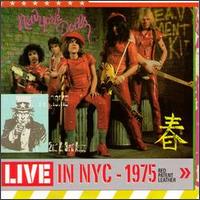
Most accounts cite the New York Dolls as the first rock band to play there--including Nina Antonia's
Too Much, Too Soon: The Makeup and Breakup of the New York Dolls (London: Omnibus, 1998):
[T]he 82 Club had been an influential drag revue since its opening in 1953. Anyone who wanted to make it as a serious drag artist performed there and by the mid-sixties it was a big draw for any celebrities who wanted to take a little walk on the wig side. By the following decade however, the club had lost its clandestine appeal and most of its clientele. The Stonewall riots had taken drag out of secretive smoky bars and on to the street. David Jo: "We used to always go there and say to Tommy, who was this butch dyke who took the tickets, 'You should have rock & roll here.' The place was dying, that whole speakeasy element was over, 'cause everything was out in the open. People didn't have to go there and hide what they were doing anymore but Tommy didn't get it. 'Where are all the people going?' 'They're doing it in the street, Tommy.'"
A photo of Tommy posed with "valet of the Dolls" Frenchy appears in the book. The band's first show at the club (on April 17, 1974) was performed in drag--save for Johnny Thunders, who refused to wear a dress.
David Jo: "The stage was behind the bar, so when you're singing, the bartender is in front of you. Butchie the bartender was Tommy's partner and she had one of those voice box things that you hold up to your neck to talk. We used to really like Butchie, she was really something. We played the first song and Butchie's trying to get my attention from the bar, waving her hands at me and kicking me on the leg, so I lean over 'cause I can't hear her because of the voice box, which she then puts up to her neck and says, 'I always thought you were a fag.'"
The Dolls did a couple more non-drag shows in August that year, but these gigs may have been symptomatic of some problems.
Chris Charlesworth, reporting for the Melody Maker, took the Dolls' pulse and found all was not well..."For the past two Mondays, the Dolls have appeared at the Club 82, an ideal place for premiering new 'glittery' talent in New York, but hardly the kind of venue for a band with two British tours and two albums under their belt. An obvious step down...In a club, a small, sweaty, noisy, crowded basement like the 82, the Dolls are perfect. On a concert stage, exposed before the eyes of a few thousand, their imperfections stand out like sore thumbs..."...Their second 82 show on August 19 was curtailed by the arrival of police officers who slapped writs on the club management for overcrowding, and the disappointed Dolls were swept out like debris, into the night.
Despite such difficulties and Charlesworth’s insults,
the Dolls were part of a viable scene at Club 82. In Clinton Heylin’s
From the Velvets to the Voidoids (New York: Penguin, 1993),
Bob Gruen states, “Since the Club 82 had had this outcast image for so long, the punk and the early glitter kids were treated very openly by the management. They didn’t think they were weird and didn’t try and cash in on ‘em—they’d been dealing with weirdos for forty years! So when bands started going there they brought the young rock & roll crowd.”
[UPDATE 2/7/2007: The legends casting the Dolls as Club 82's first rock band are apparently apocryphal. A former Club 82 glam-era regular left a comment stating that bands were booked there as early as 1972, and that
Another Pretty Face were the house band in 1973. Thanks for settin' me straight, so to speak.]
Perhaps the best depiction of Club 82’s ambiance appears in Gary Valentine’s memoirs,
New York Rocker: My Life in the Blank Generation (London: Sidgwick & Jackson, 2002). As a wide-eyed but wordly teen, some of his earliest forays into New York nightlife were at the 82--occasionally accompanied by his local Jersey pal and fellow future Blondie member
Clem Burke.
In between the fall of the Mercer Arts Center and the rise of CBGB, groups like the pre-Blondie Stillettoes, Suicide, and Wayne County, and glitter casualties like Teenage Lust and the Harlots of 42nd Street hit its stage, while celebs like Lou Reed and David Bowie headed there for a walk on the slum side…The place was run by two very old bull dykes, Tommy and Butch. Tommy worked the door and Butch handled the bar. When I first saw them, they looked as if they’d been there for twenty years—which, in fact, they had. It took me a while to figure out they weren’t men…Butch had to speak through a voice box she held to her throat. The stage was behind the bar, so with the band playing or dance music blasting it was impossible to make out what she was saying. If she was asking you what you had ordered you had to nod and hope for the best. The place had the effect that all good sleazy joints do, of making it seem that once you were inside, the world outside didn’t exist. Going in you really entered an underworld. It was a basement club, and to get to it you had to walk down a steep stairway, lined with photographs of famous female impersonators, actresses and celebrities. It had an aura of sadness and tragedy, a Cinderella quality that was especially apparent at the end of the night, when the music stopped, the lights came up and the dark mysterious faces were suddenly revealed in all their stubble…There was nothing very remarkable about Club 82. It was dark and smelled, as all nightclubs do, of cigarettes and stale beer. The walls were mirrored and the ceiling was decorated with those rotating, strobe-lighted globes that Saturday Night Fever
would soon make very popular. There was a hallway or foyer that ran behind the stage from one side of the place to the other, and often this was used by people to make out…Guys with girls, girls with girls, and guys with guys. Half of the times you couldn’t tell who was with who, and that, I guess, was part of the attraction. The dance floor was to one side of the bar and stage. A few tables bordered this, but most of the seats were on a raised section which reached back into the greater darkness. Here people engaged in more serious matters, like snorting coke and getting head, sometimes simultaneously. Sometimes there’d be no one in the place but a handful of drag queens, some glam rockers looking for the scene, and us. Other times it would be packed with tourists, weekend voyeurs anxious to be hip, well-heeled individuals trying to impress their dates with some downtown slumming, gold coke spoons and openness to transvestitism. One of the regular attractions was Wayne County…If the Dolls brought trash to rock and roll, Wayne was a one-man landfill…Occasionally the DJ would blast “Rebel Rebel” or “Suffragette City.” Once in a while you heard some Stones. But most of the time the PA was given over to “Rock the Boat,” “Honey Bee,” Barry White or some Donna Summer Dreck…
Valentine goes on to narrate some of his misadventures there, including an encounter with Bowie and Reed (who was then romantically involved with a tranny named Rachel)—but you’ll have to seek out his highly recommended tome to read them.
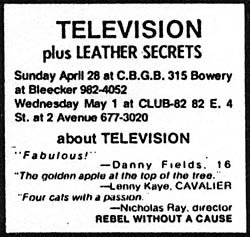
Some bands associated with Club 82 include Blondie precursors
the Stillettoes,
the Dictators,
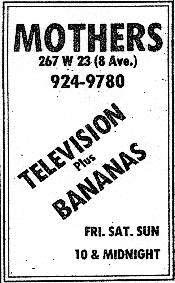
Television (see dates and ads
here and
here),
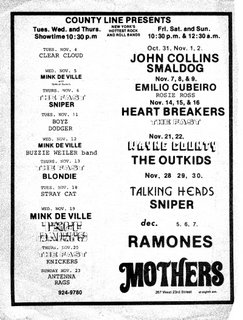
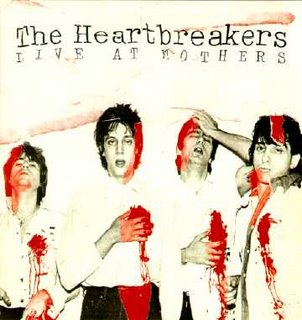
the Heartbreakers,
the Dogs,
the Brats,
the Mumps,
Leather Secrets, and
Another Pretty Face. I haven't found any references to gigs after 1976, leading me to believe the club's rock & roll period was rather short-lived--but apparently it remained open for drag-bar business until 1978.
NY Songlines states that a gay bar/movie theater called the Bijou resides there now, but I'm not sure about this; I'm more inclined to believe it's currently some type of restaurant.
UPDATE 10/5/2007: I picked up Roberta Bayley's
Blondie: Unseen 1976-1980 (London: Plexus, 2007) a couple months ago, but only just got around to reading the text--the intro of which includes a few further details about Club 82:
The Club 82, at 82 East 4th Street, was originally owned by one of Lucky Luciano's early cohorts, Vito Genovese. Though heroin was at the center of the Genovese empire, Vito also owned several nightclubs, usually purchased in other people's names. The 82 Club (as it was then called) featured drag queens, which was considered risque at the time. At its height, the 82 drew celebrities such as Elizabeth Taylor and Montgomery Clift. By the seventies it was a discotheque, and was put on the map when David Bowie visited one night.
UPDATE 4/22/2009: Here's a scan of an article about a Dolls appearance at Club 82 taken from the October '74 issue of
Rock Scene. [Question to self on 11/27/2014--did I personally scan this? I have no recollection of doing it, but if so, I also have no idea why it appears so cruddy and small. You can see it in better condition on the
Rock Scenester archive, page 38.]

UPDATE 1/29/2014: As part of its
"Storied Venues" series, the Bedford and Bowery blog featured a post about
Club 82.
UPDATE 11/27/2014:
My ancient entry on
Club 82 has probably gotten the most criticism of anything I've written here. Too short, too inaccurate, too inauthentic, too unauthoritative. I completely agree, and I'm grateful for all the real-deal first person stories left in the comments section by those lucky enough to have hung out there. [I mean jeez, when I wrote it I didn't even make the connection that Ron Wood's short-lived
Woody's, which I'd been very much aware of during its existence, was in the Club 82 space. All I can do is apologize for lack of research oomph that day.] The Bedford + Bowery blog has also helped flesh out the club's story by running a couple of pieces about it over the past year: a
mini oral history of the glitter period, and a peek at what occupies it now,
the Bijou. Just a few days ago, an anonymous reader of this blog wrote a comment about the Bijou. It was accidentally left on an adjacent post about the Hotel Diplomat, so I'll just insert it here it its all-caps glory.
"CLUB-82 OR THE BIJOU THEATRE TURNED INTO A GAY PORNO THEATRE IN THE 1990'S AND THEN CLOSED IN 2008 FOR RENOVATIONS. IT REMAINED SHUT FOR YEARS AND JUST REOPENED IN 2013 AGAIN AS A GAY -XXX- MOVIE THEATRE. THERE IS PLENTY OF SEX GOING ON DOWNSTAIRS IN THE BOOTHS AND NEARLY PITCH-BLACK GROPE ROOM. WALK-IN LEVEL IS THE MOVIE SCREEN WITH GAY PORN FILMS. DOWNSTAIRS MOANS 'N GROANS COME FROM EVERY ANGLE...LOAD-FILLED CONDOMS ARE STREWN ABOUT, EMPTY LUBE TUBES, POPPERS, EMPTY BOOZE BOTTLES AND THE OCCASIONAL STRAY DILDO !IT IS ONLY OPEN AT NIGHT (FROM 8 PM UNTIL 4 AM) ADMISSION IS $ 14.00 AND IT STILL HAS NO KNOWN TELEPHONE NO. IT'S KINKY, IT'S QUEER AND IT'S FABULOUS !"
I recently saw a
Guitar Center Sessions show with Blondie, which dates from 2011, but was aired a few months ago on the nearest thing to a music documentary channel we have up here, AUX TV. There were interview segments in between the songs, and to my delight Club 82 was brought up. Since the whole show isn't online, I felt compelled to transcribe the discussion.
Clem: I saw the Stillettoes play at Club 82, which made me become aware of the two of them [Debbie and Chris]. This Club 82 was around the corner from CBGB.
Chris: The 82 Club was a fabulous scene. It was in a basement.
Clem: No one ever talks about Club 82.
Deb: It was such a great place.
Interviewer: So let's talk about it.
Chris: People were fascinated by it here and there, but generally it's not known.
Clem: It was a gay sort of slash lesbian bar slash trans--
Chris: It was a tranny bar. It was a transvestite bar.
Clem: --combination anything goes type of bar, and I dunno if you know, like, in Times Square for instance, the dancers, like, y'know, the topless dancers would dance behind the bar on a platform. And they had a platform like that at Club 82, and that's where the bands would play. The bar would be here [gestures] and the bands would play behind the bar, whether it be the New York Dolls or Wayne County or these guys [the Stillettoes]. And it was basically a dance club, y'know, that had rock and roll one night a week--what night was it, Wednesday night, right?
Chris: Yeah, that sounds right.
Clem: That was the rock night.
Chris: And it was really, but it went way back, to probably even the 1940s. And they had pictures in the background, and there was a picture of Abbott and Costello with a drag queen, that had been taken at the club, and I always wanted to steal it but I regret that I probably didn't. But I dunno what happened to any of that stuff or any of those people.
Clem: It had the aura of a speakeasy.
Chris: Yeah, it was just great and funky and had fake palm trees and all this stuff. It was run by all these like hardcore butch old ladies.
Clem: And all the music was dance music, except for when the New York Dolls or the Neon Boys would play. All the music was dance music otherwise, which kinda, I think it kinda made me get into dance music more, 'cause it was always in the background during punk rock, the way dance music and punk rock started, kinda started happening at the same time in a lotta ways.
Chris: Yeah, sure.
And I suppose it should come as no surprise that the club is also lovingly mentioned in arguably THEE New York Rock Book of the Year, Paul Zone's
Playground (New York: Glitterati, 2014). "Spending my nights at a place like Club 82 was better than anything the mainstream could have offered. It was a drag club in the sixties that became a glitter rock hangout in the early seventies without any redecorating: the ruffled glitter valence curtains, backdrop, and three-sided wraparound stage framed our glamorous icons perfectly." [I don't think the 82 was mentioned at all in Chris Stein's
Negative, but it's still a New York Rock Book contender.]
By the way, a few years back I found a bunch of Club 82 ads in some early '70s issues of the Village Voice. You can see them
here and
here, or click on Club 82 in the Labels list to the right.
UPDATE 12/8/2014: Marky Ramone has a
book coming out next month. As part of the advance publicity, Bedford + Bowery did a cool post on
his favorite East Village clubs of yore, including the 82.