Showing posts with label '60s rock n roll. Show all posts

Friday, October 26, 2007

Let's swim to the moon, uh-huh...

I promised myself I'd crank out a post before leaving for Cavestomp! so here 'tis.

By the way--check out the Bowery Boys' wonderful blog on NYC history every Friday for a wicked wayback trip through all eras of New York nightlife. They're pros, so Lord knows they'll get to some of the more rockin' joints I've been meaning to cover way before I will! Actually, you'll wanna read it on a daily basis if you're any sort of an NYC history geek.


ONDINE--308 E. 59th Street. Arguably the hippest of the posh mid-'60s East Side discotheques that sprang up in Arthur's wake, this frequent Warhol-crowd hangout is best known for hosting the Doors' first New York gig. According to most sources it opened in 1965 and was co-owned by Jerry Schatzberg and Olivier Coquelin. However, the club's sound engineer and DJ Jim Reeves cites Howard Pratt, Claude Bell and Geist Ely as the owners. Reeves explains some of Ondine's internal workings far better than I can on his site:

"Ondine was an exclusive private discotheque club, pretty much a celebrity-based restaurant and dance club which pioneered a new trend in "happenings" of the era and after a year or so of its existence to the public, the then manager, Brad Pierce, had some connection with industry types, and somehow began to book the current acts. There weren't that may venues then so I guess it was a logical step for all involved in entertainment to take.

Around '64, as a recording engineer at Skitch Henderson's Studio 3 during the daytime, my mentor, Dave Sarser, who had set up private discotheques like Le Club (almost "speak easy"-ish) in the '50's and '60's, assigned me to a new club called Ondine. It was named after an Olympic winning sailboat. I was to install their sound system...I had become the head Discaire (now known as "DJ") as a result and played back to back pop records at night and weekends, stirring up a frenzy of go-go dancers. I also handled the sound for the house band, The Losers, and eventually for transient bands like the Pilgrims, who wore tunics styled after the knickers look of the Young Rascals who started out at the Barge, a sister discotheque in the Hampton's on Long Island. There was Arthur's, another New York disco owned by Sybil Burton, whose house band was the Fuzzy Bunnies. Many clubs followed as the trend caught on like Harlowe's and The Coney Island Pub and Nepenthe and many others.

At Ondine, The Doors, The Druids of Stonehenge, Buffalo Springfield, Jimi Hendrix, The Denims were among the list of performers. Live PA sound systems were just in their infancy then. It was new and exciting. Lots of real action. Bikers outside, mingled with the limousines. Jackie Gleason and Jackie Kennedy and Faye Dunaway would be mingling with Monti Rock III and Eric Burdon and Hilton Valentine of the Animals, while Jimi bit his guitar strings on the 8'x12'x18" stage. What can I say? Sonny and Cher would pop in. We'd hang out together with Steve Stills in the kitchen snacking on staff dinners together. Hendrix and I would go out after the club closed to the Brasserie for late night dinners. That's how it was. Nothing to compare it to then. Eventually it all led to The Cheetah and Studio 54, along with the Fillmore East and the Electric Circus and so on. It was all new to all of us."


The Olympian yacht Ondine was surely named after the water-sprite. And accordingly, the club was decked out in a nautical motif--an "undersea discotheque heavily draped in fisherman's nets," according to Michael and Ariane Batterberrys' On the Town in New York (New York: Routledge, 1999; orig. 1973). (Hmmm...wonder if it looked anything like T.O.'s The Boat?) Some suggestion of this can be seen in these photos of Curtis Knight and the Squires, found on earlyhendrix.com (note porthole beside the head of the guy dancing in front of Jimi).


Reeves offers some details about the club's layout on the Hendrix page: "After the new management (with Brad Pierce) took over, they moved the stage to the south wall. You can see the arched, ship-like rafters above on ceiling and the porthole near the guitar on the stand....Ondine was not at all a large venue. There was a 18' to 22' foot bar at the front and a coat check room across from it. Continuing on to the rear was a 25' x 35'x 9'h room with a stage, dance floor, and beyond that, a fairly large kitchen. There were booths around the perimeter of the room. "The Losers" was the house band. They were a funky blues rock pop band. Joe Nessor (bass and vocal), Tony Sal (Guitar and vocal), Brian Keenan (drums) and Russell ??? (guitar) I think."

Did the superstars in Warhol's firmament dig the place because one of their own was named Ondine? Andy doesn't say, but he does give some of the best available evocations of the club's ambiance in Popism: The Warhol Sixties (New York: Harper & Row, 1980; Pat Hackett, co-author).


"A discotheque called Ondine (just a name coincidence...) opened...at the very beginning of '65, and that was where you started seeing lots of beautiful girls in mini-skirts (they weren't even called that yet, though), short and pleated with stripes and dots and big colors and stretchy knits. Everyone started going to Ondine right away, all the celebs in town. The girls there were beautiful--Gerard picked Marisa Berenson there one night on her very first modeling trip to New York and brought her to the Factory for a screen test. Edie went there all the time, throwing a lot of money around in the beginning when she still had it, picking up the check for as many as twenty people every night..." [p. 99]

"[A]fter working all day at the Factory, we'd usually go out to Il Mio and then to Ondine and wind up at Arthur. A band called the Druids had been playing at Ondine for a couple of months. Jimi Hendrix--this was before he was Jimi Hendrix, he was still Jimmy James--would sit there in the audience with his guitar and ask them if he could play with them and they'd say sure. He had short hair and really beautiful clothes--black pants and white silk shirts...before the bandanna and the twangy guitar and all that. But he was already playing with his feet. [p. 189. Probably misheard in the transcribing; I'm sure he meant teeth. --Ed.]

"In November [1966] the Doors came to New York for the first time and they played at Ondine. When we walked in, Gerard took one look at Jim Morrison in leather pants just like his and he flipped. 'He stole my look!' he screamed, outraged. It was true enough--Jim had, I guess, picked it up from seeing Gerard at the Trip...The Doors were at Ondine because, according to Ronnie Cutrone, who should know--he hung out there enough--the girl who played the records, Billie, knew them from L.A. (She also knew the Buffalo Springfield from the Coast and she got them a gig there, too, right after the Doors...)...After [that], the image of the place went from chic to rocking, and groupies started hanging out there, beautiful girls like Devon and Kathy Starf***er...When you walked into Ondine, on the right was the coat check, on the left was a red leather couch, then there was the bar, and then a narrow strip with tables in it, and then the back room that was the dance floor, with the record booth at the end of it. Jim Morrison got to be a regular there, and the Doors played there again a few times the following spring. Jim would stand at the bar drinking screwdrivers all night long, taking downs with them, and he'd get really far gone--he'd be totally oblivious--and the girls would go over and jerk him off while he was standing there." [p. 189-90]


The Doors had three residency gigs at Ondine--November 1 to 30, 1966, January 19 to 29, 1967, and March 13 to April 2, 1967. Here are some more pics, and here are some of Richard Meltzer's reminiscenses (he refers to Ondine as a "plush clip joint...under the 59th St. Bridge").

[UPDATE 5/16/2010: Just found a fantastic "Pop Eye" column by Richard Goldstein in the March 23, 1967 issue of the Village Voice, covering several cool topics: Zal Yanovsky's rep as an informant; the growing use of psychedelics among musicians; the Toronto scene ("the influx of draft dodgers has given that city's hip community the status of an international mecca"); Joe Tex; the Monkees; the Fugs; a review of an attempted series of happenings called "Rock Flows" at the Broadway Central Hotel; and a fabulously evocative account of the atmosphere at Ondine during the Doors' stand that month.]


Following a one-night Night Owl stand on December 30, 1966, the Buffalo Springfield did a residency at Ondine's from New Year's Eve '66 through to January 9, 1967, as a support act for Mitch Ryder & the Detroit Wheels. According to this Springfield chronology, during one set Otis Redding sang "In the Midnight Hour" with them; during another, a fight broke out between Stephen Stills and Bruce Palmer after Palmer refused to turn down his bass amp.


Unknown gal sharing a confidence with Bob Dylan at Ondine.

Other bands known to have played there include the Daily Flash, Peck's Bad Boys, the Graypes, and the Remains--who recorded their audition for Capitol Records the morning after one of their very late Ondine nights (immortalized on Sundazed's A Session with the Remains).

[UPDATE 5/6/2010: I can't believe I missed any references to the Bobby Fuller Four's engagement, which started on May 2, 1966! The Barbarians apparently played there also. What can I say, the Billboard Google Archives didn't exist at the time I first wrote this. Must do a more thorough Ondine search there soon.]


I'm not sure how long Ondine was open, but I haven't come across any references to it dating later than 1967. Under new ownership it briefly operated as a disco called Together. Both incarnations of the club were frequently shook down by mobsters, including a certain Sopranos cast member.

Not sure if the same building still stands at 308, but apparently the address is currently used by Danny Alessandro, Ltd., a fireplace specialist.


The fabulous That60sGirl.com has a scan of a terrific article on the mid-'60s discotheque scene. There's no direct link, so click on "music," then "dances," and you'll come across it. One of the "discaires" pictured in it, Annette of L'Interdit, was on What's My Line once; it was hilarious to hear Bennett Cerf ask her about the "watutsi" and "frug" (which he incorrectly rhymed with rug).


[UPDATE 5/6/2010: A while back I actually uploaded the WML clip--here 'tis.]


Lastly--the CBGB gallery space is set to become a designer clothing store. No word yet on the fate of the club itself.


If you happen to be in T.O. tomorrow night--BOO!


Thursday, August 04, 2005

Give a hoot

I hereby dedicate this post to the anonymous loud chick in the audience at the January 22, 1967 Ed Sullivan Show, who repeatedly hollered "Zal!!!!" throughout the Lovin' Spoonful's appearance. And why not--he was dashingly decked out in a dark green velvet suit after all, plus he needed some support after having ol' Sullystone mispronounce his surname as "Yanoosky." I imagine that large-lunged lass must've been among the regulars at this most storied Greenwich Village nitery:


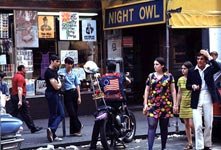
NIGHT OWL CAFE, 118 West 3rd Street b/w Macdougal Street and Sixth Avenue. I have no idea what businesses occupied this space before the Night Owl era, nor have I been able to ascertain the Night Owl's exact years of operation. Seems like it was open through much of the decade, though--specializing in folk, blues, and jazz at first in the early '60s, and gradually evolving into a rock club by '64/'65. The most vivid description of the joint by far is on Peter Sando's website--he performed there frequently with the Rahgoos, who later metamorphosed into Gandalf. These links are must-reads, but I can't resist quoting a pertinent excerpt on the club's atmosphere:

It was a very unique room, a long and narrow storefront. The stage faced straight at a wall in the center with one church pew at the foot (the "crotch watchers bench"), an aisle, and then another pew against the wall. All the other seating was to the left and right of the stage, giving a side view. The PA was very trebly and faced to the sides. The music crashed into the wall and died, leaving the vocals very bare to the bulk of the crowd to each side. You had better sing on key or else it was a disaster. Good harmony went a long way at the Night Owl! The cast of characters: "Jack the Rat" at the door, a frightening cat with teeth missing and dirty clothes; Joe Marra, the owner; Annie, head waitress (very bossy)...The waitresses all used four letter words that we had never heard from girls before...shocking to four straight, naive, suburban rockers! There was Pepe, the openly gay cook (we had never seen anyone "openly gay"); and of course, all of the great bands! An interesting and happy family indeed...Joe Marra would blink the stage lights on and off, kind of a poor man's strobe light effect...Waitress Shelly Plimpton appeared in the original cast of "Hair." [And later had a daughter with Keith Carradine--peerlessly cool actress Martha Plimpton. -Ed.] Every Thanksgiving the Night Owl had a huge feast. Everyone was there past and present--even The Spoonful...and The Mothers of Invention served the food! Yes, we "believed in magic"!

Indeed, the Lovin' Spoonful was unquestionably the most successful band to emerge from the club. Richie Unterberger traces the twisted roots of the group in this excerpt from Turn! Turn! Turn!: The '60s Folk Rock Revolution (San Francisco: Backbeat Books, 2002); elsewhere in the book he discusses their early '65 Night Owl residency:

The Night Owl, a narrow room of about 75 by 20 feet with a stage so small that [drummer Joe] Butler had to play on the floor, was the Spoonful's equivalent to the Byrds' residency at Ciro's, giving the musicians time to refine their sound and develop material as they lobbied labels for a recording contract. When they weren't at the Night Owl, they were rehearsing at the Albert Hotel, where they lived in a single room that also included all their instruments, dodging the rent by having their friend Denny Doherty sweet-talk the female bookkeeper.

They soon fielded offers from Elektra and Kama Sutra, but ultimately opted for the latter's rock & roll teen appeal over the former's folkie street cred. The band's Top Ten potential was realized later that year with a song inspired by a twinkle-toed gal in the Owl audience, according to this quote from John Sebastian:

"We were playing pretty steadily for the local people from Greenwich Village who were part of the Jazz scene or part of the kind of downtown 'in crowd.' They were 'finger poppers,' guys who played chess, 'beatniks.' But there was this one particular night as we were playing, I looked out in the audience and saw this beautiful 16-year-old girl just dancing the night away. And I remember Zal and I just elbowed each other the entire night because to us that young girl symbolized the fact that our audience was changing, that maybe they had finally found us. I wrote 'Do You Believe In Magic' the next day."

An instrumental entitled "Night Owl Blues" appeared on their first album, and Sebastian later recorded a song called "Night Owl Cafe" on his '93 solo album Tar Beach. A 1965 live set recorded at the club was supposed to be released on Varese Vintage in the late '90s, but remains in the can.

Other Night Owl notables may not have reached the same lovin' lofty heights of stardom, but most are no less esteemed by '60s garageniks and folkfiends. Here's a brief list:

The Magicians were named after the aforementioned Spoonful hit, if the liner notes to An Invitation to Cry on Sundazed are to be believed. Various Village denizens made up the band--but unlike the Spoonful, the Magicians were assembled as a recording unit first (by Bob Wyld and Art Polhemus of Longhair Productions), and actually got a contract with Columbia before settling into a regular Night Owl gig. Their alliance begat the great songwriting team of Bonner and Gordon. Garry Bonner still sings with doo-woppers Kenny Vance and the Planotones. Alan Gordon, also still in the biz, frequently contributes to the Spectropop yahoogroup, always signing his informative missives as "That Alan Gordon." Guitarist Allan "Jake" Jacobs stayed active in music through the years as well.

The Blues Magoos also made it to the Longhair Productions stable, but they did so the old fashioned way by gigging around first. And after gaining a fan base at the Night Owl, they managed to become the club's second most commercially viable success story. Here's an article about them from the February 24, 1967 issue of Billboard. Also check out Peppy Castro's site.

The Strangers are often cited as being an outstanding Owl band, but what little they recorded apparently has not been comped, and thus I cannot judge. Regardless, you can't help but dig this photo showing them, the Magicians, and the Blues Magoos (utilizing the original spelling, Bloos) all listed on the Night Owl's entrance awning. Strangers drummer Eric Eisner was the boyfriend of Woody Guthrie's daughter Nora; the two collaborated on one of the most bizarre songs of a decade filled with 'em, "Emily's Illness"--read an excellent article about that record here.


I've been told the fella in the center is Steve Martin from the Left Banke.


I'm no big James Taylor fan, but I'm nonetheless impressed that he paid his initial dues as part of the Albert Hotel/Night Owl scene. Following stints at a strict private boys academy and a mental institution, teenaged Taylor moved to New York in 1966 and soon formed a band called the Flying Machine. Despite an Owl residency and a recording contract, the band went nowhere, and the emotionally volatile Taylor succumbed to a heroin addiction. The experience did provide fodder for his future direction, however. In "Fire and Rain," the line "sweet dreams and flying machines in pieces on the ground" (or as The Simpsons would have it, "flying machines flying safely through the air") is a reference to his old band. You can hear some Flying Machine sound samples here (including "Night Owl," later covered by erstwhile wife Carly Simon--the club may have inspired the title, but the lyric has nothing to do with the place). I was hoping their material would be in straight-up garage mode, but they're not far removed in wimpiness from Taylor's later output. Keyboardist/Flying Machine fan/all-around character Mark "Moogy" Klingman offers some memories of the band here and here.

Taking a break from their standing residency at the Cafe Au Go Go, the Blues Project played the Night Owl from October 7-9, 1965. [Coincidentally, I'm currently reading Al Kooper's Backstage Passes and Backstabbing Bastards (New York: Billboard, 1998)--highly recommended!]

Fred Neil was a frequent fixture on the Night Owl's stage--here's a 1966 article about him from Hit Parader.

Circa '64-'65, Tim Rose, Jake Holmes, and Richie Hudson comprised an early folk-rock trio with a steady Night Owl gig. They called themselves either the Feldmans or Tim Rose and the Thorns, depending on which source you trust. The band was short-lived, but Rose and Holmes later regularly performed at the club as solo acts.

After being discovered at It's Boss on the Sunset Strip, Tim Buckley was booked for his first New York engagement at the Night Owl in mid-1966. That August Jac Holzman signed him to Elektra posthaste. Here's a picture of him performing there; the same Buckley fansite also has a great photo of the front of the building.

Lothar and the Hand People's New York debut was booked at Trude Heller's, but they were soon fired for "talking too much between numbers," according to this article. Fortunately they found a more receptive environment at the nearby Night Owl. San Francisco's Sopwith Camel later opened for them there in early '67 (and soon toured with fellow Owl alumi/Kama Sutra labelmates the Spoonful).

Other performers with Night Owl connections include Tim Hardin, Richie Havens, Dino Valenti, the First Foundation Blues Band, the Ginger Men, the Fifth Avenue Band, the Myddle Class, Random Concept, "Big Mike" DeVita, Tom Pacheco (with the Ragamuffins), Stan Penridge, Stephen Stills, and of course all the names listed on Peter Sando's page. You can read some audience member reminiscences here, here, here, and here. And here's a 1967 Tiger Beat article that mentions a visit to the club paid by Micky Dolenz and some members of the Raiders.

Not sure when the Night Owl closed, but I have not found any post-1967 references to the place. Following a '70s stint as a poster/button/head shop, for close to three decades now the storefront has been occupied by Bleecker Bob's Records. It's perhaps the most overpriced record shop in town, but apparently Bob at least has the common decency to keep a picture of the Blues Magoos onstage at the Night Owl displayed in the front window.


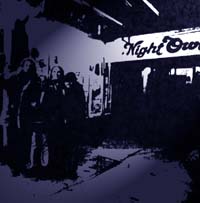
UPDATE 5/25/2010: I recently made the tumblr acquaintance of Hip Toad and cheapocheapo, two young ladies who are positively obsessed with '60s teen mags, vintage NYC, and the Lovin' Spoonful. In turn, I'm obsessed with many of the photos and mag scans they post, including these two rare interior shots of the Night Owl. Oh yeah, the pics also happen to feature Peter Tork and Buzzy Linhart.


UPDATE 1/24/2013:  The Night Owl Cafe Tribute Page has just been established on Facebook--please join and share your stories and pics.  Here are some more images I've gathered over the last couple of years, mostly from my pals on tumblr.

Menu--pretty sure this scan came from "cheapocheapo."

John Sebastian relaxing between sets.


IIRC these two came from "goodtimemusic" (formerly "hiptoad").  I don't have the full article were attached to--probably a Monkees spec issue of 16 or Tiger Beat or something like that.  They show Monkees-era Peter Tork visiting the club and sitting in with a band.  Do you recognize them?


If you can deal with the Evil Getty Watermark, there are some cool exterior shots of the club on the Getty website.  I haven't seen the Jeff Buckley/Tim Buckley biopic yet, but I hear it includes a scene depicting Tim performing at the Night Owl, which was shot at Sophie's bar.  A few months ago I read two memoirs which contain some Night Owl stories--Carole King's A Natural Woman, and Kathy West's A Song for You: The Quest of the Myddle Class.  And as you've no doubt heard by now, the closure of Bleecker Bob's is imminent.