In a feeble attempt to combat my constant homesickness, I compile tales of New York City rock & roll landmarks, most of 'em long gone. Moronic musings on various other enthusiasms are also thrown in for good measure.
Monday, April 02, 2012
I can get some, sa-tis-fac-shun
No Mad Men episode has ever given me as intense a '60s rock and roll geek-gasm as last night's did. I think the only '66 Forest Hills Music Festival poster in view is the white one beside the girl in the pink dress (the Joan Baez poster behind Don and the green and yellow flyer in the lower right corner of the corkboard are '64 I believe--not sure about the large one in the upper left corner)...but I must admit that I had no idea the Trade Winds were among the openers for the Stones that night. As if all the backstage boogie and Bewitched jokes weren't enough, they also threw in a Queens Boulevard White Castle reference. Jeez, even Betty's thyroid issues hit close to home for me. Kill me now, 'cause I can't see any more episodes being quite as perfectly up my alley as this one--and yet I hope to be proven wrong!
AMC "Inside Mad Men Episode 503" video.
Stones show pics from the Life Magazine Archives.
My Forest Hills Tennis Stadium post from Sept. 2005.
FHTS Youtube videos.
Article from Feb. 2011: "Will Forest Hills Stadium Rock Again in the 21st Century?"
Stones/Mad Men post on Basket of Kisses.
Gothamist post on the Stones show at FHTS.
EDIT 4/4/2012: I just started reading Johnny Ramone's Commando. Apparently he kept meticulous records of every rock show and movie he ever went to see, and saved all his ticket stubs...and his stub for the Stones show at Forest Hills is reproduced in the book! I'm only up to chapter 3 thus far so I can't give a fully-formed review--and besides, that's already been done far better than I could do it. But I'm digging it so far, especially his succinct summation of his time as an NYC rock scene spectator in chapter one. [Sample reminiscence: "I knew people who went to Woodstock, and I knew that I didn't want to sit outside on the ground, in the mud. That just sounded bad. I told them they were crazy. I had seen all the bands that were playing it anyway." And he bought his first Stooges elpee at Alexander's!!!] Something's missing though. As in other Ramone-bios (particularly the Joey-centric ones), we are told about Johnny's hep fashion sense prior to the Perfecto jacket/jeans/t-shirt uniform, but we aren't shown it in pictures. We see him in his Little League outfits, and we see him in his military school getups, so why are we denied the chance to see how he looked clad in leopard print and silver lame? C'mon, keepers of Ramones-abilia, release such shots...at this point it's not gonna tarnish the mystique, it'll only enhance it!
Wednesday, June 29, 2011
Recent Reads Round-up
"Riff Randell was based on three women I knew at the Fillmore East, when I was an usher and backstage hand there, while I went to New York Film School. Diane, Gayle, and, uh, I can't remember the third one. Just three girls from Brooklyn and Queens who used to hang out, and we'd talk about music. And they had different taste than I did. They were much more into the flash English bands than I was, like Bowie and T. Rex. And whenever there was an open seat, I'd get them good ones. And they were such avid rock fans--they were Riff Randell. And in 1969, they got on line for tickets for a Rolling Stones show in town, and got their picture in the paper. And that's where I got that stuff in the movie, with Riff sleeping on line for the tickets to the Ramones show."
I knew he must have worked there--you can see him sporting a Fillmore jersey during the ticket-taking scene. Here's my DVD booklet cover, with Mary Woronov's autograph:
The latest issue of Shindig has a cool piece by Domenic Priore on John Sebastian's Village days. Here's a moody shot of him most likely taken at the Night Owl--I think it was scanned from an ancient teen mag by my pal Allison.
Lastly, I just finished Steven Tyler's memoir. As I'd been forewarned, it's mainly full of anecdotes about sex, drugs, rock and roll, and still more drugs (severe later-in-life painkiller dependencies from over-medicating his numerous aging rocker stage injuries). But I read it mostly for his account of his early years on the NYC scene, and while he doesn't linger in that part of his past for very long, I did enjoy his recollections. However, I've been advised that his Left Banke story leaves much to be desired in terms of validity...and later I was stunned to see him take a writing credit for "Big Ten Inch Record." So while the book is an entertaining read on the whole, it's probably best to take much of what he says with a surfeit of sodium. I'm told another book on Aerosmith called Walk This Way goes into greater detail about the Chain Reaction, so I may check that out at some point.
I'd also be discussing the new 33 1/3 volume on Television's Marquee Moon here, were it not for the Canada Post strike of the last couple of weeks. Thanks Bryan!
Wednesday, October 05, 2005
Hey Johnny, hey Dee Dee, Little Tom and Joey
[M]y cousin Ivan...was a locksmith and had installed a lock in a loft for this lesbian couple on E. 20th Street. One girl was a musician and the other had lots of money. They wanted to make some money by turning it into a hip studio and asked him if he knew anyone who could do it. My cousin asked me about it since I was in the music industry, and I called Tommy since he had the studio experience [He had worked at the Record Plant and other studios in the late '60s.--Ed.]. We built that place by hand; designed it and everything. We had a main stage, a separate booth with a glass wall for a four-track recorder, a rehearsal studio, offices and a lobby. We provided much of the gear ourselves, so we got all the free studio time we wanted in return. Unfortunately, we were in a residential neighborhood and kept on getting dragged into court due to noise complaints...Eventually they shut us down, but we managed to make a name for ourselves in the meantime.
The book includes reprints of the floor plan and business card, which extols the studio's many virtues: "Quality sounds, creative environment, baby grand, Hammond, Marshall, Sunn, Ludwig, Shure P.A, Wurlitzer, Peavey, 4-2 track TEAC, air conditioning."
People like Blondie and the Dolls were rehearsing there. I was working with a group called Smiley. We'd make flyers, charge a coupla bucks at the door, get a crowd, talk some label people into coming down and made our own little scene. I was doing the sound and lights at the time, which Tommy taught me how to do. On the side, Tommy was working on this unknown group, the Ramones. They were terrible...I thought it was a joke. I was a musician. I had two albums out. I was into four-part harmonies. I played with a symphony orchestra for chrissakes! I came from a different world. I thought, "What is this? What the hell is going on? Forget about it!"
Famous last words--he'd go on to spend the next two-decades-plus as their long-suffering tour manager. Tommy, who had initially served as the band's advisor/musical director, was also recruited into the fold--but not until after their first gig. The original line-up, which began practicing at Performance in January '74, consisted of Johnny on guitar, Dee Dee on lead vocals and rhythm guitar, Joey on drums, and a fellow named Ritchie Stern on bass, who quit after just a couple of sessions. Dee Dee took over bass duties, but had some trouble singing and playing simultaneously. He also a tendency to get hoarse after just a couple of numbers, so Joey would sing a few from behind his kit. Their first public appearance, and their only one as a trio, took place at a Performance Studio showcase on March 30, 1974.
Johnny, quoted in On the Road With the Ramones: We took ads in the Village Voice and we played one show for our friends around March 30, 1974. We were awful. We didn't have the image down yet. Our friends didn't even want to talk to us anymore after that.
Tommy got the bright idea that Joey should be the frontman--which necessitated a search for a new drummer. The cats who came to audition tended to play in a busy Bonham or Appice-like manner, as was the style at the time. Though not a drummer himself, Tommy would try to demonstrate a simpler, Slade-like way of playing to these prospects. They just couldn't seem to grasp proper Ramone technique, though--and so Tommy eventually realized he was the only logical choice to join the brudderhood. The first show with the new complete line-up was at CBGB on August 16, 1974--but they continued to do showcase gigs at Performance throughout '74 and '75, sometimes sharing the stage with Blondie.
It's unclear exactly when Performance closed down or what replaced it. Monte Melnick of course went on to be the Fifth Ramone, and in mid-1978 Tommy conceded his Fourth Ramone status to Marc Bell when he decided to re-devote his energies to sound engineering. The address is currently occupied by the Trixie + Peanut Pet Emporium, a purveyor of pricey pet paraphernalia.
Monday, October 03, 2005
Mother's ilk
Blondie, October 3-5 and November 13, 1975, and an unspecified date in January, 1977. In Making Tracks (New York: Da Capo, 1998), Debbie Harry remembers, "The first gig we played together [with Jimmy Destri] was at Mother's, which was a bar made into a small club on W. 23rd Street across from the Chelsea Hotel, where everyone played at least once."
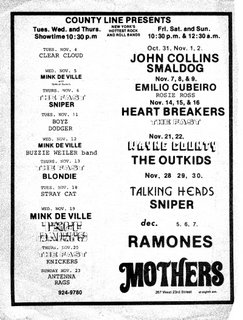
The Ramones shared those October dates with Blondie, and also played December 5-7, 1975 according to this ad (accessible from the Blondie gig list above if this link doesn't work). An A&R-hunting Linda Stein checked out the band on one of these nights, and later gave a full report and thumbs-up to her flu-stricken hubby, Sire Records owner Seymour Stein. As she recalls in Jim Bessman's Ramones: An American Band (New York: St. Martin's Press, 1993), "It was a gay bar for elderly gays. It was really a cold, winter, snowy night. Of course, they did 'Blitzkrieg Bop' and all the standards. I was fascinated by the simplicity of the lyrics and the beat, and by Dee Dee, who was always so sexy and cute! I came home and told Seymour, 'You gotta sign them!'" He auditioned them soon thereafter, and the rest is gabba gabba history.

Dig some of the other bands listed in the ad, including Mink DeVille, Sniper (so they did continue after Joey's departure after all), the Fast, Tuff Darts, Knickers (Jimmy Destri's pre-Blondie band, also featuring future Trouser Press scribe Ira Robbins), Rosie Ross (formerly with the Stillettoes), the Heartbreakers, Talking Heads, and Wayne County. The ad's heading reads, "County Line presents New York's hottest rock & roll bands"--I guess Crowley named his company after Wayne.
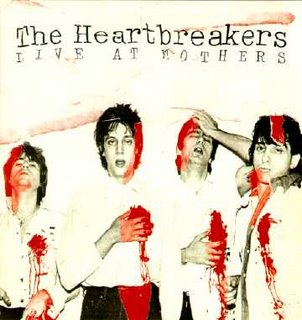
Speaking of the Heartbreakers, their 1976 Live at Mother's is available from New Rose/Fan Club Records.

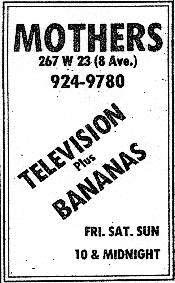
Television, with Bananas, October 17-18, 1975. Richard Lloyd describes the place as a "little teeny crappy club" in this article.

I kinda figured Nancy Spungen would have been a regular there, since she lived about a block west on 23rd Street during this time. Her mother Deborah makes no mention of it in the essential And I Don't Want To Live This Life (New York: Ballantine, 1983; reprint, 1996), but McNeil & McCain's Please Kill Me (New York: Grove, 1996) does have an anecdote from the Senders' Philippe Marcade about the night she introduced herself and asked him to teach her how to shoot up properly.
That's all I've been able to find thus far. Peter Crowley went on to book shows at the second incarnation of Max's. Reports in Yvonne Sewell-Ruskin's High On Rebellion: Inside the Underground at Max's Kansas City (New York: Thunder's Mouth Press, 1998) state that new owner Tommy Dean was attempting to give the place a misguided T.G.I.F.'s-style makeover, replete with stained glass decor and bow-tied waitresses, when Crowley stepped in to bring rock & roll back. "He basically came on board as Wayne County's manager, and since Wayne was the DJ and was an attraction at Max's, Crowley became insinuated and sold himself to the Deans, who I think really didn't know the music at that point," says musician/writer Jim Lalumia. Under Crowley's direction, Max's shared--or rivaled for, depending on your P.O.V.--punk prominence with CBs, until its 1981 closure.
Not sure when Mother's closed, but the space is currently a branch of Ricky's, the beauty-supply chain.
[UPDATE 2/7/2007: Here's some further info, generously provided by Peter Crowley!]
Thursday, September 22, 2005
Starship trouper
Joey, quoted in Ramones: An American Band: I was into dressing up in my own style. I had a black satin-like jumpsuit made of stretch material with a bullet chain hanging around the groin with the zipper open, and elbow-length black leather gloves and a chain. I had pink-lavender boots with six-inch platform heels, a leather jacket, black sunglasses, long hair. It was pretty androgynous, but in those days you could let go. Still, a lot of people wanted to kill me!
From McNeil and McCain's Please Kill Me (New York: Grove, 1996)--Mickey Leigh: Joey really got into the glitter thing. He was stealing all my mother's jewelry, her clothes, her makeup, and her scarves, which created even more fights between them. She would flip out when she saw all her clothes were missing...[I]t was really dangerous to hitchhike down Queens Boulevard looking the way Joey did. Joey's so unusual looking to begin with, so tall--he's about 6'6'' naturally, but in platform shoes he stood over seven feet tall. And he wore a jumpsuit. At that time, you really couldn't be doing that safely. You were taking a chance hitchhiking down Queens Boulevard looking like that. Joey: When I was hitching I'd be completely decked out. I used to wear this custom-made black jumpsuit, these like pink, knee-high platform boots--all kinds of rhinestones--lots of dangling belts and gloves. I got rides, but that was my first time experiencing queers. All of a sudden you'd be halfway there and they'd say, "What do you think about going under the bridge?" Usually, if I was close enough, I'd just jump out of the car.
Evocative imagery for sure--but I'm jonesing for an actual IMAGE. Was he camera-shy in those days? Or did he burn all potentially embarrassing mementoes of past lives? What gives?
At any rate, the end destination of those risky Queens Blvd. hitches was a club Jeff Starship frequented as both a patron and, later, performer.
THE COVENTRY--47-03 Queens Boulevard, Sunnyside, Queens. One could be forgiven for never expecting rock & roll to emerge from the squaresville shadows of the 7 viaduct. Yet this little Queens club held pride of place as one of the few regular venues for new bands in the pre-CB's city. "The Coventry was one of the glitter-rock places in New York, and if you were doing original music, that was the ONLY place to play," says the Dictators' Andy Shernoff (in this interview). I'm not sure of its opening year, but the place was originally called the Popcorn Pub as popcorn was a featured concession at the bar.
According to Nina Antonia's Too Much Too Soon (London: Omnibus, 1998), the New York Dolls "took the Coventry in Queens by storm and established the club as a rock joint." But the Coventry is most famous for being the site of KISS' earliest gigs ever in late January, 1973. With fewer than 10 people in attendance (including the bar staff) at their first show, they certainly had humble beginnings--but by the end of the year they were booked at the Academy of Music, and were soon thereafter hot on the (platform) heels of "hottest band in the land" status. Check out the flyer for some September '73 Coventry gigs, and guffaw heartily at these examples of Coventry-era KISS outfits and makeup. The KISS-themed "Psycho-Circus" video game included references to the Coventry. (Speaking of Queens-KISS connections--some legends have it that the band's name is decidedly NOT an acronym for "Knights In Satan's Service," but rather a reference to Kissena Boulevard in Flushing. And for a brief period I did a fill-in gig at a Queens Library branch where one of the staff members was Gene Simmons' aunt.)

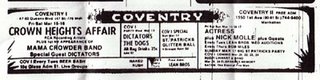
The Dictators were fixtures at the club in '74 and '75, despite the fact that they didn't quite fit the prevailing aesthetic. According to a John Holmstrom article in Punk magazine, "they'd often heckle and call out the other groups, calling them fags, wimps and homos. Remember--this is 1973 when glitter is in. Dictators weren't." "We were the only punk rock band playing there so we were outcasts there," says Andy Shernoff in this interview. Enjoy these ads for several 'Tators Coventry shows. The ads also make reference to a Coventry II club on the Upper East Side (1550 First Avenue @ 80th Street). Lord only knows who played there, though--seems like the Queens outpost was hipper than its Manhattan counterpart.
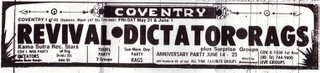
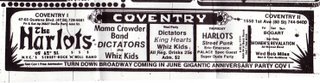
As for that otherworldly Jeff Starship creature, I'll let Handsome Dick describe his presence at the Coventry: Back in 1974, the Dictators were playing regularly at a joint on Queens Blvd. called the Coventry. We saw Kiss play there and we opened for bands like the NY Dolls & the Harlots of 42nd St. I always noticed this guy at the bar at the Coventry. He was ALWAYS hanging out. You couldn't help but notice him. He was very tall, very skinny, & very unique looking. "Who is that guy?" I wanted to know. "That guy?--that's Jeff Starship--he's got a band called Sniper!" Well, Jeff soon became Joey and his band soon became the Ramones!
That's not quite correct--Joey was the only future Ramone in Sniper. But it was through Sniper that Joey made his Ramone connections and honed his onstage persona. Though they both grew up in Forest Hills, Dee Dee and Joey didn't really meet until Dee Dee was in a Sniper audience.
Dee Dee, in Please Kill Me: I saw Sniper play with Suicide one night, and Joey was the lead singer and he was great. He was really sick looking. I thought Joey was the perfect singer because he was so weird looking. And the way he leaned on the mike was really weird. I kept asking myself, How's he balancing himself? The thing was, all the other singers were copying David Johansen, who was copying Mick Jagger, and I couldn't stand that anymore. But Joey was totally unique.
Joey, from Ramones: An American Band: I knew John from seeing him around and hanging out after high school. He and Tommy were friends, and he was in a band with my brother Mitch. Then I got to be friends with Dee Dee, and he and John were friends, too. He mentioned me to John, and John called and asked me to be in a band...I thought John and Dee Dee looked really cool. John had the same kind of haircut as now, and his presentation was the same as when he plays--a very intense demeanor. We didn't have the superficial image of bands today. Maybe we were more dressy in the glitter days, but the later look became jeans, sneakers, leather jackets--what we wore when we walked around the street. We are like we seem.
Goodness knows what happened to the other members of Sniper--but I needn't elaborate on Joey's destiny. While Sniper were apparently Coventry regulars (as were the aforementioned Butch), the Ramones are known to have played there only once, as openers for the Heartbreakers on May 30, 1975.
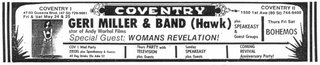
Other Coventry-affiliated bands include the Dogs, the Brats, Television (ad enlargement here), Alexis, and Piper. I presume the place closed around '76 or so as I've found no post-'75 references. The address currently appears to be occupied by a neurologist's office.
Take a stroll down Queens Blvd. courtesy of forgotten-ny.com. I'll leave you with a Queens-centric excerpt from a 1991 Fleshtones interview:
Most people in Australia would have absolutely no idea what you mean when you say you grew up in Queens and there is a "Queens Sensibility." What exactly is it?
Keith Streng: There's New York City and you have five boroughs. Everybody is generally into Manhattan, that's where everything's happening, but you have the boroughs around where all the lunatics grew up, like us. I tell you, like, the Ramones are from Queens, Dictators are from Queens, some of the members of Television were from Queens, and the Fleshtones are from Queens.
Peter Zaremba: Right, and a lot of the [New York] Dolls.
KS: A lot of the Dolls. I think even people from, like, even groups as horrible as Kiss, but, um . . .
PZ: [laughing] Kiss was from Queens.
KS: They are, they are! They played at The Coventry, you know, they were a bunch of, you know, Jewish guys from Queens.
PZ: Definitely.
So what is it about Queens that breeds rock & roll musicians?
PZ: I think the only thing that breeds rock & roll musicians, is just, there's a lot of people there, so out of all those people--
KS: Right, somebody's gotta do something.
PZ: Right.
KS: I don't know about the other boroughs, but in Queens we were the people that were meant to do something.
PZ: Right. It's a bedroom borough, they call it, and it's just a bunch of bored people.
KS: Also a lot of garages for bands to rehearse in.
PZ: Ah ha! And basements.
KS: And basements. I prefer a garage, you know you can get sunlight.
PZ: But we had a basement.
KS: [laughing] Yeah. You know.
PZ: We made do.
UPDATE 7/20/2007: I recently came across the fab http://www.magictramps.com/, which is loaded with images of rare memorabilia, including a number of gig flyers. There's a primitive flyer for a series of shows the Magic Tramps did with Link Wray at the Popcorn Pub, the Coventry's earlier incarnation. The dates are listed as September 1,2,3/8,9,10; no year is given but I imagine it was probably '72. Also check out the photo page, with has a couple of shots of the band taken at the Coventry.
UPDATE 5/26/2010: NYCDreamin' of This Ain't the Summer of Love did a magnificent annotated Coventry concert chronology in September 2009. (OMG, even Link Wray played there!!!) Quite a while ago, I was contacted on myspace by the son of a former Sniper member. He was going to find out whether his Dad might have any photos of the band and Jeff Starship, but I never heard back from him. I'm waiting on a library-reserved copy of Mickey Leigh's I Slept With Joey Ramone, but I did have a look at its photo pages at a bookstore last Boxing Day...still no pics of a glammed-out Joey to be had!
UPDATE 8/25/2010: Read Binky Philips' incredible account of one dangerously memorable night at the Coventry here.
UPDATE 9/17/2013: You need to get your grubby mitts on the essential Nothin' to Lose: The Making of KISS, 1972-1975 by Ken Sharp, which includes a lengthy account of the band's stint at the Coventry. Here's Binky's review.