Thursday, September 14, 2006


Sunday, April 30, 2006
Boogie Down Seductions, etc.
Read this excellent NY Times article on the long-lost music scene of Morrisiana while you can.
While you're at it, might as well patronize the Continental soon before it starts catering strictly to the turntablist set this summer. Speaking of lost punk dives, click here for loads of City Gardens memorabilia.
I've had a longtime video lending exchange program going with my dear friends Flipped Out and Sophie. Among the treasures they've loaned me are their DVDs of the Naked City TV series. The movie has long been one of my faves, and while the TV show's stories aren't always as super-engaging as that film's plot, its priceless location shots totally capture the look and feel of early-'60s NYC. Various rock & roll landmarks have even made their way into some shots. An episode entitled "The Fault in Our Stars," featuring Roddy McDowall as a psycho-killer actor, had an extended scene at the Cafe Bizarre, the beatnik (as opposed to beat) hangout/future Velvet Underground gig spot. Another episode, "The Face of the Enemy," had many scenes on Second Avenue, with the Anderson Theater, a neon sign for Club 82, Loew's Commodore, Thau's Restaurant, and Ratner's clearly visible. And a previous episode whose title escapes me included a fight scene outside of Slugger Ann, the bar owned by Jackie Curtis' grandmother. Other buildings crucial to my personal mythology, like the Hunter dorms (my alma mater housing) and Sunnyside Gardens (where my parents had some early dates), have also shown up as background. There are eight million stories...
New material to come soon, I promise...but between estate administration, DJ-ing at CIUT, and constant listening to Gene Pitney records, it hasn't been easy to carve out a spare moment for research.
While you're at it, might as well patronize the Continental soon before it starts catering strictly to the turntablist set this summer. Speaking of lost punk dives, click here for loads of City Gardens memorabilia.
I've had a longtime video lending exchange program going with my dear friends Flipped Out and Sophie. Among the treasures they've loaned me are their DVDs of the Naked City TV series. The movie has long been one of my faves, and while the TV show's stories aren't always as super-engaging as that film's plot, its priceless location shots totally capture the look and feel of early-'60s NYC. Various rock & roll landmarks have even made their way into some shots. An episode entitled "The Fault in Our Stars," featuring Roddy McDowall as a psycho-killer actor, had an extended scene at the Cafe Bizarre, the beatnik (as opposed to beat) hangout/future Velvet Underground gig spot. Another episode, "The Face of the Enemy," had many scenes on Second Avenue, with the Anderson Theater, a neon sign for Club 82, Loew's Commodore, Thau's Restaurant, and Ratner's clearly visible. And a previous episode whose title escapes me included a fight scene outside of Slugger Ann, the bar owned by Jackie Curtis' grandmother. Other buildings crucial to my personal mythology, like the Hunter dorms (my alma mater housing) and Sunnyside Gardens (where my parents had some early dates), have also shown up as background. There are eight million stories...
New material to come soon, I promise...but between estate administration, DJ-ing at CIUT, and constant listening to Gene Pitney records, it hasn't been easy to carve out a spare moment for research.
Wednesday, March 15, 2006
Dive into this
In one fell swoop I went from having my work cut out for me to having the work done for me. Enjoy this terrific site on the Cheepskates and that hotbed of '80s garage action, The Dive (257 W. 29th Street). See also the East Coast Mod Scene Archive yahoogroup for more stories and photos.
Thursday, March 09, 2006
More Diplomacy
Further pieces of the Hotel Diplomat puzzle were found in a cheapo book I picked up recently at the Strand--Times Square and 42nd Street in Vintage Postcards, by Randall Gabrielan (Charleston, S.C.: Arcadia, 2000). Beside a ca. 1911 postcard of the building is the following caption:
New York Lodge No. 1 of the Benevolent and Protective Order of Elks opened its 43rd Street clubhouse in 1911, a time when fraternal organizations were enjoying rising membership and growing financial capabilities. The architect of this 14-story, Neo-Classical structure was James Riley Gordon, who had earlier designed the Elks' Bronx lodge. The facility, with 240 rooms and a main ballroom with a 32-foot-high ceiling, was, in effect, a city hotel for visiting Elks. The Depression hit fraternal organizations hard. Their business diminished while they retained major operating expenses, the likely cause for its 1932 opening to public guests and a 1934 foreclosure. The place was later a modest-priced hotel, first the Delano, then the Diplomat, and in time, a single-room occupancy hotel for long-term residents. The hotel was acquired by real estate interests and demolished c. 1990 for inclusion in a prime development assemblage.
The Diplomat also gets a brief mention in another recent read--James Traub's The Devil's Playground: A Century of Pleasure and Profit in Times Square (New York: Random House, 2004). Anita Durst, a theater artist and member of the Durst real estate family, once put on a play there:
Like many shy people, Anita fell in love with acting. Unlike most of the others, she had a father who owned Broadway theaters...He [Douglas Durst] allowed her to use the semi-defunct Diplomat Hotel, on West 43rd Street, for a play called The Law of Remains, in which, Anita says, "Andy Warhol and Jeffrey Dahmer meet in Heaven." They play was apparently based on The Egyptian Book of the Dead. The hotel had a series of splendid, haunted-looking ballrooms. "The big ballroom was Heaven," Anita says, "and God was a Puerto Rican drag queen with an erection."
Her grandfather Seymour was a passionately voracious collector of books about New York City. Upon his death his collection was bequeathed to the CUNY Graduate Center to form their Seymour B. Durst Old York Library. Would that I were a CUNY student again and could peruse those riches.
The Devil's Playground also offers some further info on the International Casino, precursor to Bond's:
The International Casino was the last word in refinement, luxe, and swank. Here is how a reporter described the opening, in September 1937: "Hollywood on Broadway...a glittering gallimaufry of chromium and glass, crystal fountains, sliding doors, revolving stages, staircases which descend from heaven (when they work), a stainless steel escalator and a three story spiral bar, where you can drink your way up and fall your way down, or vice versa, as befits your mood." Life magazine did one of its "Life Goes to a Party" series about the International soon after it opened, and the author noted, with what seems admirable candor for a family magazine, that "most people go to the International Casino to see a hundred odd youngish girls in various states of undress." The article's opening photo spread shows a glistening chrome escalator with a tuxedoed headwaiter standing at the top, and then half a dozen beauties in two-piece bathing suits balancing spinning plates on long rods. Inside, Life offered pictures of bathing beauties descending from the ceiling in an elaborate trapezelike contraption and another riding bareback on a revolving stuffed horse.
The book also contains an extremely poignant chapter on the last Howard Johnson's, entitled "A la Recherche des Fried Clams Perdus," which I'd urge all clam-diggers to read.
Lastly for today...is this the work of thee Steve Paul?
New York Lodge No. 1 of the Benevolent and Protective Order of Elks opened its 43rd Street clubhouse in 1911, a time when fraternal organizations were enjoying rising membership and growing financial capabilities. The architect of this 14-story, Neo-Classical structure was James Riley Gordon, who had earlier designed the Elks' Bronx lodge. The facility, with 240 rooms and a main ballroom with a 32-foot-high ceiling, was, in effect, a city hotel for visiting Elks. The Depression hit fraternal organizations hard. Their business diminished while they retained major operating expenses, the likely cause for its 1932 opening to public guests and a 1934 foreclosure. The place was later a modest-priced hotel, first the Delano, then the Diplomat, and in time, a single-room occupancy hotel for long-term residents. The hotel was acquired by real estate interests and demolished c. 1990 for inclusion in a prime development assemblage.
The Diplomat also gets a brief mention in another recent read--James Traub's The Devil's Playground: A Century of Pleasure and Profit in Times Square (New York: Random House, 2004). Anita Durst, a theater artist and member of the Durst real estate family, once put on a play there:
Like many shy people, Anita fell in love with acting. Unlike most of the others, she had a father who owned Broadway theaters...He [Douglas Durst] allowed her to use the semi-defunct Diplomat Hotel, on West 43rd Street, for a play called The Law of Remains, in which, Anita says, "Andy Warhol and Jeffrey Dahmer meet in Heaven." They play was apparently based on The Egyptian Book of the Dead. The hotel had a series of splendid, haunted-looking ballrooms. "The big ballroom was Heaven," Anita says, "and God was a Puerto Rican drag queen with an erection."
Her grandfather Seymour was a passionately voracious collector of books about New York City. Upon his death his collection was bequeathed to the CUNY Graduate Center to form their Seymour B. Durst Old York Library. Would that I were a CUNY student again and could peruse those riches.
The Devil's Playground also offers some further info on the International Casino, precursor to Bond's:
The International Casino was the last word in refinement, luxe, and swank. Here is how a reporter described the opening, in September 1937: "Hollywood on Broadway...a glittering gallimaufry of chromium and glass, crystal fountains, sliding doors, revolving stages, staircases which descend from heaven (when they work), a stainless steel escalator and a three story spiral bar, where you can drink your way up and fall your way down, or vice versa, as befits your mood." Life magazine did one of its "Life Goes to a Party" series about the International soon after it opened, and the author noted, with what seems admirable candor for a family magazine, that "most people go to the International Casino to see a hundred odd youngish girls in various states of undress." The article's opening photo spread shows a glistening chrome escalator with a tuxedoed headwaiter standing at the top, and then half a dozen beauties in two-piece bathing suits balancing spinning plates on long rods. Inside, Life offered pictures of bathing beauties descending from the ceiling in an elaborate trapezelike contraption and another riding bareback on a revolving stuffed horse.
The book also contains an extremely poignant chapter on the last Howard Johnson's, entitled "A la Recherche des Fried Clams Perdus," which I'd urge all clam-diggers to read.
Lastly for today...is this the work of thee Steve Paul?
Tuesday, February 14, 2006
How Diplomatic
All apologies for not posting--been otherwise occupied as of late.
Came across a couple of references to the Hotel Diplomat recently. MuchMoreMusic, Canada's answer to VH-1, occasionally shows some VH-1 programming, and a few weeks ago they aired When KISS Ruled the World, a pretty good doc on the band's origins and heyday. Here's what the Starchild, the Demon, and their minder had to say about one of their earliest venues:
Paul Stanley: We found the Hotel Diplomat, which was basically a cheap hotel right off Times Square which seemed to cater to hookers, drug addicts, and people who needed a room for an hour with very crispy sheets.
Gene Simmons: I put together a mailer with Paul--"KISS playing at the Diplomat Hotel Ballroom"--and I sent that out, must've been a thousand copies, to everybody in the television industry, managers, record companies, everybody...
Bill Aucoin (then-manager): They were playing the second floor ballroom, and we actually had to step over broken stairs, and there were holes in the floor.
Also caught Fame on one of my movie channels recently. Since I hadn't seen it in over 20 years, I kinda forgot that it wasn't all about spontaneous song-and-dance outbursts in the lunchroom and on car hoods in the street--quite a lot of late-'70s NYC grit and seediness made its way into the flick, including yet another Hotel Diplomat reference:
Ralph Garcey (a.k.a. Rafael Garcia): Hey Doris, listen, I, uh, I meant to tell ya, there's, uh, there's an open call for a movie at the Diplomat Hotel.
Doris: Oh yeah?
Ralph: Actually, what they're doing is, they're looking for your type for a movie.
Doris: What's my type?
Ralph: Well, y'know, your type--Irishy, Jewishy, paranoid...
Doris: What's the name of this movie?
Ralph: I Was a Teenage Fag-Hag.
I've been to NYC four times since November, mainly to deal with matters (and madness) pertaining to settling my father's estate. The bulk of these trips were spent stranded and insanely busy in Queens, but I did manage to spend a few "days off" gallivanting in Manhattan. One of the hi-lites of my MLK Day shopping/wandering trek was the chance to check out a small exhibit of Mick Rock pictures at the Soho Grand Hotel's gallery. On my way there I passed another Soho gallery whose existence was previously unknown to me--Morrison Hotel, a rock photography outlet, who coincidentally represent Rock and were co-sponsoring the Soho Grand show. Great as all the photos were, they looked a little outta place in such stark rarefied surroundings--they're better suited to the walls of Manitoba's (or Wowsville, R.I.P.).
A couple weeks ago my husband and I were able to dovetail one of my "business trips" with the Reaction Weekender, a 3-day '60s DJ fest put on by Josh Styles and Layla "Peppermint Twist" Lozano, the couple behind NYC's "monthly freakout," Smashed Blocked. We flew down and stayed at the same hotel with our dear galpal Sophie Au Go Go, a fellow erstwhile (though not native comme moi) New Yorker/current Torontonian. A splendid, sweaty, sloshed, tuneful, and terpsichorean time was had by all at each of the four packed venues, and I had a blast catching up with old buddies and meeting new folks from all corners of the '60s-enthusiast world. [Check out Tony El Tigre's photos--including one in which I look hideous but happy, clearly basking in the reflected glory of my heroine, Miriam Linna.]

Since Josh and Layla didn't start putting on their night until after I moved, I hadn't previously met them or most of their circle, which includes the Dansettes, a soulful guy-backed gal trio who performed at the event's culmination on Saturday night. Like the proverbial prodigal daughter I am, I've admired them all from afar in the meantime, but I kinda feel super-shy and outta the loop where they're concerned...and I probably was a little too quick to point out to those newer NYC scenesters I did manage to meet that I'm not from Toronto, I just live there--but I couldn't help myself. All were super-nice and understanding about it, though, particularly the lovely, gracious Layla herself, whose dark, wavy-haired good looks and infectious smile reminded me of Lori Lightning Maddox. Not to imply that Ms. Lozano is any sort of a groupie, but if you have the slightest idea of how groupie-obsessed I am, you'll know that's a compliment. Speaking of groupie obsessions, by sheer coincidence Miss Pamela was in town promoting the new edition of I'm With the Band, and despite a torrential downpour I couldn't resist attending her reading/signing/meet & greet at Coliseum Books, featuring special guests Patti D'Arbanville and Sandra Bernhard. Neither could I resist shelling out for a copy of the book and standing on line for my chance to be a blithering idiot fangirl before her, even though I'd recently purchased a half-priced copy back at T.O.'s BMV! We were sitting about two feet away when these WireImage shots of her with Bernhard and Gabriel Byrne were taken. While we were celeb-stalking, Sophie was busy scoring some Ossie Clark originals at a vintage clothing expo I'd hipped her to at the Metropolitan Pavilion. Thrills galore, I tell ya.
Had to spend a few extra days in Queens myself to take care of mo' bizness, but I did manage to slip away for a few hours later in the week, during which I took in The Downtown Show at NYU and its sister exhibit, Anarchy to Affluence, at nearby Parsons. While the art was cool in and of itself (one of those menacing life-sized black graffitti silhouettes, ubiquitous in the '80s, was painted right on a wall--of course I'm blanking out on the artist's name), I was particularly taken with the amount of rock & roll content on display. Issues of Punk Magazine and New York Rocker were tantalizingly laid out under glass...New York Rocker # 1 featured the headline, "MICHAEL BROWN on the right banke." Lots of rock & roll flyers and posters were on display at the Fales Library portion of the show, some advertising gigs at places I'd never heard of--including The Sea of Clouds (5 E. 16th Street, 5th floor--a New Year's Eve party with the Heartbreakers, the Ramones, and Wayne County DJ-ing), the Squat Theatre (256 W. 23rd Street), Tier 3 (77 White Street), and unnamed storefronts at 52 White Street and 204 E. 7th Street. At the low price of an optional 3-buck "suggested donation," this exhibit is not to be missed--especially if you're the type who frequently pored over the likes of Details, Paper, the Voice, and/or Art After Dark to add a little pseudo-sophistication to your callow adolescence.
Came across a couple of references to the Hotel Diplomat recently. MuchMoreMusic, Canada's answer to VH-1, occasionally shows some VH-1 programming, and a few weeks ago they aired When KISS Ruled the World, a pretty good doc on the band's origins and heyday. Here's what the Starchild, the Demon, and their minder had to say about one of their earliest venues:
Paul Stanley: We found the Hotel Diplomat, which was basically a cheap hotel right off Times Square which seemed to cater to hookers, drug addicts, and people who needed a room for an hour with very crispy sheets.
Gene Simmons: I put together a mailer with Paul--"KISS playing at the Diplomat Hotel Ballroom"--and I sent that out, must've been a thousand copies, to everybody in the television industry, managers, record companies, everybody...
Bill Aucoin (then-manager): They were playing the second floor ballroom, and we actually had to step over broken stairs, and there were holes in the floor.
Also caught Fame on one of my movie channels recently. Since I hadn't seen it in over 20 years, I kinda forgot that it wasn't all about spontaneous song-and-dance outbursts in the lunchroom and on car hoods in the street--quite a lot of late-'70s NYC grit and seediness made its way into the flick, including yet another Hotel Diplomat reference:
Ralph Garcey (a.k.a. Rafael Garcia): Hey Doris, listen, I, uh, I meant to tell ya, there's, uh, there's an open call for a movie at the Diplomat Hotel.
Doris: Oh yeah?
Ralph: Actually, what they're doing is, they're looking for your type for a movie.
Doris: What's my type?
Ralph: Well, y'know, your type--Irishy, Jewishy, paranoid...
Doris: What's the name of this movie?
Ralph: I Was a Teenage Fag-Hag.
I've been to NYC four times since November, mainly to deal with matters (and madness) pertaining to settling my father's estate. The bulk of these trips were spent stranded and insanely busy in Queens, but I did manage to spend a few "days off" gallivanting in Manhattan. One of the hi-lites of my MLK Day shopping/wandering trek was the chance to check out a small exhibit of Mick Rock pictures at the Soho Grand Hotel's gallery. On my way there I passed another Soho gallery whose existence was previously unknown to me--Morrison Hotel, a rock photography outlet, who coincidentally represent Rock and were co-sponsoring the Soho Grand show. Great as all the photos were, they looked a little outta place in such stark rarefied surroundings--they're better suited to the walls of Manitoba's (or Wowsville, R.I.P.).
A couple weeks ago my husband and I were able to dovetail one of my "business trips" with the Reaction Weekender, a 3-day '60s DJ fest put on by Josh Styles and Layla "Peppermint Twist" Lozano, the couple behind NYC's "monthly freakout," Smashed Blocked. We flew down and stayed at the same hotel with our dear galpal Sophie Au Go Go, a fellow erstwhile (though not native comme moi) New Yorker/current Torontonian. A splendid, sweaty, sloshed, tuneful, and terpsichorean time was had by all at each of the four packed venues, and I had a blast catching up with old buddies and meeting new folks from all corners of the '60s-enthusiast world. [Check out Tony El Tigre's photos--including one in which I look hideous but happy, clearly basking in the reflected glory of my heroine, Miriam Linna.]

Since Josh and Layla didn't start putting on their night until after I moved, I hadn't previously met them or most of their circle, which includes the Dansettes, a soulful guy-backed gal trio who performed at the event's culmination on Saturday night. Like the proverbial prodigal daughter I am, I've admired them all from afar in the meantime, but I kinda feel super-shy and outta the loop where they're concerned...and I probably was a little too quick to point out to those newer NYC scenesters I did manage to meet that I'm not from Toronto, I just live there--but I couldn't help myself. All were super-nice and understanding about it, though, particularly the lovely, gracious Layla herself, whose dark, wavy-haired good looks and infectious smile reminded me of Lori Lightning Maddox. Not to imply that Ms. Lozano is any sort of a groupie, but if you have the slightest idea of how groupie-obsessed I am, you'll know that's a compliment. Speaking of groupie obsessions, by sheer coincidence Miss Pamela was in town promoting the new edition of I'm With the Band, and despite a torrential downpour I couldn't resist attending her reading/signing/meet & greet at Coliseum Books, featuring special guests Patti D'Arbanville and Sandra Bernhard. Neither could I resist shelling out for a copy of the book and standing on line for my chance to be a blithering idiot fangirl before her, even though I'd recently purchased a half-priced copy back at T.O.'s BMV! We were sitting about two feet away when these WireImage shots of her with Bernhard and Gabriel Byrne were taken. While we were celeb-stalking, Sophie was busy scoring some Ossie Clark originals at a vintage clothing expo I'd hipped her to at the Metropolitan Pavilion. Thrills galore, I tell ya.
Had to spend a few extra days in Queens myself to take care of mo' bizness, but I did manage to slip away for a few hours later in the week, during which I took in The Downtown Show at NYU and its sister exhibit, Anarchy to Affluence, at nearby Parsons. While the art was cool in and of itself (one of those menacing life-sized black graffitti silhouettes, ubiquitous in the '80s, was painted right on a wall--of course I'm blanking out on the artist's name), I was particularly taken with the amount of rock & roll content on display. Issues of Punk Magazine and New York Rocker were tantalizingly laid out under glass...New York Rocker # 1 featured the headline, "MICHAEL BROWN on the right banke." Lots of rock & roll flyers and posters were on display at the Fales Library portion of the show, some advertising gigs at places I'd never heard of--including The Sea of Clouds (5 E. 16th Street, 5th floor--a New Year's Eve party with the Heartbreakers, the Ramones, and Wayne County DJ-ing), the Squat Theatre (256 W. 23rd Street), Tier 3 (77 White Street), and unnamed storefronts at 52 White Street and 204 E. 7th Street. At the low price of an optional 3-buck "suggested donation," this exhibit is not to be missed--especially if you're the type who frequently pored over the likes of Details, Paper, the Voice, and/or Art After Dark to add a little pseudo-sophistication to your callow adolescence.
Monday, January 02, 2006
Crown of (my) Creation
Just as I'm in the process of severing my final ties to my hometown (selling off the family home and all), forgotten-ny.com pulls out all the stops for an excellent feature on cafone Corona. Scroll down for pics of the Lemon Ice King, Corona Park Salumeria (a.k.a. "Nucci's"), and Spaghetti Park--I grew up just 'round the corner from these goombah bastions. Apart from a mention in Simon & Garfunkel's "Me and Julio Down by the Schoolyard" ("Goodbye to Rosie, the Queen of Corona"), and the existence of at least one '60s garage band (The Go-Betweens), not much in the way of rock & roll hails from this burg. Legend has it Madonna lived in a little red synagogue on 53rd Avenue (not pictured on the site) during her pre-fame days as a member of the Breakfast Club--but Corona's cooler associations lie in its geographic situation just north of Forest Hills, birthplace of the Ramones. My own birthplace, the former LaGuardia (now North Shore) Hospital, stands just across the street from the Birchwood Towers, Joey's childhood home--and I dig milking that factoid for all it's worth, which admittedly ain't much. The scene in End of the Century where Forest Hills High School is shown and the Rubettes' "Sugar Baby Love" is playing cues my waterworks every time, and Hills ain't even close to being my alma mater--I mean, I took a sewing class there once, but yeesh. At any rate, read it and weep...
Saturday, December 31, 2005
From L.A. to N.Y., from N.Y. to L.A.
The current issue of L.A. Weekly features an excellent cover story on East Side '50s & '60s Chicano rock & roll. Obviously it's an L.A.-centric article, but it also contains a few NYC-related anecdotes; the surviving members of Cannibal & the Headhunters offer memories on shows they played at the Brooklyn Fox, Small's Paradise in Harlem, and at Shea as openers for the Beatles.
Speaking of L.A.-NYC connections...the new Bob Gruen New York Dolls DVD, All Dolled Up (to which I was initially hipped by an informative streetsyoucrossed reader), includes a healthy dose of L.A. action. There's live footage from the Whisky, both from soundchecks ("Johnny Rivers didn't sound like this," a dissatisfied David Jo quips at one point) and actual shows, plus a lip-synch session for The Real Don Steele Show. Lotsa cool downtime footage as well--backstage scenes (with the fabled Sable Starr and Lori Maddox among others), a relaxed interview on a grassy knoll near the NBC studios (the guys were taking a break from a Midnight Special taping), hanging at the Hyatt, cruising down Hollywood Boulevard and the Strip, purchasing nipple slippers at some sex/novelty shop, and dancing at Rodney Bingenheimer's English Disco. Don't worry, plenty of NYC footage made the cut, including clips from Kenny's Castaways, Max's, Club 82, Little Hippodrome, and the "St. Valentine's Day Mascara" film shown before the big Academy of Music gig--not to mention clueless local newscasts and a hilarious scene at JFK Airport. As one Amazon.com reviewer pointed out, though, if Gruen has forty hours worth of this stuff, releasing only about 95 minutes of it is tantamount to a tease. I'm left grateful, but greedy for mo'.
Speaking of L.A.-NYC connections...the new Bob Gruen New York Dolls DVD, All Dolled Up (to which I was initially hipped by an informative streetsyoucrossed reader), includes a healthy dose of L.A. action. There's live footage from the Whisky, both from soundchecks ("Johnny Rivers didn't sound like this," a dissatisfied David Jo quips at one point) and actual shows, plus a lip-synch session for The Real Don Steele Show. Lotsa cool downtime footage as well--backstage scenes (with the fabled Sable Starr and Lori Maddox among others), a relaxed interview on a grassy knoll near the NBC studios (the guys were taking a break from a Midnight Special taping), hanging at the Hyatt, cruising down Hollywood Boulevard and the Strip, purchasing nipple slippers at some sex/novelty shop, and dancing at Rodney Bingenheimer's English Disco. Don't worry, plenty of NYC footage made the cut, including clips from Kenny's Castaways, Max's, Club 82, Little Hippodrome, and the "St. Valentine's Day Mascara" film shown before the big Academy of Music gig--not to mention clueless local newscasts and a hilarious scene at JFK Airport. As one Amazon.com reviewer pointed out, though, if Gruen has forty hours worth of this stuff, releasing only about 95 minutes of it is tantamount to a tease. I'm left grateful, but greedy for mo'.
Saturday, December 17, 2005
Sunday, December 04, 2005
Read 'em while you can
Enjoy these two semi-pertinent (though not rock & roll-ish) articles in today's New York Times before they get consigned to the paid archive:
- "Now Showing: God," about extant movie palaces now functioning as churches.
- "Last Living Ziegfeld Girl," about 101-year-old national treasure Doris Eaton Travis.
Friday, December 02, 2005
You can't keep a good Brooklyn band down
My dear Pops unexpectedly departed a couple of weeks ago, and I've been up to my ears in the emotional and economic fall-out ever since. Ergo, I don't know when I'll have a free moment to write the next entry. In the meantime, allow me to draw your attention to a cool interview with Art Steinman from the Jagged Edge, one of Brooklyn's garage-rock class of '66--a new addition to Mike Dugo's super-fab 60sgaragebands.com. Also check out Steinman's own must-see Jagged Edge page, featuring mp3 snippets and loads of time-warp J.E. photos and 16 Magazine scans.
Friday, November 18, 2005
Thursday, November 17, 2005
Unga-wah!
UNGANO'S--210 West 70th Street, between Amsterdam and West End Avenues. Haven't been able to find much background info about this late '60s/early '70s club or its proprietors, brothers Arnie and Nicky Ungano. Most of the show dates I've found range from '69-'71, but Genya Ravan recalls playing there as early as '64 in her memoirs, Lollipop Lounge (New York: Billboard Books, 2004). She describes it as "yet another Italian-owned club," and infers that such joints were no strangers to mob-related activity. A spectropop.com article about the Dickens (mock-rock alter egos of NRBQ) describes the place as "a cozy showcase club," while an R. Meltzer tribute on thedictators.com dubs it "a hepster basement rock club." A contributor to this George Harrison condolence page--who met the Quiet Beatle at the club in 1970--remembered it as "a place where 'name' artists could play, and also where A&R reps and agents would go to see talent auditions." As Mike Fornatale explained a while back on the Bomp list:
In 1966 and '67, when out-of-town bands came to NYC, they would do shows at places like Ungano's and the original Peppermint Lounge, that were really holdovers of the Copacabana era and not so very unlike this "vibe" (maaaan) at all. [He's referring to the scene at the Hard Rock Cafe during its launch party for Little Steven's Underground Garage.--Ed.] (Once they turned on the three-dollar color-wheel lights, that is.) The only difference here is that the Hard Rock Cafe has a fifty-foot ceiling and the lights cost three THOUSAND dollars each.
According to featbase.net, a site devoted to Little Feat (who played there on January 4, 1971), it was a "basement club" with an occupancy of 200; "[it] closed around March 20, 1971, and then reopened on Staten Island as Ungano's Ritz around May 21, 1971." This second venue was in an old 2,000-seat movie house, the Ritz Theater, at 251 Port Richmond Avenue.
Both the club and the theater attracted a surprisingly impressive array of the era's talent, including:
A Staten Island local on cinematreasures.org remembers seeing "Alice Cooper, Mountain, Black Sabbath, Yes, Capt. Beefheart, MC5, King Crimson, The Kinks, Fleetwood Mac, Deep Purple...even Vanilla Fudge" at Ungano's Ritz. He adds, "The Ritz concerts did not last to due 'contract riders' put into place in the early seventies by NYC concert promoters. They insisted that the musicians performing at their place could not book additional shows within a 50 mile radius of the venue nor within a month surrrounding the show. This essentially killed the bookings for national recording acts at the Ritz Theater." Apparently the building went on to become a roller rink, but since 1985 it has been occupied by Pedulla Ceramic Tile. What became of the basement of 210 W. 70th Street is unclear. The building as a whole was, and may still be, the Bradford Hotel, but seems to also house various other businesses.
[UPDATE 5/6/2010: Here are a couple of Ungano's ads unearthed by a long-time Internet pal of mine, the eagle-eyed Rob B. Jeez, this piece seems skimpy--I should really see if more info has come forth. The daughter of one of the proprietors contacted me quite a while ago, offering answers to any questions I might have...unfortunately I was too shy and too preoccupied with non-blog matters at the time to fully take her up on it, and I fear the offer may have expired by now.]


UPDATE 3/15/2012: Here is a revised and improved post on 1969 Ungano's ads.
In 1966 and '67, when out-of-town bands came to NYC, they would do shows at places like Ungano's and the original Peppermint Lounge, that were really holdovers of the Copacabana era and not so very unlike this "vibe" (maaaan) at all. [He's referring to the scene at the Hard Rock Cafe during its launch party for Little Steven's Underground Garage.--Ed.] (Once they turned on the three-dollar color-wheel lights, that is.) The only difference here is that the Hard Rock Cafe has a fifty-foot ceiling and the lights cost three THOUSAND dollars each.
According to featbase.net, a site devoted to Little Feat (who played there on January 4, 1971), it was a "basement club" with an occupancy of 200; "[it] closed around March 20, 1971, and then reopened on Staten Island as Ungano's Ritz around May 21, 1971." This second venue was in an old 2,000-seat movie house, the Ritz Theater, at 251 Port Richmond Avenue.
Both the club and the theater attracted a surprisingly impressive array of the era's talent, including:
- The MC5--their NYC debut, on the heels of a junior high gig in Great Neck, L.I. a few nights before. This MC5 page contains the text of a 1969 Changes article by Mike Jahn, offering a rare physical description of the club: "Ungano's is an average size club with a big back room checked off by four mirrored pillars. The stage is along one wall. Opposite it is a small raised gallery for the press. It takes a club with imagination to put the press in a raised gallery with a Dayglo light that makes their underwear show through their clothes."
- The Stooges
- The Flamin' Groovies
- The Kinks
- Badfinger--see more memories and photos here and here.
- The Vagrants
- Mountain--Jimi Hendrix jammed at a couple of their shows in September 1969, once playing Felix Pappalardi's right-handed bass upside down. Another Hendrix jam session at Ungano's is described here.
- Captain Beefheart and his Magic Band
- The Allman Brothers--NYC debut, August 4-6, 1969, and more gigs in 1970.
- The Grateful Dead
- Tony Williams' Lifetime, featuring John McLaughlin, Jack Bruce, and Larry Young.
- Fleetwood Mac
- Uriah Heep
- The Faces
- Chelsea (Not to be confused with the British punk band of the same name--these guys included Peter Criss, pre-KISS.)
- Van Morrison
- Golden Earring
- Black Sabbath
- Bird bands Crow and Raven
- The Heard--never *heard* of 'em, but the pics at this link are super-cool.
- Plum Nelly
- Free
A Staten Island local on cinematreasures.org remembers seeing "Alice Cooper, Mountain, Black Sabbath, Yes, Capt. Beefheart, MC5, King Crimson, The Kinks, Fleetwood Mac, Deep Purple...even Vanilla Fudge" at Ungano's Ritz. He adds, "The Ritz concerts did not last to due 'contract riders' put into place in the early seventies by NYC concert promoters. They insisted that the musicians performing at their place could not book additional shows within a 50 mile radius of the venue nor within a month surrrounding the show. This essentially killed the bookings for national recording acts at the Ritz Theater." Apparently the building went on to become a roller rink, but since 1985 it has been occupied by Pedulla Ceramic Tile. What became of the basement of 210 W. 70th Street is unclear. The building as a whole was, and may still be, the Bradford Hotel, but seems to also house various other businesses.
[UPDATE 5/6/2010: Here are a couple of Ungano's ads unearthed by a long-time Internet pal of mine, the eagle-eyed Rob B. Jeez, this piece seems skimpy--I should really see if more info has come forth. The daughter of one of the proprietors contacted me quite a while ago, offering answers to any questions I might have...unfortunately I was too shy and too preoccupied with non-blog matters at the time to fully take her up on it, and I fear the offer may have expired by now.]
UPDATE 3/15/2012: Here is a revised and improved post on 1969 Ungano's ads.
Rockin' the Para--uh, mount, toniiiiiite!
I can trace my fondness for old theaters back to two habits of my misspent youth--special-treat Saturday matinees at the RKO Keith's in Flushing (whose building may be finally redeveloped as condos after two decades of vacancy and decay), and frequent pre-teen contemplation of the poignant gatefold cover of Styx's Paradise Theater (sorry, couldn't find a photo showing both the "1928 Gala Premiere" front and the "1958 slated-for-demolition" back). I oughta be ashamed of the sheer cheesiness of the latter, but I'm not--and though I haven't listened to the record in eons, I still find the cover entrancing. Evidently I'm not alone, either. Let's stick together and futurize our attitudes!
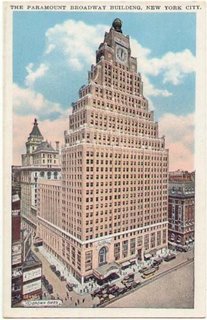
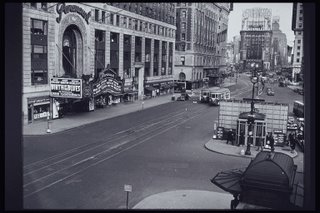

(NEW YORK) PARAMOUNT THEATRE--in the Paramount Building, 1501 Broadway between 43rd and 44th Streets. There's no need for one of my usual redundant recaps on the Paramount Theatre's history--cinematreasures.org's Paramount Theatre page contains a surfeit of lore galore, plus further links to photos and movie screening ads. Can't resist poaching a few pertinent quotes, though:
The Paramount was the first great movie palace in New York City that was built in the "Chicago-style" pioneered by the architectural firm of Rapp & Rapp. When first opened in 1926, its extravagant French Renaissance interiors were a radical change from the restrained Adam and Empire styles that New Yorkers had become accustomed to at the Paramount's main rivals, the Strand, Capitol, and Loew's State (all designed by Thomas Lamb). The Paramount became one of the city's top tourist attractions, but not for long due to the 1927 opening of the Roxy, which was almost twice as large and even more spectacular...For a theatre of its size (3,664 seats), the Paramount was one of the narrowest ever built because the auditorium had to be squeezed between two adjacent buildings--the Paramount office tower, which faced Broadway, and the headquarters of The New York Times (229 West 43rd Street). Consequently, the Paramount Theatre's entrance and a short lobby were carved out of the Paramount Building. After you passed through that short lobby, the actual theatre building began with the Grand Lobby, where you found yourself at the rear of the auditorium, which ran parallel to Broadway with the stage wall backing on West 44th Street. The main floor had only four sections of seats. Above that was a separate and recessed mezzanine with boxed seats. And one level above the mezzanine was the steeped balcony, divided into five sections of seats across and four from front to back. Due to the narrowness of the auditorium, the Paramount also had a narrow stage opening that proved a problem throughout the theatre's lifetime. Stage productions had to use the orchestra lift as part of the show or erect small platforms next to the pit. When the wide screen era arrived, some of the procscenium had to be removed to accommodate it...
The lobby was modeled after the Paris Opera House with white marble columns, balustrades and an opening arms grand staircase. Inside, drapes were red velvet, the rugs were a similar red. The theater also had a grand organ, and an orchestra pit that rose up to the stage level. The ceilings were fresco and gilt. The railings were brass, and the seats plush. There were Greek statues and busts in wall niches. The rest rooms and waiting rooms were as grand as any cathedral. In the main lobby there was an enormous crystal chandelier.
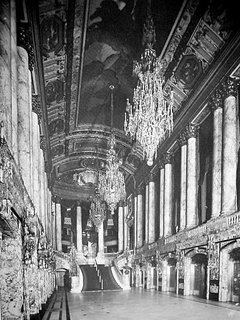


[Side note: these pages on early Times Square signage mention the previous structure on this site, the Putnam Building--named in honor of General Israel "whites of their eyes" Putnam. Supposedly he and George Washington met at this spot during the Revolutionary War.]
Famed as much for its stage shows as for its films and sumptuous decor, the Paramount boasted a long list of legendary performers, including Mary Pickford, Bing Crosby, Benny Goodman (with Gene Krupa on skins), Cab Calloway, Woody Herman, Duke Ellington, Artie Shaw, Tommy Dorsey, Jimmy Dorsey, Count Basie, Ella Fitzgerald, Nat King Cole, Perry Como, Eddie Fisher, Erskine Hawkins, the Treniers, Martin and Lewis (and apparently Jerry had worked as a Paramount usher in the early '40s), Peggy Lee, Tony Bennett, Vic Damone, Joey Bishop, Les Paul and Mary Ford, the Mills Brothers, Louis Prima and Keely Smith, Imogene Coca, and Jackie Gleason with his "Honeymooners" cohorts, among many others. Fine as these folks were, none of them caused quite as much of a stir as Frank Sinatra, who played several multi-date engagements to hordes of screaming, swooning, street-blocking bobby-soxers in the early '40s.
Alas, the theater's rock & roll connections concern us most here. Such events were few and far between, but fun.
Elvis never made an appearance, but his 40-foot-tall, guitar-slung likeness was mounted above the marquee for the November 15, 1956 premiere of Love Me Tender.

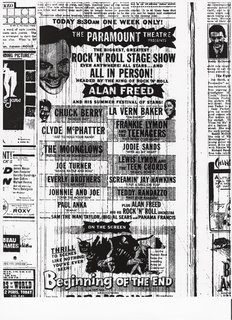
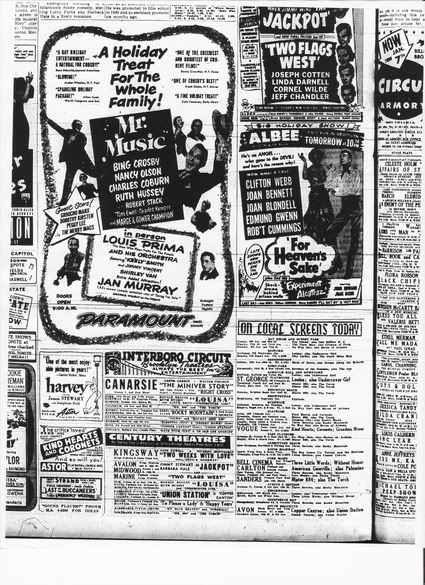
Although Alan Freed's association with the Brooklyn Paramount is more well-known, he did put on a few of his extravaganzas at the Manhattan location. Some researchers confuse the two venues, which has made ascertaining the correct dates a bit difficult.
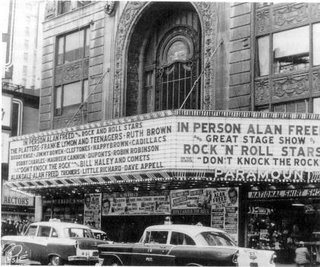
Here's a pic of the statuary management put in storage before these bookings in an effort to prevent rowdy teens from toppling them. And here's a pic of said delinquents dancing in the aisles and on seats. Be sure to consult the archives section of alanfreed.com--especially the "newspaper articles" link, loaded with vintage scans about these events.
[Side note # 2: While Freed booked most frequently at the two Paramounts, he also utilized the Brooklyn Fox (10 Flatbush Avenue), the Academy of Music, Loew's State (1540 Broadway), Loew's Paradise (2413 Grand Concourse in the Bronx--which hopefully won't meet a Stygian fate), the St. Nicholas Arena in Harlem, the Sussex Avenue Armory in Newark, and the New York Coliseum (10 Columbus Circle, demolished; now the site of the Time Warner Center).]
[UPDATE 2/7/2007: The Game Show Network recently aired a '50s episode of To Tell the Truth with Alan Freed as one of the contestants. It must have been originally aired around the time of the 57/58 Holiday Show of Stars, because some references were made to broken house records--not to mention broken house seats and other damage sustained by the Paramount in the wake of those raucous record-breaking delinquents. The panelists, including Polly Bergen, Ralph Bellamy, Kitty Carlisle, and Hy Gardner, clearly had an anti-rock & roll bias--I mean, jeez, the man had been in three movies by then and they didn't recognize him? Still, Bellamy and Carlisle correctly identified him as the real Freed. Polly Bergen chose one of the impostors because he knew the Paramount's manager was named Bob Shapiro.]
A cinematreasures.org regular posted the following: "For the Easter holiday period in 1964, the Paramount presented what the press reported as the theatre's first stage show in seven years. It was a Rock-N-Roll revue emceed by the radio deejays known as the 'WMCA Good Guys.' The performers included Sam Cooke, Dean & Jean, Rufus Thomas, the Devotions, the Sapphires, the Four Seasons, Terry Stafford, Chris Crosby, Diane Renay, and King Curtis & Band. There were five stage shows per day, punctuated by screenings of Zenith International's "No, My Darling Daughter," a British comedy with Juliet Mills and Michael Craig. The engagement ran from March 27 through April 5." Another cinematreasures guy remembers seeing Lesley Gore and James Brown at one of these shows. "Dandy" Dan Daniel offers some memories of those shows in this obit for his former fellow Good Guy, Dean Anthony.
Just when I thought I couldn't possibly learn anything new about the Beatles, along came another factoid. As if to commemorate the 20th anniversary of Frankie's fervent '44 fanbase, the Fab ones caused further screaming to echo off the Paramount's proscenium on September 20, 1964. Steve Lawrence and Eydie Gorme, of all people, were the opening act. All proceeds went to the United Cerebral Palsy and Retarded Infants Services charities--and this was the sole benefit concert the lads did in the U.S.


[UPDATE 7/20/2006: According to Norton Records' required-reading Mary Weiss interview, the Shangri-Las were also on this bill!!!]
[UPDATE 9/29/2007: Mary offers some further memories of this gig in a NY Sun interview.]
[UPDATE 6/9/2010: Oh my, am I late to the party on this one. Over a year ago, an NYC photo-blogger ("what about the plastic animals?") located the remnants of an old poster on the side of a Harlem building that was undergoing renovations at the time. It advertised a Dave Clark Five show at the Paramount, emceed by Murray the K. The blogger couldn't ascertain a concert date, but according to this DC5 chronology, it must have been on October 31, 1964.]

In May, 1965, coinciding with the engagement for Harlow (one of two Jean Harlow biopics released that year, this one starring Carol Lynley), local dance-party TV show host Clay Cole put on a revue featuring several soulful acts--Mary Wells, the Marvelettes, Ronnie Dove, Tony Clark, Charlie & Inez Foxx, and the Gypsies.

[UPDATE 2/14/2007: While researching an entry on the Brooklyn Fox, I came upon this auction site page featuring a number of '60s concert programs for sale, including three for shows held at the Paramount:


[UPDATE 5/27/2010: In a BBC Radio 2 documentary originally broadcast on 5/26/2010, Allan Clarke and Bobby Elliott recalled that Jimi Hendrix was playing for Little Richard's band at the time...but that Penniman was let go and forcibly removed from the premises at a certain point, for refusing to cut his set down to two songs.]
The Paramount closed later that year; Thunderball was the final flick shown. The auditorium and lobby sections were gutted and remodeled as office space, most of it serving as an annex to the adjacent New York Times headquarters. (The theater's renowned Wurlitzer organ survived and eventually found its way to Wichita, Kansas.) In the early aughts, the World Wrestling Federation operated a theme restaurant on the lower level of the building, where the theater's lounges and restrooms had previously been located. To spruce up the entrance, the WWF funded the construction of a replica of the Paramount's original marquee design. Though fans were presumably pleased that they now could actually smell-ell-ell-ell-ell what the Rock was cookin', the wrasslin' restaurant didn't last very long. As of August, 2005, the space became the new home of the Hard Rock Cafe. In a related-in-name-only twist, plans are afoot to convert the nearby Paramount Hotel (235 W. 46th Street) into the city's first Hard Rock Hotel by Spring 2006.
(NEW YORK) PARAMOUNT THEATRE--in the Paramount Building, 1501 Broadway between 43rd and 44th Streets. There's no need for one of my usual redundant recaps on the Paramount Theatre's history--cinematreasures.org's Paramount Theatre page contains a surfeit of lore galore, plus further links to photos and movie screening ads. Can't resist poaching a few pertinent quotes, though:
The Paramount was the first great movie palace in New York City that was built in the "Chicago-style" pioneered by the architectural firm of Rapp & Rapp. When first opened in 1926, its extravagant French Renaissance interiors were a radical change from the restrained Adam and Empire styles that New Yorkers had become accustomed to at the Paramount's main rivals, the Strand, Capitol, and Loew's State (all designed by Thomas Lamb). The Paramount became one of the city's top tourist attractions, but not for long due to the 1927 opening of the Roxy, which was almost twice as large and even more spectacular...For a theatre of its size (3,664 seats), the Paramount was one of the narrowest ever built because the auditorium had to be squeezed between two adjacent buildings--the Paramount office tower, which faced Broadway, and the headquarters of The New York Times (229 West 43rd Street). Consequently, the Paramount Theatre's entrance and a short lobby were carved out of the Paramount Building. After you passed through that short lobby, the actual theatre building began with the Grand Lobby, where you found yourself at the rear of the auditorium, which ran parallel to Broadway with the stage wall backing on West 44th Street. The main floor had only four sections of seats. Above that was a separate and recessed mezzanine with boxed seats. And one level above the mezzanine was the steeped balcony, divided into five sections of seats across and four from front to back. Due to the narrowness of the auditorium, the Paramount also had a narrow stage opening that proved a problem throughout the theatre's lifetime. Stage productions had to use the orchestra lift as part of the show or erect small platforms next to the pit. When the wide screen era arrived, some of the procscenium had to be removed to accommodate it...
The lobby was modeled after the Paris Opera House with white marble columns, balustrades and an opening arms grand staircase. Inside, drapes were red velvet, the rugs were a similar red. The theater also had a grand organ, and an orchestra pit that rose up to the stage level. The ceilings were fresco and gilt. The railings were brass, and the seats plush. There were Greek statues and busts in wall niches. The rest rooms and waiting rooms were as grand as any cathedral. In the main lobby there was an enormous crystal chandelier.

[Side note: these pages on early Times Square signage mention the previous structure on this site, the Putnam Building--named in honor of General Israel "whites of their eyes" Putnam. Supposedly he and George Washington met at this spot during the Revolutionary War.]
Famed as much for its stage shows as for its films and sumptuous decor, the Paramount boasted a long list of legendary performers, including Mary Pickford, Bing Crosby, Benny Goodman (with Gene Krupa on skins), Cab Calloway, Woody Herman, Duke Ellington, Artie Shaw, Tommy Dorsey, Jimmy Dorsey, Count Basie, Ella Fitzgerald, Nat King Cole, Perry Como, Eddie Fisher, Erskine Hawkins, the Treniers, Martin and Lewis (and apparently Jerry had worked as a Paramount usher in the early '40s), Peggy Lee, Tony Bennett, Vic Damone, Joey Bishop, Les Paul and Mary Ford, the Mills Brothers, Louis Prima and Keely Smith, Imogene Coca, and Jackie Gleason with his "Honeymooners" cohorts, among many others. Fine as these folks were, none of them caused quite as much of a stir as Frank Sinatra, who played several multi-date engagements to hordes of screaming, swooning, street-blocking bobby-soxers in the early '40s.


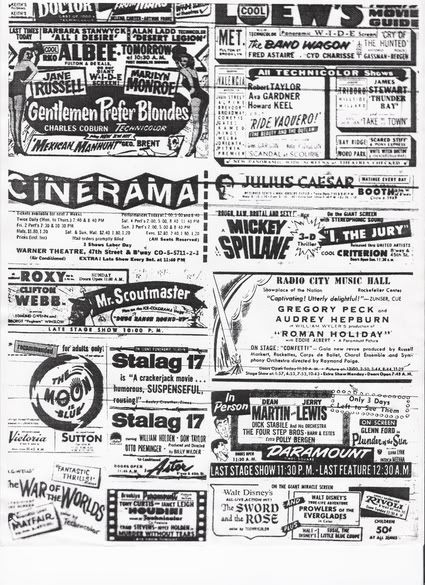
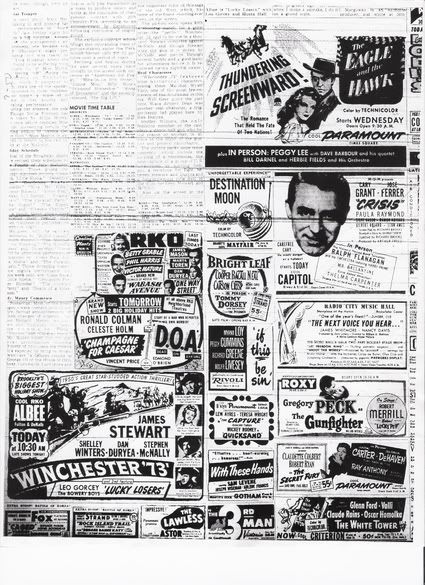


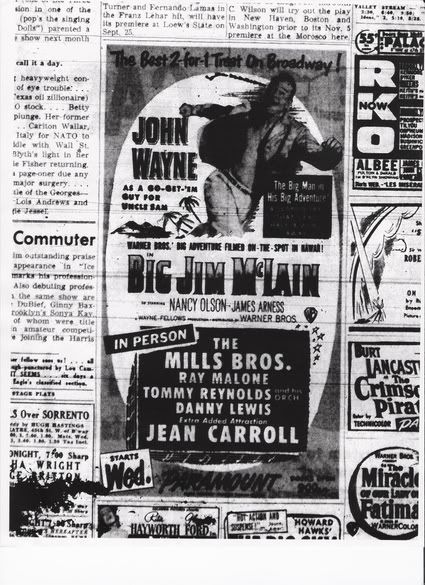

Alas, the theater's rock & roll connections concern us most here. Such events were few and far between, but fun.
Elvis never made an appearance, but his 40-foot-tall, guitar-slung likeness was mounted above the marquee for the November 15, 1956 premiere of Love Me Tender.

Although Alan Freed's association with the Brooklyn Paramount is more well-known, he did put on a few of his extravaganzas at the Manhattan location. Some researchers confuse the two venues, which has made ascertaining the correct dates a bit difficult.
- The earliest appears to have taken place in February 1957, in conjunction with the premiere of Don't Knock the Rock. The bill included the Platters, Frankie Lymon & the Teenagers, Ruth Brown, Nappy Brown, the Cleftones, the Cadillacs, and the Duponts, which featured a pre-Imperials Little Anthony Gourdine.
- Not absolutely sure of the dates for this show, but I believe it happened in early July, 1957--Chuck Berry, Clyde McPhatter, the Moonglows, Big Joe Turner, the Everly Brothers, Johnny & Joe, Paul Anka, LaVern Baker, Frankie Lymon & the Teenagers, his brother Lewis Lymon with the Teen Chords, Jodie Sands, Screamin' Jay Hawkins, and Terry Randazzo.
- From December 26, 1957 through January 6, 1958, the "Christmas Jubliee/Holiday Show of Stars" featured Fats Domino, Jerry Lee Lewis, Buddy Holly, the Everly Brothers, the Rays, Paul Anka, Danny & the Juniors, Lee Andrews & the Hearts, the Teenagers (I guess Frankie L. went solo by then), Jo Ann Campbell, and the Rays. Seems this show broke Frankie Sin's house record!


Here's a pic of the statuary management put in storage before these bookings in an effort to prevent rowdy teens from toppling them. And here's a pic of said delinquents dancing in the aisles and on seats. Be sure to consult the archives section of alanfreed.com--especially the "newspaper articles" link, loaded with vintage scans about these events.


[Side note # 2: While Freed booked most frequently at the two Paramounts, he also utilized the Brooklyn Fox (10 Flatbush Avenue), the Academy of Music, Loew's State (1540 Broadway), Loew's Paradise (2413 Grand Concourse in the Bronx--which hopefully won't meet a Stygian fate), the St. Nicholas Arena in Harlem, the Sussex Avenue Armory in Newark, and the New York Coliseum (10 Columbus Circle, demolished; now the site of the Time Warner Center).]
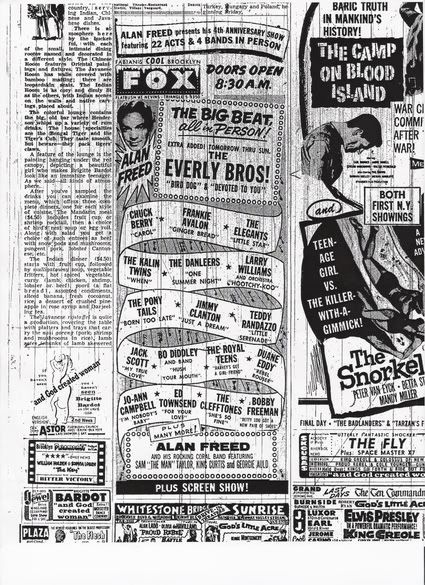
[UPDATE 2/7/2007: The Game Show Network recently aired a '50s episode of To Tell the Truth with Alan Freed as one of the contestants. It must have been originally aired around the time of the 57/58 Holiday Show of Stars, because some references were made to broken house records--not to mention broken house seats and other damage sustained by the Paramount in the wake of those raucous record-breaking delinquents. The panelists, including Polly Bergen, Ralph Bellamy, Kitty Carlisle, and Hy Gardner, clearly had an anti-rock & roll bias--I mean, jeez, the man had been in three movies by then and they didn't recognize him? Still, Bellamy and Carlisle correctly identified him as the real Freed. Polly Bergen chose one of the impostors because he knew the Paramount's manager was named Bob Shapiro.]
A cinematreasures.org regular posted the following: "For the Easter holiday period in 1964, the Paramount presented what the press reported as the theatre's first stage show in seven years. It was a Rock-N-Roll revue emceed by the radio deejays known as the 'WMCA Good Guys.' The performers included Sam Cooke, Dean & Jean, Rufus Thomas, the Devotions, the Sapphires, the Four Seasons, Terry Stafford, Chris Crosby, Diane Renay, and King Curtis & Band. There were five stage shows per day, punctuated by screenings of Zenith International's "No, My Darling Daughter," a British comedy with Juliet Mills and Michael Craig. The engagement ran from March 27 through April 5." Another cinematreasures guy remembers seeing Lesley Gore and James Brown at one of these shows. "Dandy" Dan Daniel offers some memories of those shows in this obit for his former fellow Good Guy, Dean Anthony.
Just when I thought I couldn't possibly learn anything new about the Beatles, along came another factoid. As if to commemorate the 20th anniversary of Frankie's fervent '44 fanbase, the Fab ones caused further screaming to echo off the Paramount's proscenium on September 20, 1964. Steve Lawrence and Eydie Gorme, of all people, were the opening act. All proceeds went to the United Cerebral Palsy and Retarded Infants Services charities--and this was the sole benefit concert the lads did in the U.S.

[UPDATE 7/20/2006: According to Norton Records' required-reading Mary Weiss interview, the Shangri-Las were also on this bill!!!]
[UPDATE 9/29/2007: Mary offers some further memories of this gig in a NY Sun interview.]
[UPDATE 6/9/2010: Oh my, am I late to the party on this one. Over a year ago, an NYC photo-blogger ("what about the plastic animals?") located the remnants of an old poster on the side of a Harlem building that was undergoing renovations at the time. It advertised a Dave Clark Five show at the Paramount, emceed by Murray the K. The blogger couldn't ascertain a concert date, but according to this DC5 chronology, it must have been on October 31, 1964.]
In May, 1965, coinciding with the engagement for Harlow (one of two Jean Harlow biopics released that year, this one starring Carol Lynley), local dance-party TV show host Clay Cole put on a revue featuring several soulful acts--Mary Wells, the Marvelettes, Ronnie Dove, Tony Clark, Charlie & Inez Foxx, and the Gypsies.

[UPDATE 2/14/2007: While researching an entry on the Brooklyn Fox, I came upon this auction site page featuring a number of '60s concert programs for sale, including three for shows held at the Paramount:
- The aforementioned WMCA Good Guys "Easter Parade of Stars" in 1964, with James Brown, Sam Cooke, Jackie Wilson, Bobby Rydell, Lesley Gore, the 4 Seasons, King Curtis, Chris Crosby, Dean & Jean, American Beetles, Rufus Thomas, the Sapphies, Diane Renay, Ruby & The Romantics, and Terry Stafford.
- Another WMCA Good Guys event called the "Show of Shows," with the Animals, Bobby Rydell, Del Shannon, Jan & Dean, Elkie Brooks, the Dixie Cups, Sam "The Man" Taylor, Ronnie Dove, Dee Dee Sharp, The Chartbusters, and Ronnie Dayton. The dates aren't given, but this site suggests that it occurred during Labor Day week in 1964.
- A "10-Day Easter Show" hosted by Soupy Sales in 1965, with the Hullabaloos, the Detergents, Shirley Ellis, Little Richard, the Vibrators {sic.--should probably be the Vibrations}, the Exciters, the Hollies, the Uniques, Dee Dee Warwick, Roddy Joy, Sandie Shaw, and King Curtis.] [UPDATE 3/22/2009: Found these images from the program.]
[UPDATE 5/27/2010: In a BBC Radio 2 documentary originally broadcast on 5/26/2010, Allan Clarke and Bobby Elliott recalled that Jimi Hendrix was playing for Little Richard's band at the time...but that Penniman was let go and forcibly removed from the premises at a certain point, for refusing to cut his set down to two songs.]
The Paramount closed later that year; Thunderball was the final flick shown. The auditorium and lobby sections were gutted and remodeled as office space, most of it serving as an annex to the adjacent New York Times headquarters. (The theater's renowned Wurlitzer organ survived and eventually found its way to Wichita, Kansas.) In the early aughts, the World Wrestling Federation operated a theme restaurant on the lower level of the building, where the theater's lounges and restrooms had previously been located. To spruce up the entrance, the WWF funded the construction of a replica of the Paramount's original marquee design. Though fans were presumably pleased that they now could actually smell-ell-ell-ell-ell what the Rock was cookin', the wrasslin' restaurant didn't last very long. As of August, 2005, the space became the new home of the Hard Rock Cafe. In a related-in-name-only twist, plans are afoot to convert the nearby Paramount Hotel (235 W. 46th Street) into the city's first Hard Rock Hotel by Spring 2006.
Tuesday, November 15, 2005
Anachronistic minds think alike
Every once in a while a rock journalist shares my sentiments exactly--as in this excerpt from last week's (November 11-17) "Rock & Roll Love Letter" column by Kate Sullivan in the L.A. Weekly:
Most of the time, I walk around in a meta-historical haze, my spirit tossed between musical decades — haunting some imaginary Brill Building of the soul, then reclining in the hair of Marc Bolan and then — occasionally — being drawn back to the future by a contemporary artist of real imagination and talent. So there’s nothing like a great band pulling a stunt like this to remind me, You’re actually alive, now, at this precise moment in history.
Not that I'd necessarily ascribe this occurrence to the White Stripes' Tegan and Sara cover record that she's reviewing in the article, even if I knew what it sounded like. In fact, such a phenomenon--getting completely bowled over by a new, non-revivalist band/record, and thus feeling somewhat in step with the times--hasn't happened to me in many a year. Yet Sullivan's enthusiasm gives me hope that this could conceivably come to pass at some point. And 'til then, there's no shame in frettin' to the oldies.
"Brill Building of the soul." Why couldn't I have come up with that line?
[Currently reading Ken Emerson's Always Magic in the Air: The Bomp and Brilliance of the Brill Building Era (New York: Viking, 2005).]
Most of the time, I walk around in a meta-historical haze, my spirit tossed between musical decades — haunting some imaginary Brill Building of the soul, then reclining in the hair of Marc Bolan and then — occasionally — being drawn back to the future by a contemporary artist of real imagination and talent. So there’s nothing like a great band pulling a stunt like this to remind me, You’re actually alive, now, at this precise moment in history.
Not that I'd necessarily ascribe this occurrence to the White Stripes' Tegan and Sara cover record that she's reviewing in the article, even if I knew what it sounded like. In fact, such a phenomenon--getting completely bowled over by a new, non-revivalist band/record, and thus feeling somewhat in step with the times--hasn't happened to me in many a year. Yet Sullivan's enthusiasm gives me hope that this could conceivably come to pass at some point. And 'til then, there's no shame in frettin' to the oldies.
"Brill Building of the soul." Why couldn't I have come up with that line?
[Currently reading Ken Emerson's Always Magic in the Air: The Bomp and Brilliance of the Brill Building Era (New York: Viking, 2005).]
Friday, November 04, 2005
The Bow-Ties that Bond
BOND INTERNATIONAL CASINO--1530 Broadway, on the east side of Broadway between 44th and 45th Streets. (Often referred to as Bond's.) A short-lived discotheque most famous for hosting the "Clash on Broadway" residency in 1981, Bond's sat on one of the Times Square-iest spots of land in Times Square. This New York Times article summarizes its phases well, but I'll add some elaboration here, as is my wont.
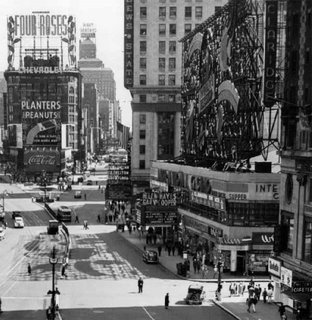
Before the Times set up shop in the area, Longacre Square was the horse dung-scented center of New York's carriage trade. An unseemly spot indeed for the future Crossroads of the World, but as the city's entertainment districts had been inexorably migrating ever further uptown along Broadway throughout the 19th century, the Square's eventual colonization by the theater crowd was inevitable. Oscar Hammerstein I was the earliest impresario to venture there. In 1895, on the site of the former 71st Regiment Armory (destroyed in a fire), he opened the Olympia Theatre, a massive Beaux Arts complex comprising a 2,800-seat Music Hall, a 1,850-seat playhouse called the Lyric Theatre, a smaller Concert Hall, and a roof garden theater. According to Anthony Bianco's Ghosts of 42nd Street (New York: HarperCollins, 2004), admission was fifty cents, and patrons could wander between the theaters at will. "[T]he Olympia did not style itself as a family entertainment venue," writes Bianco. "Content to leave the middle of the road to others, Hammerstein experimented with provocative new acts and formats that expanded vaudeville's boundaries." Hammerstein's adventurous fare included operas (some of which were his own compositions), "Living Pictures" (tableaus presented partially in the nude), Isham's Octaroons (an African-American song-and-dance troupe), and a notoriously so-bad-they're-good act called the Cherry Sisters. Unfortunately, not every production he put on was a financial success, which led to a foreclosure on the property after only three years of operation. The building was auctioned off, and the theaters became separate entities under the auspices of different producers. Hammerstein's next local enterprises, the smaller-in-scale Victoria and Republic Theatres, were more lucrative. Meanwhile, the Music Hall was renamed the New York Theater, and was converted into a movie/vaudeville house when Loew's took it over in 1915. The Lyric was first renamed the Criterion, then became a movie house called the Vitagraph in 1914, only to revert to the Criterion moniker a couple of years later. In 1907, Flo Ziegfeld staged his first production of Follies at the rooftop garden theater, renamed Le Jardin de Paris. When he decamped for the New Amsterdam in 1913, the roof garden was converted into a dancehall called Jardin des Danses. Despite its many virtues, the magnificent Olympia building did not outlast the Depression; it was demolished in 1935.
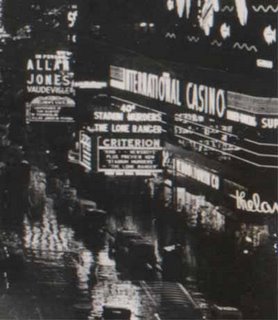
The building featured a new Criterion movie house (designed by Thomas Lamb and Eugene de Rosa), ground-level retail space, and a fabulous Art Deco nightclub/restaurant called the International Casino. According to Susan Waggoner's Nightclub Nights: Art, Legend, and Style, 1920-1960 (New York: Rizzoli, 2001), this Casino had nothing to do with gambling:
Once one passed through the solid brass doors and into the red and gold mosaic lobby, there was no shortage of amusements. The Cosmopolitan Salon was fitted with a small stage and littered with settees that could accommodate nearly eight hundred. Another one hundred and sixty could quench their thirst at the Spiral Bar, a curved slide of polished mahogany that swept from the ground floor up to the mezzanine. All this was a mere warm-up for the main room, where tiered platforms assured all fifteen hundred diners an unobstructed view of the show.
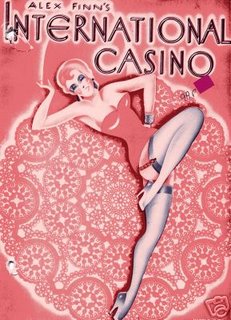
The show, mounted on an elaborately high-tech motorized stage, featured such delights as "novelties from five continents and the beauties of ten countries," an orchestra "whose reed section might suddenly plunge from sight, like riders on a parachute drop," a fanciful "Ice Frolics" revue, comedians like Milton Berle, and gorgeous chorines with gams for days. The swank Streamline Moderne surroundings were "designed by Donald Deckie, who later designed the Radio City Music Hall," according to Anthony Haden-Guest's The Last Party (New York: William Morrow, 1997). However, the Casino may have been too gloriously grandiose for its own good; much like the Olympia, it closed after a mere three years in business.
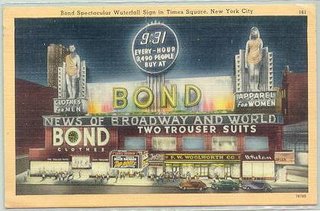
Bond Clothes took over the Casino's space in 1940, moving from its previous location adjacent to the Palace Theater a couple of blocks north. In its new digs Bond styled itself as the world's largest men's haberdashery, and offered some women's wear as well. As if the store's famous "TWO TROUSER SUITS" neon sign weren't enough, beginning in 1948 it also boasted the most splendid spectacular ever to grace the Great White Way, designed by Douglas Leigh for Artkraft-Strauss. As described in Leigh's 1999 Times obituary:
At the base of the Bond sign was an electric news zipper, about five feet high, running along the entire facade. In Mr. Leigh's design, twin 50-foot-high figures, one male and one female, flanked a waterfall 27 feet high and 120 feet long. Strands of electric lights seemed to clothe the chunky classical figures at night, but by day they appeared naked.
Before the Times set up shop in the area, Longacre Square was the horse dung-scented center of New York's carriage trade. An unseemly spot indeed for the future Crossroads of the World, but as the city's entertainment districts had been inexorably migrating ever further uptown along Broadway throughout the 19th century, the Square's eventual colonization by the theater crowd was inevitable. Oscar Hammerstein I was the earliest impresario to venture there. In 1895, on the site of the former 71st Regiment Armory (destroyed in a fire), he opened the Olympia Theatre, a massive Beaux Arts complex comprising a 2,800-seat Music Hall, a 1,850-seat playhouse called the Lyric Theatre, a smaller Concert Hall, and a roof garden theater. According to Anthony Bianco's Ghosts of 42nd Street (New York: HarperCollins, 2004), admission was fifty cents, and patrons could wander between the theaters at will. "[T]he Olympia did not style itself as a family entertainment venue," writes Bianco. "Content to leave the middle of the road to others, Hammerstein experimented with provocative new acts and formats that expanded vaudeville's boundaries." Hammerstein's adventurous fare included operas (some of which were his own compositions), "Living Pictures" (tableaus presented partially in the nude), Isham's Octaroons (an African-American song-and-dance troupe), and a notoriously so-bad-they're-good act called the Cherry Sisters. Unfortunately, not every production he put on was a financial success, which led to a foreclosure on the property after only three years of operation. The building was auctioned off, and the theaters became separate entities under the auspices of different producers. Hammerstein's next local enterprises, the smaller-in-scale Victoria and Republic Theatres, were more lucrative. Meanwhile, the Music Hall was renamed the New York Theater, and was converted into a movie/vaudeville house when Loew's took it over in 1915. The Lyric was first renamed the Criterion, then became a movie house called the Vitagraph in 1914, only to revert to the Criterion moniker a couple of years later. In 1907, Flo Ziegfeld staged his first production of Follies at the rooftop garden theater, renamed Le Jardin de Paris. When he decamped for the New Amsterdam in 1913, the roof garden was converted into a dancehall called Jardin des Danses. Despite its many virtues, the magnificent Olympia building did not outlast the Depression; it was demolished in 1935.


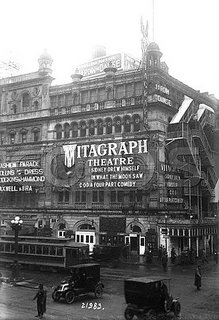
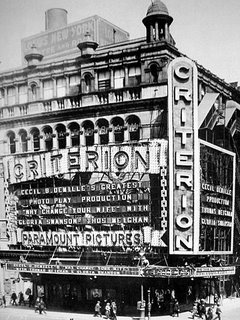
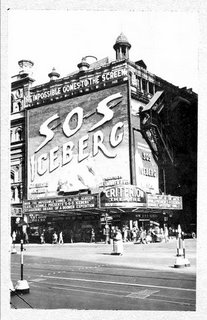
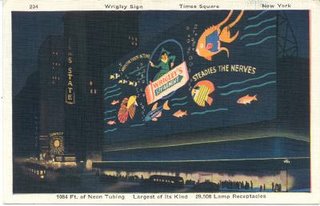
A year later, the Criterion Building rose in its stead. It occupied the same block-long frontage, but was not nearly as tall as its predecessor--unless you include the height of its huge rooftop neon sign, a fish-festooned spectacular advertising Wrigley's Spearmint Gum.

The building featured a new Criterion movie house (designed by Thomas Lamb and Eugene de Rosa), ground-level retail space, and a fabulous Art Deco nightclub/restaurant called the International Casino. According to Susan Waggoner's Nightclub Nights: Art, Legend, and Style, 1920-1960 (New York: Rizzoli, 2001), this Casino had nothing to do with gambling:
Once one passed through the solid brass doors and into the red and gold mosaic lobby, there was no shortage of amusements. The Cosmopolitan Salon was fitted with a small stage and littered with settees that could accommodate nearly eight hundred. Another one hundred and sixty could quench their thirst at the Spiral Bar, a curved slide of polished mahogany that swept from the ground floor up to the mezzanine. All this was a mere warm-up for the main room, where tiered platforms assured all fifteen hundred diners an unobstructed view of the show.
The show, mounted on an elaborately high-tech motorized stage, featured such delights as "novelties from five continents and the beauties of ten countries," an orchestra "whose reed section might suddenly plunge from sight, like riders on a parachute drop," a fanciful "Ice Frolics" revue, comedians like Milton Berle, and gorgeous chorines with gams for days. The swank Streamline Moderne surroundings were "designed by Donald Deckie, who later designed the Radio City Music Hall," according to Anthony Haden-Guest's The Last Party (New York: William Morrow, 1997). However, the Casino may have been too gloriously grandiose for its own good; much like the Olympia, it closed after a mere three years in business.
Bond Clothes took over the Casino's space in 1940, moving from its previous location adjacent to the Palace Theater a couple of blocks north. In its new digs Bond styled itself as the world's largest men's haberdashery, and offered some women's wear as well. As if the store's famous "TWO TROUSER SUITS" neon sign weren't enough, beginning in 1948 it also boasted the most splendid spectacular ever to grace the Great White Way, designed by Douglas Leigh for Artkraft-Strauss. As described in Leigh's 1999 Times obituary:
At the base of the Bond sign was an electric news zipper, about five feet high, running along the entire facade. In Mr. Leigh's design, twin 50-foot-high figures, one male and one female, flanked a waterfall 27 feet high and 120 feet long. Strands of electric lights seemed to clothe the chunky classical figures at night, but by day they appeared naked.
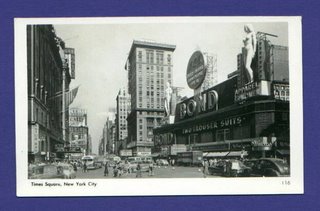
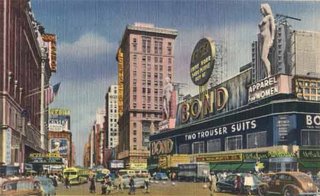
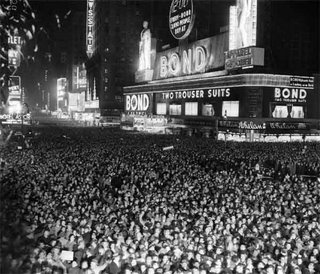
Those loincloth-lights were added only after guests at the Hotel Astor across the street complained about the statues' scandalously starkers state. A clock poised above the waterfall perpetually reminded the public, "EVERY HOUR 3,490 PEOPLE BUY AT BOND." (I suppose an even 3,500 customers per hour would have been too much to handle...)
After six good-looking years, the sign was replaced with a Pepsi ad; the waterfall remained (and kept gushing until the early '60s), but was now flanked with giant Pepsi bottles. Apparently a Chevy ad was once meant to take Pepsi's place, but a garagantuan Gordon's Gin bottle and a smoking Winston man (a total Camel sign rip-off) eventually appeared there instead. The ground-level storefronts evolved over time as well--among the successive occupants were Woolworth's, Whelan Drugs, King of Slim's Ties, Loft's Candy, Regal Shoes, Disc-O-Mat Records, tourist tchotchke outlets, and those ubiquitous bad-deal '70s/'80s electronics stores.
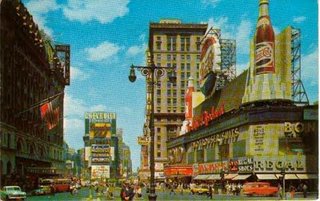
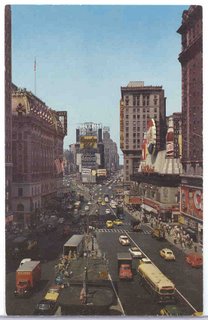
Bond Clothes sold its last two-trouser suit in 1977, and after a couple of vacant years, the space was respectfully rechristened as Bond International Casino, supposedly the largest disco the world had yet seen. As described in The Last Party, the club was co-owned by John Addison and Maurice Brahms. It opened in July 1980, and featured such accoutrements as a "musical staircase," fountains retrieved from the set of The Liberace Show (which often ended up filled with near-naked patrons), and a wide-ranging music policy (usually spun by resident DJ Kenny Carpenter). However, according to these opinionated folks on discomusic.com, the joint never quite caught on, for various reasons--bad location (Times Square at the height of its sleazy-seedy era), poor acoustics, lack of an atmospheric theme, inconsisent musical choices, and above all, too much space to fill on a nightly basis.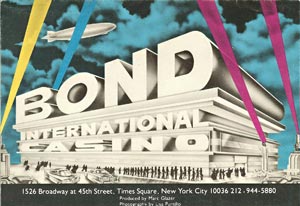
There were no such space-filling difficulties during the Clash's booking in May-June, 1981. The buzz surrounding their initial eight-night stand was so high that the shows were dangerously oversold--3,500 tickets for each night, at a venue with a legal capacity of about 1,800. The FDNY threatened to shut the place down following the first two overcrowded nights. After much negotiation with city authorities, the band worked out a deal wherein they would play as many shows as it would take to honor all ticket holders--an unprecedented seventeen concerts. Times Square hadn't seen that much commotion since Frankie at the Paramount, or V-J Day. An incredibly and obsessively detailed day-by-day account of the residency is provided at blackmarketclash.com (click on the link for 1981, then click on each Bond's date). Also check out the Westway to the World DVD, which includes Don Letts' documentary footage of Bond's. And dig these articles by Ira Robbins and Jonathan Lethem.
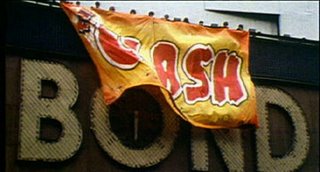
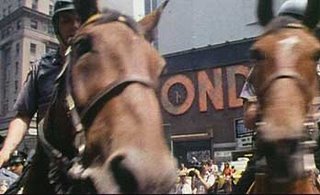
I've found references to only a few other rock shows, including Wendy O. Williams (yes, a car was blown up), the Blues Project (I don't recall Al Kooper mentioning this one in Backstage Passes and Backstabbing Bastards), Blue Oyster Cult, and a one-off night featuring members of Blondie and Chic. It's unclear just when Bond's closed, or what, if anything, occupied its space from the mid-'80s to the mid-'90s--but the neon BOND sign remained in place for quite some time.
The Criterion Building still exists, but it looks nothing like it did in the old postcards. Now called the Bow-Tie Building (a reference to the shape of the Times Square intersection when viewed from above), it's owned by members of the same Moss family who have had interests in the structure since its 1936 inception. The Roundabout Theater Company rented space in the building through much of the '90s, but I'm not sure which part they used. The Criterion Theater, which spent its last few years as a much-maligned multiplex, closed in 2000. Most of the building is now occupied by the flagship Toys R Us, a Foot Locker, and a Swatch emporium. There's no BOND sign facing Broadway anymore, but if you go around the corner on 45th, you'll find a smaller facsimile on the side of the building, attached to an old school-inspired Italian restaurant called Bond 45.


Wednesday, November 02, 2005
Mind-melding Magoo Madness
Dig this Blues Magoos article from the Lama Workshop website. It features a couple of super-cool vintage interview scans--one from the April, 1967 issue of Beat, and another from an issue of Greg Shaw's Mojo Navigator--in which the Magoos offer their unique insights on the Night Owl, the Albert Hotel, Cafe au Go Go, and the Greenwich Village scene in general.

Tuesday, October 18, 2005
From the Hip
LITTLE HIPPODROME--227 E. 56th Street, between 2nd & 3rd Avenues. This dinner theater/cabaret type of place is most notable as the site of the New York Dolls' final NYC shows, during their ill-advised (by Malcolm McLaren), Commie-inspired Red Patent Leather period in 1975. Nina Antonia explains it all in Too Much, Too Soon (London: Omnibus, 1998):
Malcolm...secured the band four dates between February 28 and March 2 at the Little Hippodrome. Situated on E. 56th Street, the theatre had a capacity of 2,000 and was more familiar with drag shows and stand-up comedy than rock groups, although the New York Dolls combined all three elements. The Little Hippodrome was out of the Dolls' usual venue circuit but that suited McLaren just fine, even if it proved a little disconcerting for their old fans...[Part of Malcolm's press release read], "The New York Dolls...have, in fact, assumed the role of the 'People's Information Collective' in direct association with the Red Guard. This incarnation entitled 'Red Patent Leather' will commence on Friday, February 28 at 10 p.m. continuing on Saturday at 9 and 11 p.m. followed by a Sunday matinee at 5 p.m. for our high school friends at the Little Hippodrome. This show is in co-ordination with the Dolls' very special 'entente cordiale' with the People's Republic of China."....Malcolm took the Communist Party image further by insisting that all tables in the Little Hippodrome should be draped in red fabric and even suggested that every drink sold while the Dolls were appearing should have an injection of red dye. The major theatrical gesture, aside from the band [attired in red outfits], was a huge red flag bearing the hammer and sickle which would be hung as a backdrop behind the group.
On the first weekend the opening act was Pure Hell, an all-black band. By the second show in the run, Jerry Nolan proved too drug-addled to perform, and Pure Hell's drummer Spider was asked to fill in. Arthur Kane was also undergoing some heavy drug problems at the time, managing to make it only to the final show; a bass player named Peter Jordan played the other shows in his stead. The following weekend, March 7-9, featured Television as the openers--their final shows with Richard Hell in the line-up. Wayne County DJed between the sets; David Jo had him intersperse his usual garage rock classics with tracks from a Communist Worker's Party album, much to Wayne's and the audience's chagrin.


Accounts vary widely as to how well, or how terribly, the Dolls went over on these dates.
From Too Much Too Soon: David Johansen clutched a copy of the Maoist handbook like a Bible and wondered who was going to be the next in line to fall. In the fact of adversity--in reality the only face they'd ever known--the Dolls performed as pluckily as ever. Unfortunately, the band didn't sound totally at ease with the new numbers and neither did the audience who lit up only when the Dolls broke into established favourites....Paul Nelson: "It was a disaster...It was very strange, you didn't know if it was supposed to be funny or not."...If McLaren had staged the Dolls' red uprising in Europe, the audience's sensibilities might not have been so ruffled, but 56,555 American soldiers had died in Vietnam attempting to stem a Communist take-over. It was too much of a sore point for most to understand the intended irony of the Dolls' attire.
In McNeil & McCain's Please Kill Me (New York: Grove, 1996) Jerry Nolan complains about the artsy-fartsy stupidity of the Red posturing. But in contrast, Clinton Heylin's From the Velvets to the Voidoids (New York: Penguin, 1993) has quotes from Nolan and Chris Stein attesting that these were among the greatest, tightest, and least erratic shows the band ever put on. Regardless of what actually went down at the Hippodrome, it wasn't long before a combination of less-than-stellar Florida gigs and over-the-top drug abuse led to the final dissolution of the Dolls. One of the Hippodrome shows was documented on a live album, Red Patent Leather--currently available as part of a two-disc set entitled Great Big Kiss.
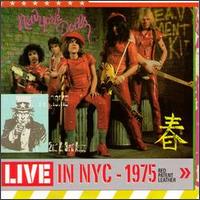

Seems as if few other bands played at the Little Hippodrome--I've found references only for Orchestra Luna and the Steve Lyons Eyeshow. Not sure when the theater closed, but the site is currently occupied by a fancy old-school (but not Red) Chinese restaurant called Bill Hong's.
Wednesday, October 05, 2005
Midnight ravers
MIDNIGHT RECORDS--263 W. 23rd Street between 7th and 8th Avenues (also occupied the adjacent storefront at 255). Though many in the record collecting and garage rock "communities" have mixed feelings about Midnight Records and its proprietor, most cannot deny the contributions J.D. Martignon's store/record label/mail-and-Internet-order business have made to the scene. Timothy Gassen's garage-revival reference book The Knights of Fuzz (Telford, U.K.: Borderline, 1996) sums up Midnight's influence succinctly:
J.D. Martignon's New York Midnight Records label and store became an important counterpoint to the California scene as well. Martignon released early efforts by the Fuzztones, Plasticland, the Outta Place, Plan 9 and a slew of others--continuing its mission into the 1990s. (The Midnight retail store and mail-order became a mecca for rare new garage/psych discs, and it has continued in its role as a candy store of goodies for this writer on numerous occasions.) Martignon points out that his widely circulated mail-order catalog, The Midnight Thymes, "had articles, a news section, and loads of hype on the garage/psych scene. It helped to propagate the music and the distribution of it worldwide." Midnight published one of the first books detailing the contents of 1960s compilation albums, which Martignon notes "was very influential on bands and collectors." Martignon also says rightfully, "Midnight became the inspiration for many of the (garage/psych) labels, mail-order companies, and distributors both in the U.S. and overseas--whether they will admit to it or not!"
Midnight deals in domestic and imported rock & roll, R&B, and blues, and particularly specializes in '50s and '60s sounds and revivalists thereof--on vinyl and CD. "Limited edition" live recordings and "rarities"--otherwise known as boots--are staples. The Midnight International label had a number of '80s garage bands and comps on its roster. The mail-order business, founded in 1978, has long been an essential resource for hinterlands garageniks (including my husband, who used to have $100+ orders shipped to his native Thunder Bay, Ontario home on a near-monthly basis). But the darkly atmospheric, intermittently open shop was shut down in early 2004, as reported in this Village Voice article by Hillary Chute from the March 17-24 issue:
On its last day, March 6, Chelsea's vaunted garage-rock record store Midnight Records was packed for the first time in recent memory. Owner J.D. Martignon—ever the enigmatic Frenchman, with cigarette, rattail, and paisley shirt—chatted with lightly eyelinered Rudolph Grey, who reminisced about using chainsaws in his late '70s band Red Transistor. Martignon's son, 10-year old Clovis—ever the '60s rocker, in a gorgeous mop-top and bemused expression—wandered crammed aisles. Shaggy-haired collectors, some spending upwards of $700, scoured rows of hard-to-find vinyl, grumbling "sad reflection" and "damn shame."
Part of the cult band Dagon in France, Martignon followed a woman to New York in 1973 and never left. A journalist for the underground magazine Parapluie, he covered the Stooges and the Dolls, interviewed the Cramps and Real Kids before they put out albums, and blew his mind on DMZ at CBGB. Punk bands were playing '60s garage, he noticed. Martignon began collecting records, but quickly amassed so many that he "had to sneak them into the house when my girlfriend wasn't around"—so he decided to start selling them. He kick-started a mail order business in 1978, and the store—which became the center of New York's garage revival in the mid '80s—opened six years later. Martignon even ran his own label from 1984 to 1993, putting out cult bands and Screamin' Jay Hawkins live tracks.
Now Martignon is fighting eviction and a lawsuit. The landlord wants to double the rent, and business has not been booming. (The current garage revival "generates zero sales" of his obscure inventory, Martignon says.) Meanwhile, Martignon is being prosecuted by the U.S. Attorney's office in conjunction with the RIAA for the sale of, to quote one of his lawyers, "what they're alleging are unauthorized recordings of concerts." Midnight is the only store of its kind facing prosecution. "A collector's store that cannot sell some bootlegs is kaput," the owner sighs. According to store employees, when Midnight was busted in September, Martignon was led off in handcuffs, protesting, "We're not harmful people! We're music people!" For now, he's mired in his court case (famed Stanford law professor Lawrence Lessig is working pro bono) and wants volunteers to revamp midnightrecords.com, where the store will now solely exist.
Seems like Ms. Chute had a soft spot for Monsieur Martignon. In the Voice's 2001 "Best of NYC" issue, she voted the shop as "Best Store for Rare Garage and Psychedelic Records," and praised its "supernice staff" and "long, easy-to-decipher catalog." In the 2004 "Best of" issue, she dubbed Martignon "Best garage-rock cran" (?), though she carefully notes that he "does not hesitate to get all Frenchman-bitchy on your ass." That may be something of an understatement. I never personally experienced his near-legendary surliness, but perhaps I'd been so intimidated by other customers' stories that I just knew to steer clear. He had a rep for unsavory business practices as well, but again, I always got decent service from the store. Read some of these accounts and decide for yourself.
In late September, 2004, Martignon made headlines when his federal indictment was dismissed on the grounds that the 1994 bootleg law was deemed unconsitutional. Google Jean Martignon for further details.
No longer a licorice pizza parlor, the storefront now serves up Ben & Jerry's ice cream.
J.D. Martignon's New York Midnight Records label and store became an important counterpoint to the California scene as well. Martignon released early efforts by the Fuzztones, Plasticland, the Outta Place, Plan 9 and a slew of others--continuing its mission into the 1990s. (The Midnight retail store and mail-order became a mecca for rare new garage/psych discs, and it has continued in its role as a candy store of goodies for this writer on numerous occasions.) Martignon points out that his widely circulated mail-order catalog, The Midnight Thymes, "had articles, a news section, and loads of hype on the garage/psych scene. It helped to propagate the music and the distribution of it worldwide." Midnight published one of the first books detailing the contents of 1960s compilation albums, which Martignon notes "was very influential on bands and collectors." Martignon also says rightfully, "Midnight became the inspiration for many of the (garage/psych) labels, mail-order companies, and distributors both in the U.S. and overseas--whether they will admit to it or not!"
Midnight deals in domestic and imported rock & roll, R&B, and blues, and particularly specializes in '50s and '60s sounds and revivalists thereof--on vinyl and CD. "Limited edition" live recordings and "rarities"--otherwise known as boots--are staples. The Midnight International label had a number of '80s garage bands and comps on its roster. The mail-order business, founded in 1978, has long been an essential resource for hinterlands garageniks (including my husband, who used to have $100+ orders shipped to his native Thunder Bay, Ontario home on a near-monthly basis). But the darkly atmospheric, intermittently open shop was shut down in early 2004, as reported in this Village Voice article by Hillary Chute from the March 17-24 issue:
On its last day, March 6, Chelsea's vaunted garage-rock record store Midnight Records was packed for the first time in recent memory. Owner J.D. Martignon—ever the enigmatic Frenchman, with cigarette, rattail, and paisley shirt—chatted with lightly eyelinered Rudolph Grey, who reminisced about using chainsaws in his late '70s band Red Transistor. Martignon's son, 10-year old Clovis—ever the '60s rocker, in a gorgeous mop-top and bemused expression—wandered crammed aisles. Shaggy-haired collectors, some spending upwards of $700, scoured rows of hard-to-find vinyl, grumbling "sad reflection" and "damn shame."
Part of the cult band Dagon in France, Martignon followed a woman to New York in 1973 and never left. A journalist for the underground magazine Parapluie, he covered the Stooges and the Dolls, interviewed the Cramps and Real Kids before they put out albums, and blew his mind on DMZ at CBGB. Punk bands were playing '60s garage, he noticed. Martignon began collecting records, but quickly amassed so many that he "had to sneak them into the house when my girlfriend wasn't around"—so he decided to start selling them. He kick-started a mail order business in 1978, and the store—which became the center of New York's garage revival in the mid '80s—opened six years later. Martignon even ran his own label from 1984 to 1993, putting out cult bands and Screamin' Jay Hawkins live tracks.
Now Martignon is fighting eviction and a lawsuit. The landlord wants to double the rent, and business has not been booming. (The current garage revival "generates zero sales" of his obscure inventory, Martignon says.) Meanwhile, Martignon is being prosecuted by the U.S. Attorney's office in conjunction with the RIAA for the sale of, to quote one of his lawyers, "what they're alleging are unauthorized recordings of concerts." Midnight is the only store of its kind facing prosecution. "A collector's store that cannot sell some bootlegs is kaput," the owner sighs. According to store employees, when Midnight was busted in September, Martignon was led off in handcuffs, protesting, "We're not harmful people! We're music people!" For now, he's mired in his court case (famed Stanford law professor Lawrence Lessig is working pro bono) and wants volunteers to revamp midnightrecords.com, where the store will now solely exist.
Seems like Ms. Chute had a soft spot for Monsieur Martignon. In the Voice's 2001 "Best of NYC" issue, she voted the shop as "Best Store for Rare Garage and Psychedelic Records," and praised its "supernice staff" and "long, easy-to-decipher catalog." In the 2004 "Best of" issue, she dubbed Martignon "Best garage-rock cran" (?), though she carefully notes that he "does not hesitate to get all Frenchman-bitchy on your ass." That may be something of an understatement. I never personally experienced his near-legendary surliness, but perhaps I'd been so intimidated by other customers' stories that I just knew to steer clear. He had a rep for unsavory business practices as well, but again, I always got decent service from the store. Read some of these accounts and decide for yourself.
In late September, 2004, Martignon made headlines when his federal indictment was dismissed on the grounds that the 1994 bootleg law was deemed unconsitutional. Google Jean Martignon for further details.
No longer a licorice pizza parlor, the storefront now serves up Ben & Jerry's ice cream.
Hey Johnny, hey Dee Dee, Little Tom and Joey
PERFORMANCE STUDIOS--23 E. 20th Street, between Broadway and Park Avenue South. At this rehearsal/recording studio-cum-punk rock laboratory, the Ramones were invented and unleashed on the world. The facilities were designed and built by Tommy Erdelyi and Monte Melnick, as explained in Monte's On the Road With the Ramones (London: Sanctuary, 2003):
[M]y cousin Ivan...was a locksmith and had installed a lock in a loft for this lesbian couple on E. 20th Street. One girl was a musician and the other had lots of money. They wanted to make some money by turning it into a hip studio and asked him if he knew anyone who could do it. My cousin asked me about it since I was in the music industry, and I called Tommy since he had the studio experience [He had worked at the Record Plant and other studios in the late '60s.--Ed.]. We built that place by hand; designed it and everything. We had a main stage, a separate booth with a glass wall for a four-track recorder, a rehearsal studio, offices and a lobby. We provided much of the gear ourselves, so we got all the free studio time we wanted in return. Unfortunately, we were in a residential neighborhood and kept on getting dragged into court due to noise complaints...Eventually they shut us down, but we managed to make a name for ourselves in the meantime.
The book includes reprints of the floor plan and business card, which extols the studio's many virtues: "Quality sounds, creative environment, baby grand, Hammond, Marshall, Sunn, Ludwig, Shure P.A, Wurlitzer, Peavey, 4-2 track TEAC, air conditioning."
People like Blondie and the Dolls were rehearsing there. I was working with a group called Smiley. We'd make flyers, charge a coupla bucks at the door, get a crowd, talk some label people into coming down and made our own little scene. I was doing the sound and lights at the time, which Tommy taught me how to do. On the side, Tommy was working on this unknown group, the Ramones. They were terrible...I thought it was a joke. I was a musician. I had two albums out. I was into four-part harmonies. I played with a symphony orchestra for chrissakes! I came from a different world. I thought, "What is this? What the hell is going on? Forget about it!"
Famous last words--he'd go on to spend the next two-decades-plus as their long-suffering tour manager. Tommy, who had initially served as the band's advisor/musical director, was also recruited into the fold--but not until after their first gig. The original line-up, which began practicing at Performance in January '74, consisted of Johnny on guitar, Dee Dee on lead vocals and rhythm guitar, Joey on drums, and a fellow named Ritchie Stern on bass, who quit after just a couple of sessions. Dee Dee took over bass duties, but had some trouble singing and playing simultaneously. He also a tendency to get hoarse after just a couple of numbers, so Joey would sing a few from behind his kit. Their first public appearance, and their only one as a trio, took place at a Performance Studio showcase on March 30, 1974.
Johnny, quoted in On the Road With the Ramones: We took ads in the Village Voice and we played one show for our friends around March 30, 1974. We were awful. We didn't have the image down yet. Our friends didn't even want to talk to us anymore after that.
Tommy got the bright idea that Joey should be the frontman--which necessitated a search for a new drummer. The cats who came to audition tended to play in a busy Bonham or Appice-like manner, as was the style at the time. Though not a drummer himself, Tommy would try to demonstrate a simpler, Slade-like way of playing to these prospects. They just couldn't seem to grasp proper Ramone technique, though--and so Tommy eventually realized he was the only logical choice to join the brudderhood. The first show with the new complete line-up was at CBGB on August 16, 1974--but they continued to do showcase gigs at Performance throughout '74 and '75, sometimes sharing the stage with Blondie.
It's unclear exactly when Performance closed down or what replaced it. Monte Melnick of course went on to be the Fifth Ramone, and in mid-1978 Tommy conceded his Fourth Ramone status to Marc Bell when he decided to re-devote his energies to sound engineering. The address is currently occupied by the Trixie + Peanut Pet Emporium, a purveyor of pricey pet paraphernalia.
[M]y cousin Ivan...was a locksmith and had installed a lock in a loft for this lesbian couple on E. 20th Street. One girl was a musician and the other had lots of money. They wanted to make some money by turning it into a hip studio and asked him if he knew anyone who could do it. My cousin asked me about it since I was in the music industry, and I called Tommy since he had the studio experience [He had worked at the Record Plant and other studios in the late '60s.--Ed.]. We built that place by hand; designed it and everything. We had a main stage, a separate booth with a glass wall for a four-track recorder, a rehearsal studio, offices and a lobby. We provided much of the gear ourselves, so we got all the free studio time we wanted in return. Unfortunately, we were in a residential neighborhood and kept on getting dragged into court due to noise complaints...Eventually they shut us down, but we managed to make a name for ourselves in the meantime.
The book includes reprints of the floor plan and business card, which extols the studio's many virtues: "Quality sounds, creative environment, baby grand, Hammond, Marshall, Sunn, Ludwig, Shure P.A, Wurlitzer, Peavey, 4-2 track TEAC, air conditioning."
People like Blondie and the Dolls were rehearsing there. I was working with a group called Smiley. We'd make flyers, charge a coupla bucks at the door, get a crowd, talk some label people into coming down and made our own little scene. I was doing the sound and lights at the time, which Tommy taught me how to do. On the side, Tommy was working on this unknown group, the Ramones. They were terrible...I thought it was a joke. I was a musician. I had two albums out. I was into four-part harmonies. I played with a symphony orchestra for chrissakes! I came from a different world. I thought, "What is this? What the hell is going on? Forget about it!"
Famous last words--he'd go on to spend the next two-decades-plus as their long-suffering tour manager. Tommy, who had initially served as the band's advisor/musical director, was also recruited into the fold--but not until after their first gig. The original line-up, which began practicing at Performance in January '74, consisted of Johnny on guitar, Dee Dee on lead vocals and rhythm guitar, Joey on drums, and a fellow named Ritchie Stern on bass, who quit after just a couple of sessions. Dee Dee took over bass duties, but had some trouble singing and playing simultaneously. He also a tendency to get hoarse after just a couple of numbers, so Joey would sing a few from behind his kit. Their first public appearance, and their only one as a trio, took place at a Performance Studio showcase on March 30, 1974.
Johnny, quoted in On the Road With the Ramones: We took ads in the Village Voice and we played one show for our friends around March 30, 1974. We were awful. We didn't have the image down yet. Our friends didn't even want to talk to us anymore after that.
Tommy got the bright idea that Joey should be the frontman--which necessitated a search for a new drummer. The cats who came to audition tended to play in a busy Bonham or Appice-like manner, as was the style at the time. Though not a drummer himself, Tommy would try to demonstrate a simpler, Slade-like way of playing to these prospects. They just couldn't seem to grasp proper Ramone technique, though--and so Tommy eventually realized he was the only logical choice to join the brudderhood. The first show with the new complete line-up was at CBGB on August 16, 1974--but they continued to do showcase gigs at Performance throughout '74 and '75, sometimes sharing the stage with Blondie.
It's unclear exactly when Performance closed down or what replaced it. Monte Melnick of course went on to be the Fifth Ramone, and in mid-1978 Tommy conceded his Fourth Ramone status to Marc Bell when he decided to re-devote his energies to sound engineering. The address is currently occupied by the Trixie + Peanut Pet Emporium, a purveyor of pricey pet paraphernalia.
Subscribe to:
Posts (Atom)