Tuesday, August 30, 2005

The *other* rock club on the Bowery

...and one which bit the dust long before the (pending) petering out of its more famous neighbor.

GREAT GILDERSLEEVES--331 Bowery between 2nd and 3rd Streets. Presumably named in honor of the '40s radio show and film series The Great Gildersleeve. In Punk magazine's "Summer 1979 Punk Club Guide" [see Punk: The Original (New York: Trans-High Publishing, 1996)], Gildersleeves is given a 3-star, "This place is smokin!" rating. But to my frustration I've yet to locate any concrete background info about the joint--ownership, exact years of operation, history of the building, atmospheric accounts, etc. Thus the best I can offer is a brief list of some bands who played there. Most gig dates are in the '79-'83 range, so I gather the place didn't see the other side of 1984.

On April Fool's Night, 1979, Elvis Costello and the Attractions played a whirlwind three shows at three separate venues--the Bottom Line, Lone Star Cafe, and Gildersleeves. This was around the time of Elvis' notorious denigrating remarks about Ray Charles; here's a Rolling Stone article which describes the controversy and mentions the extra security needed for the G.G. gig (including a couple of Hell's Angels recruited from around the corner).

Public Image, Ltd., April 22, 1980--a couple of days after a show at the Palladium.

The J. Geils Band, April 27, 1980. That night's rendition of "Love Stinks" was later released on a 12" promo picture sleeve. Listen to the mp3, which starts off with the club's outgoing phone message regarding the gig--apparently the band was billed as Juke Joint Jimmy and His Houseparty Rockers.

Starz, sometime in 1980--read one fan's memories here.

Sonic Youth played the club on June 3, 1981 (their second show ever, as openers for Glenn Branca), and on June 12 the following year. Seems Thurston Moore played there again on February 20, 1983, as a member of Even Worse (which included future Big Takeover honcho Jack Rabid).

Thrash guitarist Neil Turbin played the club as a member of the Newrace and Anthrax. Dig some Village Voice ads for a couple of his '82 gigs here--one of them lists Johnny Thunders and the Heartbreakers on October 2. Thunders & Co. are also known to have played there on November 27 and New Year's Eve of '82, and February 26, 1983. Here are sound engineer Jimmy Miller's recollections of one of these shows.

The Tickets, various dates in '82/83.

Black Flag, March 13, 1983.

Husker Du, April 17, 1983. Robert Christgau was there and maintains that fewer than a dozen witnesses were present. (Also dig this Christgau state-of-the-scene Voice article dated October 23, 1978, which discusses several noted clubs of the time.)

The Beastie Boys, still in their hardcore period, April 24, 1983. The flyer for this show also lists Reagan Youth, the Blessed, Artless, and You Suck, and further announces a Circle Jerks gig for the following week. Then a "teenage shutterbug," my pal Justina snapped a photo of the Jerks at that show--and also got a few shots of Heart Attack on some other Gildersleeves night.


This flyer for a May 29, 1983 show with S.S. Decontrol also lists several big-name hardcore shows for June of that year, including the Misfits, Minor Threat, G.B.H., and D.O.A. (who also did at least one other date on December 6, 1983).


Other bands/performers associated with the club include Iggy Pop, Another Pretty Face, the Flashcubes, Thundertrain, the Nihilistics, 15 60 75, the Savage Skulls, Amtrak, Kraut, Jackal, the Blind Dates, the Privates, Marshall Crenshaw, Gemini Jones, Doug Wahlberg, the Laughing Dogs, the Crumbsuckers, the Brats, and these unknown mudwrestlers.

One of the few bits of commentary about the club that I was able to find comes from Bruno Ravel of Danger Danger: "I started going there when I was 14 and continued for years until they closed down. It was a great scene. It gave me the bug to become a rock musician. Sure, I loved to play and loved music but hanging out in this club was like being backstage at a concert. Totally decadent, trashy and cool. I wish I could go back, even for one night." The band's 2000 album was entitled The Return of the Great Gildersleeves; its cover photo was taken on the same block where the club had been.

Lord knows what's at 331 Bowery now--probably a condo construction site. But here are a couple of blog entries about the NYC club-closure issue, here's the site for the club currently most at stake, and here's an essay on the history of NY hardcore written by Uncle Al of Murphy's Law.


UPDATE 12/29/2012:   Unbeknownst to me at the time I wrote this post, the building still exists.  A while back I posted a bunch of 1977 and 1978 Gildersleeves ads from the Voice.  Here's a 2009 post about the club from the Ffanzeen blog.  A Gildersleeves reunion show was supposed to happen in November 2012, but was cancelled due to Superstorm Sandy.  And the place gets a brief mention on page 76 of Cyndi Lauper: A Memoir (New York: Atria Books, 2012): "In Blue Angel, we recorded expensive, bad demos to send around to record labels and played clubs like Great Gildersleeves, which was (physically and sort of symbolically) right down the block from CBGB.  Gildersleeves was never the place, never the 'scene.'  Instead it was always the corny rock place that had the straighter bands."

Free Be Jeebies

[This title kinda reminds me of the time my moms took a phone message for me about meeting some friends for a show at CBGB's--only she had misheard the name as Heebie Jeebies. Most decidedly not Pandora's Golden ones, though.]

FREEBEING RECORDS, 129 Second Avenue just south of St. Marks Place. Or was it Free Being? I've seen the name of this late, lamented '70s/'80s record shop spelled both ways. According to the aforementioned Mike Fornatale, it "was one of the few places buying/selling used LPs in 1972...(sigh)...those were the days!" I recently rented the DVD of The Nomi Song--a required-viewing elegy for both a man and an era gone by--and among the many excellent extras is a brief "slide show" of some of director Andrew Horn's fave old East Village haunts. To a photo of Freebeing's front sign, he narrates as follows:

I think this was the first record store that I can remember where I started noticing the first sort of independently produced records. There was a point at which the bands at that time started realizing that for a few hundred dollars you could press your own record, and suddenly there was this explosion of records all over the place. And every week or every day [the store] would paste the new single that had just come out in the door, and the door would be full of all these singles. And I think this is the first place where I ever saw the B-52s single and the Elvis Costello.

Some other customer recollections are available here, here, here, and here, but unfortunately they have more to do with records found there than with the vibe and appearance of the store itself. I visited the store a few times as a tentative teenybopper during my earliest solo East Side expeditions (only after fully exploring the Greenwich Village frontier was it finally time to venture beyond Broadway's DMZ). Can't recall any specific items I bought, but I do remember the shop as a loud, crowded, lively hive of frenzied record-flipping activity. I'm not sure when it closed down, but ISTR a San Loco taco stand appearing in its stead by the late '80s. If I'm not mistaken, around that same time there was a record shop on Carmine Street calling itself Freebeing--but I may have the name wrong, and even if I am correct it may not have been a new location for the original. [Despite my iffyness about the Carmine St. shop's name, I can clearly recall how overjoyed I was upon finding a mint vinyl copy of the Jam's All Mod Cons there during my big 1988 Paul Weller phase.]

Since I never got into Friends I haven't seen this, but apparently one of the storefronts near Central Perk was named Free Being Records in honor of executive producer Kevin Bright's fond memores of the shop. As for the real storefront, it is currently home to Cinderella Falafel.


UPDATE 7/20/2006: Just found out that The Big Takeover's Jack Rabid worked there in the mid-'80s.


UPDATE 11/1/2010:  This photo was recently posted to the NY Rocks Facebook group--a portion of the store's sign is visible in the center.


Also, quite a while back I located some ads in the 1971 Voice which revealed that the store was originally  called Silverlight.  Here's one example, from the 7/29/71 issue.


Tuesday, August 23, 2005

Nailed down

Oh yeah...almost forgot.

The nail salon now occupying the former site of Wows!ville is called E-Nail.

Even the old Army-Navy store at Bleecker & Christopher, which certainly kept several generations of Village Persons outfitted in skintight Levi's and Sarge-fetish gear, has become a day spa.

So mystifyin'.

Saturday, August 20, 2005

Walkin' on the sidewalk, hotter than a match head

Remind me to avoid NYC in August if I can help it! We had a compelling reason for an August visit last year--Little Steven's Fest on Randall's Island--but unless a future event of that magnitude should be scheduled during this most sweltering and tourist-ridden of months, we'll be timing our visits for more temperate off-season periods. My usual power walks were largely out of the question due to the energy-sapping extreme heat, but we did manage one big record-and-book-shopping jaunt encompassing the vicinity of Other Music and Rockit Scientist. During this outing I inspected the Anderson Theater's entrance site at 66 Second Avenue--now occupied by a branch of Cartridge World--and was pleased to ascertain that the building's lobby portion and facade are extant from the original, with a couple of floors added to the roof. Also checked out the Emigrant Savings Bank branch housed in the former lobby of the Fillmore East to see if the place is indeed decorated with Fillmore photos. To my surprise and delight, the photo/memorabilia collages on display honor not only the fabled Fillmore, but also the Loew's Commodore, Village Theater, and Saint eras of the building. Yeah, I know, pictures offer small compensation for what was demolished--but I still found this little exhibit to be a lovely gesture on Emigrant's part. Speaking of pictures, though, while on another hike I checked out Bleecker Bob's window, and found no photo of the Blues Magoos at the Night Owl displayed therein (as had been reported on Peter Sando's site)--but no biggie, I was happy with their vintage life-sized Ramones cut-out.

The main reason for our unfortunate hottest-week-of-the-year timing was so I could see DEVO at the Hammerstein Ballroom. Never saw 'em before, and they don't seem to want to put T.O. on their tour itinerary, so we bit the bullet and shelled out $55 a piece (plus Ticketmaster fees) for the privilege despite my moral opposition towards outrageous ticket prices. The band was freakin' phenomenal, but the show was over much too quickly. Drummer Josh Freese (also with the Vandals and other acts), perhaps the most rhythmically precise percussionist I've ever heard, injured his hand about 45 minutes into the set--I didn't witness the actual accident but presumably he sliced it against a cymbal. Emergency first aid was administered and he managed to play a few songs in one-armed Def Leppard guy mode, but clearly couldn't continue to the end. Yeesh--you'd think the spud boys would have all the rhythm parts pre-programmed for just such an emergency. Thus we didn't get our money's worth--upsetting, but not exactly a situation you could feel pissed about given the circumstances. There was an afterparty at the FUSE Gallery/Lit Lounge in conjunction with a Mark Mothersbaugh art exhibit, at which a mostly female DEVO cover band called DEVA was to perform, but somehow we were too disheartened to venture there. Other hi-lites:
  • Beating the heat at a Union Square 14 afternoon matinee of The Aristrocrats.
  • Hanging out with my dear friend Cristina at Life Cafe and the Lakeside Lounge, and later drinking more beer at the Raven during their "Mod Mod World" '60s night.
  • Venturing to Coney Island for one last Nathan's lobster roll and Wonder Wheel ride before the area's slated devolution into some kinda antiseptic mall-like attraction.
  • Watching Peter Sellers clips, a Tom Snyder Tomorrow show tribute, and the A&E Brill Building doc at the Museum of TV (which brought back fond memories of the 2001 premiere of said doc at the Museum--Shadow Morton and Mary Weiss of the Shangri-Las were in attendance!).
  • Chowing down at Pongsri, one of the best Thai places in the city.
  • Cheering on pals Fuzzco and Moparlary at the Subway Surfers' Maxwell's debut.
  • Eating massive meals with my Pops and brother at some of our old regular haunts--the Moonstruck Diner on 23rd, venerable El Quijote in the Chelsea Hotel, and Umberto's of New Hyde Park.
  • And reviving our walk-weary souls with cool tunes and frozen drinks at Otto's Shrunken Head.

Due to massive electrical storms our Sunday night flight home was cancelled, but this later led to another highlight. While stumbling through the baggage claim area at Pearson the next morning, I walked right by Elvis Costello. He and wife Diana Krall, who I later learned had come to town to play at some special tribute to Oscar Peterson, were heading toward the baggage service counter as I was trying to find the LaGuardia carousel. I'm too much of a shy goof to ask for an autograph--and besides, maybe he was livid over a lost suitcase or something--but I had fun furtively staring at him and we did exchange "meaningful" eye contact. They say you better listen to the vice of reason...but they don't give you any chice 'cause they think that it's treason...

Saturday, August 06, 2005

More Fill (-ins)

You can count on the formidably fornatalented Mike Fornatale for many things. Excellent musicianship, vocalizing, and stage managing. Not only hobnobbing but actually Sharing the Stage with Such Stars as the Monks, Richard and the Young Lions and Mark Lindsay, among others. Beyond-encyclopedic knowledge on many aspects of life, music being merely one of his areas of expertise. Keen powers of observation and insight, manifested in elegant, witty, and hilarious writing (on his site, in Ugly Things, and on various listservs). Passionate and opinionated--but always well-reasoned and info-substantiated--debate. The ability to take my wiseass first impressions with a sense of humor. But I think what I admire most about him is his total recall of seemingly every moment of his longtime Zelig-like presence on the New York/New Jersey rock & roll scene. HE WAS THERE. And though he's not shy about letting you know it, he never does so in an obnoxious "AND YOU WEREN'T" way. His participation dates back to at least 1968, when at the tender age of 14 (and IIRC as part of a junior high field trip!) he attended his first rock concert at the Fillmore East--the Jefferson Airplane, Buddy Guy, and the Chuck Davis African Dance Company.

As part of a BLR-list debate about the likely demise of CBGB, Mike offered some thoughts on the effects of past venue closures, waxing most eloquently about the fate of his beloved Fillmore East. He kindly allowed me to quote an excerpt from his e-mail, which I offer as an update to the 7/1/2005 post:

All I can tell you is this: when the Fillmore East shut down, the building stayed empty for three years -- then some shoestring promoter tried to repoen it as the "NFE" in '74 or '75. I think there were only about three or four shows there before it shut down again. IIRC, Ike and Tina were the headliner on opening night. Then the building was sealed up like a tomb for years and years. Finally it reopened, after a radical re-modeling, as The Saint -- essentially a gay disco. Three floors, replacing the old orchestra/mezzanine/balcony sections. In 1984 or 85, someone had the bright idea to have some sort of Hippie Reunion Show thingy there. It was on the top floor. The stage was up against what had been the back wall of the old theatre. Everything inside was different -- EXCEPT the lobby, which was just as it had been back in the day. And I can't describe to you the way it felt to walk into that lobby. And, once inside, to note what parts of the stairwells were still as they were, and what architectural thingamabobs were still in place from 1968 (hell, from 19-TWENTY-8) and gaze at them fondly. Well, now the building's gone, except for the facade. And nobody will ever see that again. Of course, hell, none of us are still alive anyway.

Mike's next local appearance will be on September 30 at Magnetic Field with Shaw 'Nuff. Also in the band are Wendy Fornatale, Michael Lynch, the Headless Horsemen's Peter Stuart, and the Gripweeds' Kurt Reil. No, they're not an Enuff Z'Nuff tribute band, but they do specialize in tasteful covers, and at this show they'll be aping the Monkees. Be there if you know what's good for ya!

Thursday, August 04, 2005

Give a hoot

I hereby dedicate this post to the anonymous loud chick in the audience at the January 22, 1967 Ed Sullivan Show, who repeatedly hollered "Zal!!!!" throughout the Lovin' Spoonful's appearance. And why not--he was dashingly decked out in a dark green velvet suit after all, plus he needed some support after having ol' Sullystone mispronounce his surname as "Yanoosky." I imagine that large-lunged lass must've been among the regulars at this most storied Greenwich Village nitery:


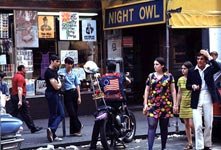
NIGHT OWL CAFE, 118 West 3rd Street b/w Macdougal Street and Sixth Avenue. I have no idea what businesses occupied this space before the Night Owl era, nor have I been able to ascertain the Night Owl's exact years of operation. Seems like it was open through much of the decade, though--specializing in folk, blues, and jazz at first in the early '60s, and gradually evolving into a rock club by '64/'65. The most vivid description of the joint by far is on Peter Sando's website--he performed there frequently with the Rahgoos, who later metamorphosed into Gandalf. These links are must-reads, but I can't resist quoting a pertinent excerpt on the club's atmosphere:

It was a very unique room, a long and narrow storefront. The stage faced straight at a wall in the center with one church pew at the foot (the "crotch watchers bench"), an aisle, and then another pew against the wall. All the other seating was to the left and right of the stage, giving a side view. The PA was very trebly and faced to the sides. The music crashed into the wall and died, leaving the vocals very bare to the bulk of the crowd to each side. You had better sing on key or else it was a disaster. Good harmony went a long way at the Night Owl! The cast of characters: "Jack the Rat" at the door, a frightening cat with teeth missing and dirty clothes; Joe Marra, the owner; Annie, head waitress (very bossy)...The waitresses all used four letter words that we had never heard from girls before...shocking to four straight, naive, suburban rockers! There was Pepe, the openly gay cook (we had never seen anyone "openly gay"); and of course, all of the great bands! An interesting and happy family indeed...Joe Marra would blink the stage lights on and off, kind of a poor man's strobe light effect...Waitress Shelly Plimpton appeared in the original cast of "Hair." [And later had a daughter with Keith Carradine--peerlessly cool actress Martha Plimpton. -Ed.] Every Thanksgiving the Night Owl had a huge feast. Everyone was there past and present--even The Spoonful...and The Mothers of Invention served the food! Yes, we "believed in magic"!

Indeed, the Lovin' Spoonful was unquestionably the most successful band to emerge from the club. Richie Unterberger traces the twisted roots of the group in this excerpt from Turn! Turn! Turn!: The '60s Folk Rock Revolution (San Francisco: Backbeat Books, 2002); elsewhere in the book he discusses their early '65 Night Owl residency:

The Night Owl, a narrow room of about 75 by 20 feet with a stage so small that [drummer Joe] Butler had to play on the floor, was the Spoonful's equivalent to the Byrds' residency at Ciro's, giving the musicians time to refine their sound and develop material as they lobbied labels for a recording contract. When they weren't at the Night Owl, they were rehearsing at the Albert Hotel, where they lived in a single room that also included all their instruments, dodging the rent by having their friend Denny Doherty sweet-talk the female bookkeeper.

They soon fielded offers from Elektra and Kama Sutra, but ultimately opted for the latter's rock & roll teen appeal over the former's folkie street cred. The band's Top Ten potential was realized later that year with a song inspired by a twinkle-toed gal in the Owl audience, according to this quote from John Sebastian:

"We were playing pretty steadily for the local people from Greenwich Village who were part of the Jazz scene or part of the kind of downtown 'in crowd.' They were 'finger poppers,' guys who played chess, 'beatniks.' But there was this one particular night as we were playing, I looked out in the audience and saw this beautiful 16-year-old girl just dancing the night away. And I remember Zal and I just elbowed each other the entire night because to us that young girl symbolized the fact that our audience was changing, that maybe they had finally found us. I wrote 'Do You Believe In Magic' the next day."

An instrumental entitled "Night Owl Blues" appeared on their first album, and Sebastian later recorded a song called "Night Owl Cafe" on his '93 solo album Tar Beach. A 1965 live set recorded at the club was supposed to be released on Varese Vintage in the late '90s, but remains in the can.

Other Night Owl notables may not have reached the same lovin' lofty heights of stardom, but most are no less esteemed by '60s garageniks and folkfiends. Here's a brief list:

The Magicians were named after the aforementioned Spoonful hit, if the liner notes to An Invitation to Cry on Sundazed are to be believed. Various Village denizens made up the band--but unlike the Spoonful, the Magicians were assembled as a recording unit first (by Bob Wyld and Art Polhemus of Longhair Productions), and actually got a contract with Columbia before settling into a regular Night Owl gig. Their alliance begat the great songwriting team of Bonner and Gordon. Garry Bonner still sings with doo-woppers Kenny Vance and the Planotones. Alan Gordon, also still in the biz, frequently contributes to the Spectropop yahoogroup, always signing his informative missives as "That Alan Gordon." Guitarist Allan "Jake" Jacobs stayed active in music through the years as well.

The Blues Magoos also made it to the Longhair Productions stable, but they did so the old fashioned way by gigging around first. And after gaining a fan base at the Night Owl, they managed to become the club's second most commercially viable success story. Here's an article about them from the February 24, 1967 issue of Billboard. Also check out Peppy Castro's site.

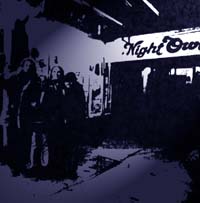
The Strangers are often cited as being an outstanding Owl band, but what little they recorded apparently has not been comped, and thus I cannot judge. Regardless, you can't help but dig this photo showing them, the Magicians, and the Blues Magoos (utilizing the original spelling, Bloos) all listed on the Night Owl's entrance awning. Strangers drummer Eric Eisner was the boyfriend of Woody Guthrie's daughter Nora; the two collaborated on one of the most bizarre songs of a decade filled with 'em, "Emily's Illness"--read an excellent article about that record here.


I've been told the fella in the center is Steve Martin from the Left Banke.


I'm no big James Taylor fan, but I'm nonetheless impressed that he paid his initial dues as part of the Albert Hotel/Night Owl scene. Following stints at a strict private boys academy and a mental institution, teenaged Taylor moved to New York in 1966 and soon formed a band called the Flying Machine. Despite an Owl residency and a recording contract, the band went nowhere, and the emotionally volatile Taylor succumbed to a heroin addiction. The experience did provide fodder for his future direction, however. In "Fire and Rain," the line "sweet dreams and flying machines in pieces on the ground" (or as The Simpsons would have it, "flying machines flying safely through the air") is a reference to his old band. You can hear some Flying Machine sound samples here (including "Night Owl," later covered by erstwhile wife Carly Simon--the club may have inspired the title, but the lyric has nothing to do with the place). I was hoping their material would be in straight-up garage mode, but they're not far removed in wimpiness from Taylor's later output. Keyboardist/Flying Machine fan/all-around character Mark "Moogy" Klingman offers some memories of the band here and here.

Taking a break from their standing residency at the Cafe Au Go Go, the Blues Project played the Night Owl from October 7-9, 1965. [Coincidentally, I'm currently reading Al Kooper's Backstage Passes and Backstabbing Bastards (New York: Billboard, 1998)--highly recommended!]

Fred Neil was a frequent fixture on the Night Owl's stage--here's a 1966 article about him from Hit Parader.

Circa '64-'65, Tim Rose, Jake Holmes, and Richie Hudson comprised an early folk-rock trio with a steady Night Owl gig. They called themselves either the Feldmans or Tim Rose and the Thorns, depending on which source you trust. The band was short-lived, but Rose and Holmes later regularly performed at the club as solo acts.

After being discovered at It's Boss on the Sunset Strip, Tim Buckley was booked for his first New York engagement at the Night Owl in mid-1966. That August Jac Holzman signed him to Elektra posthaste. Here's a picture of him performing there; the same Buckley fansite also has a great photo of the front of the building.

Lothar and the Hand People's New York debut was booked at Trude Heller's, but they were soon fired for "talking too much between numbers," according to this article. Fortunately they found a more receptive environment at the nearby Night Owl. San Francisco's Sopwith Camel later opened for them there in early '67 (and soon toured with fellow Owl alumi/Kama Sutra labelmates the Spoonful).

Other performers with Night Owl connections include Tim Hardin, Richie Havens, Dino Valenti, the First Foundation Blues Band, the Ginger Men, the Fifth Avenue Band, the Myddle Class, Random Concept, "Big Mike" DeVita, Tom Pacheco (with the Ragamuffins), Stan Penridge, Stephen Stills, and of course all the names listed on Peter Sando's page. You can read some audience member reminiscences here, here, here, and here. And here's a 1967 Tiger Beat article that mentions a visit to the club paid by Micky Dolenz and some members of the Raiders.

Not sure when the Night Owl closed, but I have not found any post-1967 references to the place. Following a '70s stint as a poster/button/head shop, for close to three decades now the storefront has been occupied by Bleecker Bob's Records. It's perhaps the most overpriced record shop in town, but apparently Bob at least has the common decency to keep a picture of the Blues Magoos onstage at the Night Owl displayed in the front window.


UPDATE 5/25/2010: I recently made the tumblr acquaintance of Hip Toad and cheapocheapo, two young ladies who are positively obsessed with '60s teen mags, vintage NYC, and the Lovin' Spoonful. In turn, I'm obsessed with many of the photos and mag scans they post, including these two rare interior shots of the Night Owl. Oh yeah, the pics also happen to feature Peter Tork and Buzzy Linhart.


UPDATE 1/24/2013:  The Night Owl Cafe Tribute Page has just been established on Facebook--please join and share your stories and pics.  Here are some more images I've gathered over the last couple of years, mostly from my pals on tumblr.

Menu--pretty sure this scan came from "cheapocheapo."

John Sebastian relaxing between sets.


IIRC these two came from "goodtimemusic" (formerly "hiptoad").  I don't have the full article were attached to--probably a Monkees spec issue of 16 or Tiger Beat or something like that.  They show Monkees-era Peter Tork visiting the club and sitting in with a band.  Do you recognize them?


If you can deal with the Evil Getty Watermark, there are some cool exterior shots of the club on the Getty website.  I haven't seen the Jeff Buckley/Tim Buckley biopic yet, but I hear it includes a scene depicting Tim performing at the Night Owl, which was shot at Sophie's bar.  A few months ago I read two memoirs which contain some Night Owl stories--Carole King's A Natural Woman, and Kathy West's A Song for You: The Quest of the Myddle Class.  And as you've no doubt heard by now, the closure of Bleecker Bob's is imminent.  

Thursday, July 28, 2005

You best be at that dance down on 14th Street, you hear?

ACADEMY OF MUSIC/THE PALLADIUM--126 E. 14th Street, between 3rd and 4th Avenues. A major rock venue of the '70s, and a humongous high-tech dance club in the '80s, this was the second theater building on 14th Street to bear the Academy of Music name.

The original Academy stood across the street at the northeast corner of 14th and Irving Place, and was "the city's first successful opera house," according to Terry Miller's Greenwich Village and How It Got That Way (New York: Crown, 1990). Designed by architect Alexander Saeltzer and built in 1854, it hosted the American premieres of Il Trovatore, La Traviata, Die Walkure, and Carmen, and such major social events as an 1860 ball in honor of the Prince of Wales. The Academy also has a roundabout connection to the birth of American musical theater. In May of 1866, a fire at the theater left a French ballet troupe stranded without a place to perform. The company, its scenery, and its elaborate stage effects were hastily added to a production of The Black Crook at Niblo's Garden; the resulting bizarre combination of Faustian drama and tutu-and-tights dance routines became a major hit and is widely considered to be the first full-fledged Broadway musical.

The Academy was restored after the fire, but it didn't last much longer as an opera house. In the Whartonesque high society of the times, one was looked down upon if one did not have a box at the opera--and to the frustration of newer Gilded Age millionaires, Old New York's most aristocratic families had long kept a tight hold on the Academy's eighteen boxes. In protest, the nouveaux riches decided to build their own palace of prestige further uptown--the original Metropolitan Opera House at 1423 Broadway near 39th Street, opened in 1883. This new house not only had ample boxes, it also had its own resident company and musical director--aspects which the Academy had always lacked. Old money was forced to admit defeat, and soon defected to the boxes at the Metropolitan. The Academy presented its last opera in 1885, and thereafter offered the public a mixture of theater, vaudeville, and later, films. [Click here for a cartoon depicting an 1871 ball held there in honor of the Grand Duke of Russia. Here and here are essays about an early experiment in widescreen film shown there in 1897. Click here to see a program from December, 1909. Sammy Cahn was inspired to take up songwriting after witnessing a vaudeville show there, according to an anecdote presented on this site. And here is a picture of the building's exterior taken sometime in the early 1900s--I can't discern if the Brewster's Millions on the marquee refers to a live production or the 1914 DeMille film.] The theater was torn down in 1926; the Con Edison Building now stands in its place.

While the second Academy of Music was obviously named after its predecessor, music was not its original raison d'etre. According to one frequent and knowledgeable poster on cinematreasures.org, it

was built by William Fox, with Thomas Lamb as architect. It was never intended as a concert hall, and first opened in 1927 as a deluxe "presentation" house with a feature movie and vaudeville. Fox had been shut out of building in the Broadway-Times Square area, so he hoped that crowds would flock to 14th Street to attend this beautifully appointed 3,600-seat theatre, but that didn't happen. With the onset of the Depression, Fox lost his entire theatre empire, including the Academy of Music. In the bankruptcy proceedings that followed, the Academy became part of the Skouras circuit, which operated it for the rest of its four decades as a movie theatre. Skouras was notorious for its housekeeping, and the Academy became increasingly shabby and uncomfortable with the passing of time.

Another contributor remembers it as being "mostly a Fox or Universal programmed grindhouse." Unfortunately I haven't found any details about said films, or of possible vaudeville performers who may have graced the Academy's stage--but I did learn that the place was also used for the occasional boxing match.

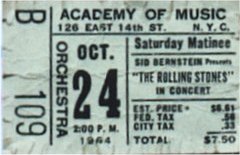
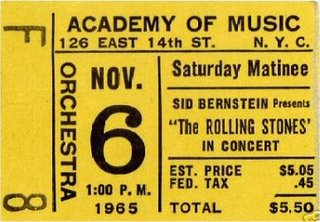
The Academy's first big rock and roll event appears to have been an Alan Freed show over the Christmas holiday in 1955, featuring the Cadillacs, LaVern Baker, the Valentines, the Heartbeats, the Wrens, the 3 Chuckles, the Bonnie Sisters, and the Count Basie Orchestra. The next rock act I've confirmed is the Rolling Stones, who played the hall on October 24, 1964, and May 1 and November 6, 1965. Tom Wolfe describes the scene at the '64 show to super-fab effect in his essay about Baby Jane Holzer, "The Girl of the Year" [available in The Purple Decades (New York: Farrar, Straus and Giroux, 1982) or The Kandy-Kolored Tangerine-Flake Streamline Baby (New York: Bantam, 1999 reprint)]. Bob Gruen recounts his memories of the November '65 gig here.


Another cinematreasures guy remembers seeing the Kinks and the Dave Clark 5--most likely that was on June 19, 1965, if this Kinks info site is correct. Impresario Sid Bernstein orchestrated these British Invasions. There were probably other shows, but such concerts seem to have been sporadic, isolated events--the Academy wouldn't hit its stride as a rock & roll stronghold until a few years later.

[UPDATE 7/13/2006: Add the Beach Boys to the list of mid-'60s Academy biggies--they played the hall on February 13, 1965. Glen Campbell had prior session commitments, so Brian fulfilled his old bass duties. This tidbit of info was culled from Brad Elliot's "Do You Remember?: A Chronology of the Beach Boys, 1964-65," an article in the ultra-fab Dumb Angel Gazette # 4: All Summer Long.]

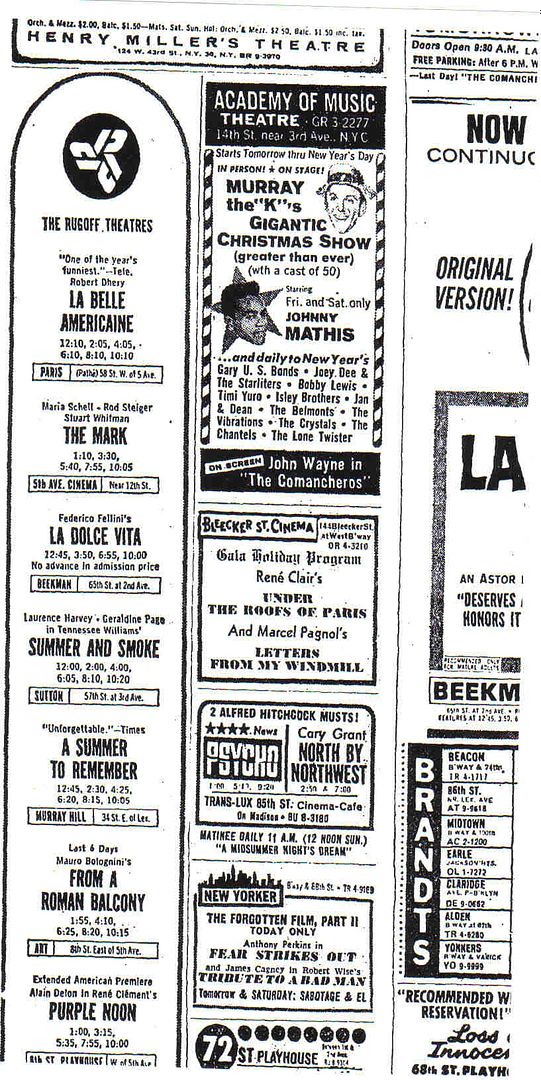
[UPDATE 7/17/2006: I should check the cinematreasures.org page on the Academy more often...I just found out about Murray the K's "Gigantic Christmas Show" over the 1961 holiday season. Headliners included Johnny Mathis from December 22-23, Bobby Vee from the 24th through the 29th, and Dion from December 30 through January 1. Other acts were nothing to sniff at, including Joey Dee & the Starliters, Gary U.S. Bonds, Timi Yuro, Bobby Lewis, the Isley Brothers, Jan & Dean, the Belmonts, the Vibrations, the Crystals, the Chantels...and the Lone Twister!]


[UPDATE 5/30/2010: Found this poster (on britishinvasionradio.com) which might clear up a few things about other Invaders who played there. However, I've heard that the Moody Blues didn't get immigration clearance to play the show with the Kinks.  There's a variation of the poster on sidbernsteinpresents.com, a site for an upcoming documentary on the man.]


A fellow named Howard Stein turned the Academy into the city's leading '70s rockitorium. Don't know very much about him apart from this colorful characterization in Anthony Haden-Guest's The Last Party: Studio 54, Disco, and the Culture of the Night (New York: William Morrow, 1997):

Howard Stein is a New Yorker. A springy, dapper man, his black hair slick as polish on a balding pate, he has a bright grin but can switch from charm to chill in a nanosecond. Some attribute this to like father like son--Howard's father, Jack "Ruby" Stein, had been a loan shark, who ended up floating down the Hudson, sans head. About this, Stein is overly sensitive, although most of the grand young Euros in New York had family histories at least as baroque. Stein was one of New York's main producers of rock concerts in the late sixties. "Bill Graham was my major competitor," Stein says..."I was doing shows at a theater in Westchester County. I was like Castro. In the hills. Taking little shots, making forays, while he controlled the market in New York City. I did a Sonny and Cher concert when they were still wearing alpaca vests."

That venue was the Capitol Theater in Port Chester; he also promoted shows at Gaelic Park in the Bronx's Riverdale section, and at the New York State Pavilion in Flushing Meadow. Shortly after Graham closed the Fillmore East, Stein seized the opportunity to take over the Academy. Apparently the place was even renamed Howard Stein's Academy of Music, but I haven't located a photo of any marquee signage that would corroborate this. Some notable performers/performances of the early to mid-'70s include:

A series of "Rock and Roll Revival" oldies shows, featuring such groups as Danny & the Juniors, the Moonglows, the Harptones, and the Fleetwoods.

Alice Cooper with Wet Willie, late 1971.

Black Sabbath, October 22, 1971.

The Band closed out 1971 with three shows, culminating in a special appearance by Bob Dylan at the stroke of midnight on New Year's Eve. This engagement was later documented on a live album, Rock of Ages.

Hot Tuna played the Academy at least once a year through much of the decade--check out the dates here.

The Grateful Dead, March 1972 (and the Spring of 1977).

New Riders of the Purple Sage, November 22 and 23, 1972.

Hawkwind had their U.S. debut there in November, 1973.

Lou Reed's pivotal live album Rock and Roll Animal was recorded there on December 21, 1973.

KISS, Teenage Lust, Iggy and the Stooges and Blue Oyster Cult played on New Year's Eve, 1973. Iggy's set wound up on a 2000 live album, Double Danger. KISS opened for Argent and Redbone a few weeks later on January 26. [UPDATE 10/14/2008: A former Academy employee named Michael recently wrote to inform me that the Stooges didn't play on this bill. There is a scan of a newspaper ad for this show on the wonderful Teenage Lust myspace page which lists BOC, Teenage Lust, and Iggy, but no KISS, so go figure. Also check out the fab page for Harold's Loft.] [UPDATE 3/7/2009: I'm a little slow on the uptake but the fabulous Harold from Teenage Lust set me straight that this gig did go off as originally listed! Retina-searing pics from this show are on Teenage Lust's myspace! GO THERE NOW!!!]


The New York Dolls' February 15, 1974 gig was dubbed the "St. Valentine's Day Massacre" (er, Mascara?). After opening acts Elliott Murphy and KISS were done, a special Bob Gruen film was screened. Entitled The Lipstick Killers and styled like an old newsreel, it depicted the five Dolls as '30s gangsters, their natty suits offset by full makeup. "The film ends with them riding up 14th Street firing off machine guns, then running into the theater," recalls Gruen in Nina Antonia's Too Much Too Soon: The Makeup and Breakup of the New York Dolls (London: Omnibus, 1998). "Then they would suddenly appear for real, running down the aisles wearing the same gangster costumes, shooting the audience. Now for some people in the audience who were on the right drugs and peaking at the right time, this worked amazingly well. I know some people for whom this was the experience of a lifetime! There was this one kid who got beaten up by the guards because he got so hysterically excited." [However, according to one eyewitness the PA crapped out on every other song. And according to one commenter, KISS didn't play this show. The Gruen film can be seen in his Dolls DVD, All Dolled Up.]

Fleetwood Mac, January 26 and October 5, 1974.

Soft Machine, with Renaissance and Larry Coryell's Eleventh House, March 23, 1974. [This conflicts with info on kissfaq.com, which states that KISS, Renaissance, Eleventh House, and Argent were on the bill.]


[NOTE: Some of the above KISS dates are incorrect--please see the comment below.]

Poco, with the James Cotton Band, April 5, 1974.

Genesis, May 4, 1974.

Gentle Giant shared a bill with those yodelin' fools Focus on November 1 and 3, 1974, and played there again with Alvin Lee on January 18, 1975.

Robin Trower wah-wahed his way through an April 18, 1975 gig.

Aerosmith are said to have frequently played the hall, but I haven't been able to confirm any dates.

According to this article, many of the shows broadcast on ABC's In Concert series were filmed there. And speaking of films, the cinematreasures.org page states that the place still operated as a B-movie theater by day throughout the decade. But by 1976, Howard Stein was out of the picture. Like Graham before him, he had found himself frustrated by the economics, and ego-nomics, of rock promotion. More quotes from The Last Party:

"It was a secret that a small number of us know. About this new industry. The British Invasion. Where you could pay a band between $500 and $5,000 and it could make you $10,000...$25,000...$50,000...I remember paying $2,500 to Pink Floyd. On their last American tour I think they grossed $65 million...Suddenly all these obscure rock and roll bands had very powerful attorneys, very powerful business managers, and agents, and the deals they were offering were terrible...They were delegating promoters to being caterers, limousine orderers, drug dealers, and pimps...You got paid $25,000 while they grossed millions of dollars. And when you booked a marginal band there was an unlimited downside...It all changed...I remember Cat Stevens telling me that he wasn't coming onstage because the crabs on his backstage menu were not Alaskan King crabs. Or Alice Cooper complaining because the beer had to be in cans, not in bottles. Some promoter saying we had to take the green M&Ms out of the batches. Nobody appreciated This Is Spinal Tap more than I did. I knew that it was time to leave. I had a little omen...I was doing a Grateful Dead concert. The marquee sign said HOWARD STEIN PRESENTS THE GRATEFUL DEAD. And it dropped its P. When I went to work that morning I saw HOWARD STEIN RESENTS THE GRATEFUL DEAD. And I knew the whole world had now discovered my secret. That I hated this industry...having no input into the musical productions...into the sounds...into the lights...into the advertising campaigns..." [B]ut he also hated being taken for a sucker, and thought he might effect a change by whaling into the agents...The agents said, "Fine!" They didn't call him anymore. Other suckers were beating their doors down. "Then when I decided I needed them, I called...They didn't take my calls...[I'd been] quasi-blackballed by the industry...I was stupid enough--I'm glad I was stupid enough--to think that rock and roll was dying. And that it was being replaced by disco."


[UPDATE 5/31/2011:  The administrator of the Academy/Palladium Facebook page pointed out that the ABC In Concert shows filmed in New York were actually done at the Brooklyn 46th St. Rock Palace--a fact I did come across long after writing this post, but forgot to come back and fix here.  Also, despite Stein's evocative anecdote about the dropped "P," he says there's no way a letter would have fallen off the marquee sign.  "I was the one who would go out and change the letters on the marquee and trust me the letters were made of wrought iron and weighed about a pound a piece and locked in solid."]   


Stein later re-emerged with clubs like Xenon, the Rock Lounge, and Au Bar. Meanwhile, ravenous rock freaks still had use for the old hall--and so the Academy was renamed the Palladium, with superpromoter Ron Delsener assuming the booking duties. Here's yet another non-exhaustive list of notable bands/shows--don't worry, it's got more coolness per capita than the one above:

The Band did a multi-night stand in September, 1976--their penultimate shows before the Last Waltz at Winterland.

Jeff Beck, October 18, 1976.

Bruce Springsteen & the E Street Band, October 28 through November 4, 1976, and September 15 through 17, 1978. Here's a pic of him and Little Steven at the stage door.

Lou Reed again, November 13, 1976.

Neil Young and Crazy Horse, November 18 through 20, 1976. Neil's Rust Never Sleeps concert film was also screened there in August, 1979.

Foghat, December 11, 1976--check out these photos.

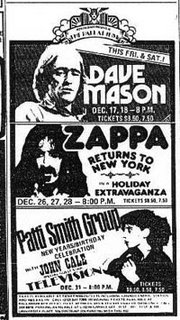
Frank Zappa, Christmas week 1976--recorded live for Zappa in New York. He also did a Halloween gig in 1977, much of which wound up in the film Baby Snakes--plus another Halloween show in 1981.

The Patti Smith Group, John Cale, and Television, New Year's Eve 1976--check out the advert (which also shows dates for Dave Mason).

Bob Seger, with Rush as openers, March 6, 1977. Rush played later that year on November 12 with UFO, Cheap Trick, and Max Webster, and again on January 13 & 14, 1979. And Cheap Trick shared a bill with the Cars on September 22, 1978.

Procol Harum had their 10th anniversary show there on May 15, 1977.

AC/DC made their New York debut supporting the Dictators on August 24, 1977 (Michael Stanley was the opener), and apparently this was the first show in which Angus Young used a liberating cordless guitar set-up. They returned to open for Rainbow on August 24, 1978, and for UFO on June 9, 1979. The band finally headlined--sadly sans the late Bon Scott--on August 1, 1980, with support from Def Leppard and Humble Pie. Have a gander at some great photos of that gig, including rare shots of the Palladium's exterior and interior.

Thin Lizzy, October 22, 1977. The boys were back in town (sorry, couldn't resist) from September 29 through October 1, 1978, sharing the bill with Blue Oyster Cult.

Fresh from their New Year's Eve '77 It's Alive show in London, the Ramones headlined the Palladium on January 7, 1978, with the Runaways and Suicide as openers. The show, recorded for the King Biscuit Flower Hour, was recently released on CD. It's nearly identical to It's Alive, except the crowd noises reflect a certain Manhattan vibe, and Joey doesn't pronounce "Beach" as "Baych" or "DDT" as "D-Day-Tay." The band's other Palladium dates include October 6, 1977 (with Iggy Pop), March 9, 1979 (with Lester Bangs' Birdland), and New Year's Eve 1979.

Angel, the Godz, and Judas Priest, March 10, 1978. Priest played there again at least three other times--April 21 and November 4, 1979, and July 22, 1981.

Elvis Costello was a fairly frequent Palladium Attraction--May 6, 1978, March 31, 1979, January 31 to February 2, 1981, New Year's Eve 1981, and August 27, 1989. At this last one, the vegetarian Declan apparently refused to go on until a banner reading "Burger King Presents Elvis Costello" was removed.

The Kinks, June 2, 1978 and New Year's Eve 1980.

The Rolling Stones similarly returned to the scene of some of their earliest NYC triumphs on June 19, 1978.

Blondie headlined on November 12, 1978; Robert Fripp provided some Frippertronics to their set, and Mitch Ryder & the Detroit Wheels opened. Blondie's previous Palladium dates include March 18, 1977 (opening for David Bowie and Iggy Pop) and May 11, 1978 (with Robert Gordon and Link Wray).

The Clash played several legendary Palladium shows: February 17, 1979 with the Cramps and Bo Diddley opening (that was my 8th birthday--why didn't somebody take me???); September 20 and 21 later that year, with support from the Undertones, Sam and Dave, and Siouxsie and the Banshees; and finally on March 7, 1980. The iconic cover image for London Calling was taken at the 9/21/79 show.

Graham Parker and the Rumour, May 11, 1979.

The Boomtown Rats, sometime in May 1979.

Dire Straits, September 11, 1979.

Devo, July 21, 1979 and November 19 and 20, 1982.

Rory Gallagher, November 17, 1979.

The Buzzcocks, with the Fall and the Sports, December 1, 1979.

There was a power pop extravaganza on December 13, 1979, featuring 20/20, the Sinceros, the Beat, and Bruce Woolley.

The Jam, February 29, 1980 and May 15 and 18, 1982.

Public Image, Ltd., April 20, 1980.

The Pretenders, sometime in May, 1980.

Tom Petty and the Heartbreakers, July 4 and 5, 1980--betcha he opened with "American Girl."

Tom Waits, November 18, 1980.

Pat Benatar, November 22, 1980.

Squeeze, January 31 to February 2, 1981.

Ozzy Osbourne, with the late Randy Rhoads on guitar, May 2, 1981.

U2, May 29, 1981, and May 11, 1983 with the Dream Syndicate.

I'd go on, but my research time is limited. Basically it seems like most well-known late-'70s touring acts not big enough for the Garden--or who wished to avoid the Garden altogether--trod the Palladium's boards at some point in their careers. More names and dates are listed on this ticket stub site--looks like an awful lot of Palladium shows were sponsored by Mateus wine. What I'd really love to add are descriptions of the Palladium's general atmosphere and decor--but pertinent anecdotes have been hard to find.

Sometime around '83/'84, concerts stopped and the building was shopped around to other developers. Steve Rubell and Ian Schrager, then searching for a place to build upon the legacy of Studio 54, inspected the site. At first they were wary--opening a club in yet another old theater would inevitably invite comparisons to Studio. But when the other locations they scouted proved unsuitable--including "bus garages on Ninth Avenue, the East 68th Street heliport, the disused train station under the Waldorf-Astoria...the Cloud Club in the Chrysler Building...[and] a savings bank on W. 36th Street," according to The Last Party--they cast their lot with the Palladium. The name was retained, and "when architect Arata Isozaki was asked to adapt the classic theater for use as a slick disco...he did [so] by honoring rather than obliterating its staid interior," as described in Greenwich Village and How It Got That Way. The balcony, plaster moldings, and stage were cleaned up a bit and left intact; the orchestra pit was leveled for dancefloor use, and a multilevel cubic grid with lights and video screens galore was built around it. To add to the visual overload, downtown artists like Keith Haring, Francesco Clemente, Eric Fischl, David Salle, Laurie Anderson, Kenny Scharf, and Jean-Michel Basquiat were commissioned to create paintings, installations, and videos. The design-conscious building was so vast it could hold clubs-within-the-club--such as the Mike Todd Room, a "VIP" lounge housed in what was said to have been the private screening room of the eponymous producer/Liz Taylor Husband #3. (In turn, the Todd Room was itself large enough to have its own separate VIP areas, nicknamed Betty Ford In-Patients and Out-Patients.) The Palladium opened in May 1985; its ensuing fortunes and phases ebbed and flowed throughout its existence, finally petering out in the late '90s after several years as part of Peter Gatien's scandalous empire. Here's a picture of the marquee, probably taken near the end. It was always mainly a DJ-fied dance club, but the occasional live show was held there--including Einsturzende Neubauten, Elvis Costello, Neil Young, Debbie Harry, and the Dictators. I was there exactly one time that I can recall, ca. '89/'90, for a show with Fishbone, the Dead Milkmen, and an unannounced "special guest." As I'd surmised, it was 2 Live Crew, then at the height of their PMRC infamy. I don't remember much from the show, save for marveling at the still-extant plaster wall details up in the balcony.

The Palladium--along with Julian's Pool Hall on the second floor--was demolished in 1998. NYU soon planted its ubiquitous purple flag on the empty lot, and by 2001 the massive Palladium Residence Hall and Athletic Facility loomed overhead. Seems like 14th Street is not as pronounced a border between Uptown and Downtown anymore.


[UPDATE 1/6/2007: Manhattan's first branch of Trader Joe's was installed in the ground floor retail space of NYU's complex in the spring of 2006. I recently located both a NY Times article and a myspace page devoted to the Palladium's dance club era. I was also recently contacted by a good fellow who worked at the Academy of Music during the Howard Stein era...if I'm real good, maybe he'll share some memories of his stint there. This person had a query about the name of the promoter who organized the Academy's oldies shows in the late '60s and early '70s. I'm stumped--any takers?] 


[ADDENDUM: A while back I came across this photo (and can't recall which site I pilfered it from--forgive me). Obviously these are all '60s acts, but I assume this was probably a '70s-era oldies show. Haven't located any info on it, though.]

[ADDENDUM 4/24/2009: A fellow named Kevin kindly sent me a night-vision photo of the same marquee, and confirms that "Murray Kaufman's last-known musical extravaganza" took place in July, 1978.]


UPDATE 12/19/2010:  The cinematreasures.org page for the Academy of Music has a lot more posts now than when I first consulted it to write this entry, and many of them are rock and roll-related.  One guy on there seems to be on a mission to track down the dates for every rock show held there.  His list as of his 2008 post isn't complete, but he was well on his way.  There are also lots of cool comments about the Academy's/Palladium's atmosphere (the general consensus being that it was kind of a dump), plus some insightful behind-the-scenes anecotes from people who worked there.  (The site has also established a page for the original Academy of Music, since it did operate as a movie theater near the end of its existence.)  I've found some ads for late '60s and early '70s Academy shows in the Village Voice archives, and the Getty Images site has some cool pics of the Beach Boys and the Stones playing there in the mid-'60s--check 'em out here.  There's also a yahoogroup and a Facebook group for the joint (and a FB group for its dance-club era too).  Here are a few pics from cinematreasures depicting the Academy in its earlier days (the first one shows firefighters putting out a small fire there while a crowd watches from across 14th Street).


UPDATE 7/15/2012:  Over the last couple of years I've gathered as many Academy/Palladium ads from the Village Voice as I could find.  Use the search function or click on the Academy or Palladium labels to locate the posts featuring these ads.

UPDATE 9/18/2013:  The Bedford + Bowery blog recently did a couple of posts about the Academy/Palladium.  The first one includes some tales from a few folks who played there, and the second includes a tribute to Sid Bernstein.

Wednesday, July 20, 2005

Just a couple o' tidbits

I guess I never paid much attention to the plaque outside ST. MARKS SOUNDS at 20 St. Marks Place, 'cause my eyes sorta bugged out when I saw an entry for the building in my recently-purchased copy of Barbaralee Diamonstein-Spielvogel's The Landmarks of New York (New York: Monacelli Press, 2005). [God bless BMV Books!] Dating from 1832 and designated as a landmark in 1969, the house has some significant Old New York ties; its original owner was Daniel LeRoy, a South Street merchant who was a son-in-law of Elizabeth and Nicholas Fish (Elizabeth was a descendant of Peter Stuyvesant) and brother-in-law to Hamilton Fish. Diamonstein-Spielvogel writes:

The LeRoy House is constructed in Flemish bond brickwork trimmed with stone. It is one of four houses on the block that retain the ornately decorated iron handrails at the stoop, low, birdcage newel posts, and iron railings in the windows of the parlor floor. The arched stone entrance has a triple keystone and a Gibbs surround. Utilitarian doors and a plain transom have replaced the original entrance and its beautiful fanlight.

According to Andrew S. Dolkart's Guide to New York City Landmarks, Second Edition (New York: John Wiley & Sons, 1998), the building is the "sole intact survivor" of a former "elegant row of 3 1/2-story brick houses erected on speculation by Thomas E. Davis."

As for the store--it's a fun place to look for bargain used CDs and vinyl, but I usually found its selection of new items to be lacking in breadth and depth. More new stuff used to be available at its sister location a few doors down at 16 St. Marks, but that shop is closed down now. I've never been to the Grassroots Tavern at the ground floor of 20 St. Marks, but it's apparently a pleasant dive.


From the "Still Spotting Cheetahs" file: There's a jazz specialty channel on Canadian digital cable called Cool TV--I watch it mainly for its Ed Sullivan, Judy Garland, Rosemary Clooney & Nat King Cole reruns, and also for its nightly "Cool Movie," which is either a great old musical or a drama about music. This past weekend they showed Young Man With A Horn, about the rise, fall, and resurrection of a trumpet player (supposedly loosely based on the life of Bix Beiderbecke). The story was rather predictable, but the cast couldn't be beat (Kirk Douglas, Doris Day, Lauren Bacall, & Hoagy Carmichael), the trumpet parts were dubbed in by Harry James, and there were lotsa lovely location shots of L.A. and NYC. Particularly notable among these were some long scenes at the Aragon Ballroom, which would years later be the home of the L.A. Cheetah. (Notice how I've conveniently bypassed discussion of the Aragon's '50s Lawrence Welk phase.)

And I'm gonna "See the Cheetah (At the Hangout)" tonite, when the Woggles play a rare Toronto gig at the Horseshoe Tavern!